Introduction
Ship supply chain management plays a critical role in keeping vessels operational, supplied and ready for their next voyage. For shipowners, managers, superintendents and procurement teams, the challenge is not simply getting equipment or supplies from one location to another. Every requirement must reach the correct vessel, at the correct location and within the available operational window.
This is particularly important in Singapore. According to the Maritime and Port Authority of Singapore (MPA), the Port of Singapore handled a record 44.66 million TEUs of container throughput and 3.22 billion gross tonnage of vessel arrivals in 2025. Singapore is also connected to more than 600 ports worldwide and is home to more than 200 international shipping groups.
For vessel operators, this creates access to a broad maritime ecosystem, but it also means procurement, logistics, documentation and vessel services must be coordinated carefully.
Effective ship supply chain management brings together maritime procurement, freight, customs clearance, warehousing, ship spares logistics, marine supplies, port coordination and final delivery to the vessel.
The objective is straightforward: reduce unnecessary handovers, improve visibility and help critical supplies reach the vessel before its operational window closes.
What Is Ship Supply Chain Management?
Ship supply chain management is the coordination of goods, equipment, information, documentation, transport and service providers required to support vessel operations.
Depending on the vessel, this can involve:
- Ship spare parts
- Engine and machinery components
- Marine safety equipment
- Deck and engine stores
- Provisions
- Technical equipment
- Lubricants and chemicals
- Repair materials
- Personal protective equipment
- Documentation and certificates
Unlike conventional land-based logistics, maritime supply chains must work around a moving asset.
A vessel’s arrival time can change. Its berth or anchorage arrangements may be revised. A spare may still be in transit while the vessel is approaching Singapore. A technician, supply boat or delivery team may also need to be coordinated within the same port call.
For this reason, effective maritime supply chain management requires both logistics capability and an understanding of vessel operations.
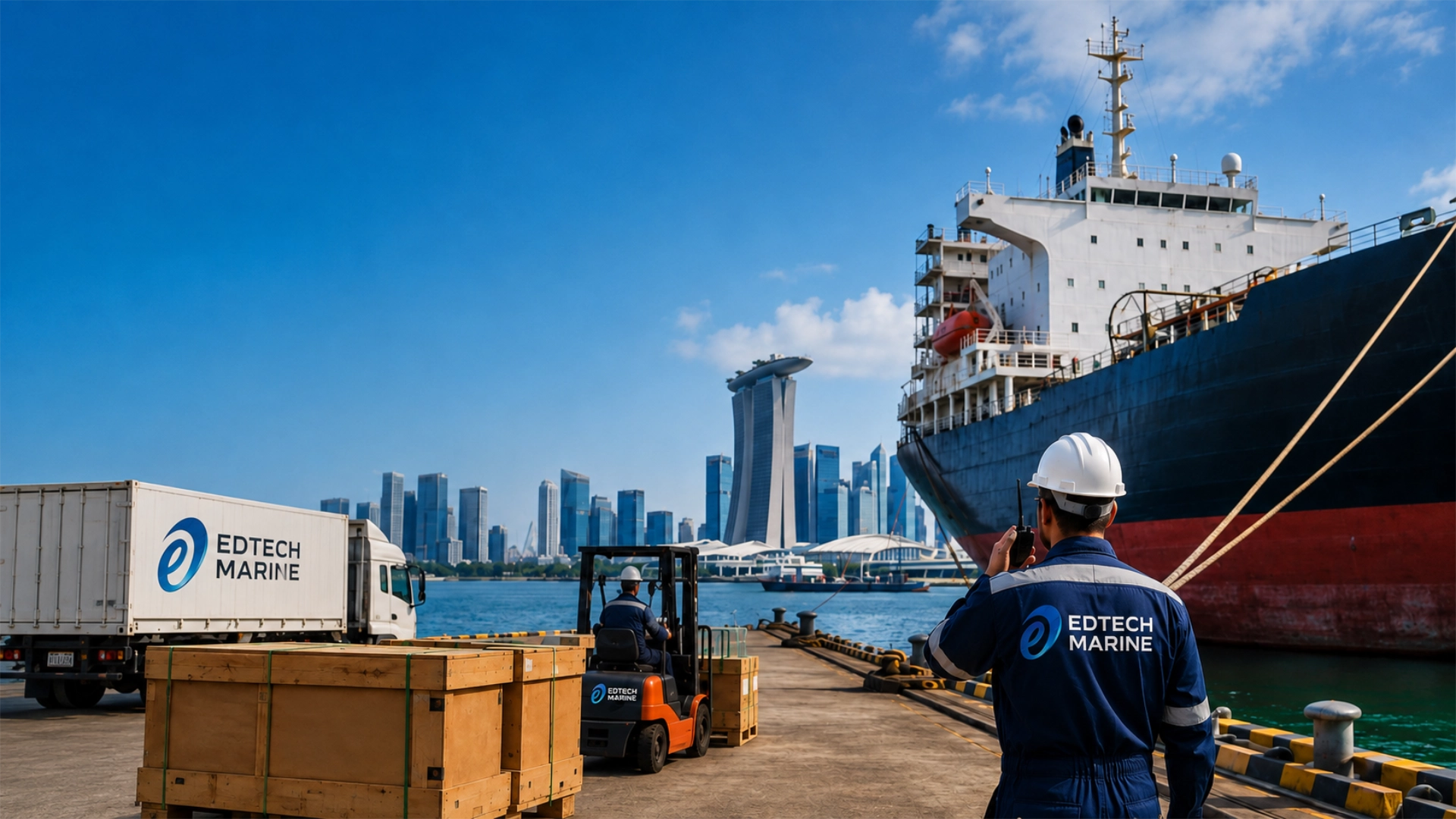
EdTech Marine’s ship agency services in Singapore combine port-call support with ship spares and stores handling, customs coordination, crew services and marine logistics. EdTech’s published services also include spares clearance and delivery, supply boat hire and coordination of technicians boarding vessels.
Why Maritime Supply Chain Singapore Operations Require Careful Coordination
Singapore’s position as an international maritime centre provides vessel operators with access to extensive port, logistics, technical and marine-support capabilities.
However, access to these services does not remove the need for careful operational planning.
A vessel calling Singapore may simultaneously require:
- Ship spares
- Customs documentation
- Provisions
- Crew movements
- Safety equipment
- Engineer attendance
- Repairs
- Launch boat arrangements
- Port clearance
- Offshore delivery
Managing each requirement independently can create additional communication and coordination points.
Effective maritime supply chain Singapore operations therefore depend on connecting these activities to the vessel’s actual schedule.
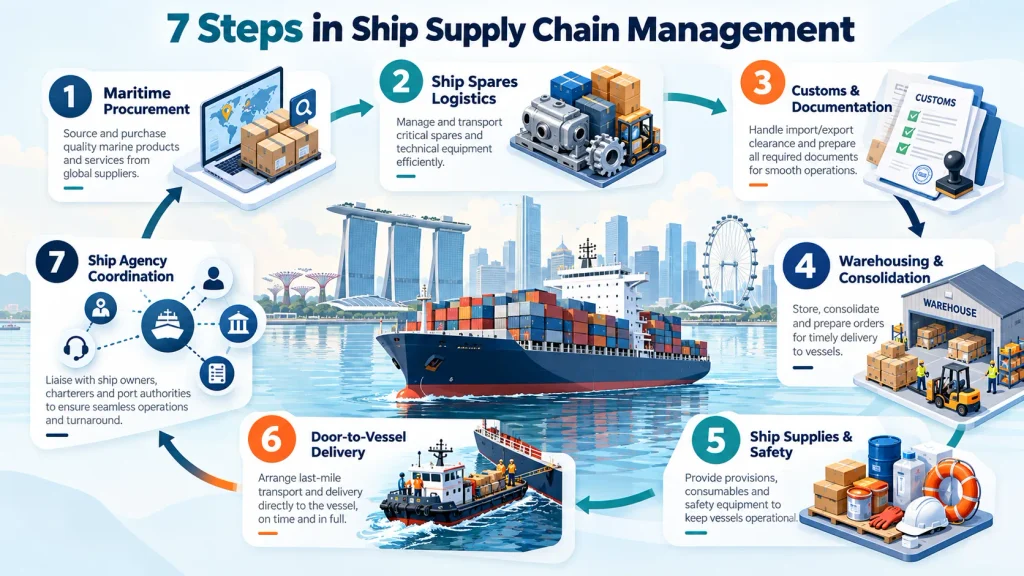
Here are seven important areas vessel operators should consider.
1. Maritime Procurement: Plan Before the Vessel Arrives
Effective maritime procurement should begin before the vessel reaches Singapore.
Owners, managers and purchasing teams should identify foreseeable requirements early and determine which items can be sourced locally and which need to be transported into Singapore.
Requirements may include:
- Planned maintenance spares
- Critical machinery components
- Safety equipment
- Consumable stores
- Deck and engine supplies
- Provisions
- Repair materials
- Replacement equipment
Early planning gives operators more time to confirm specifications, check availability, arrange transportation and identify documentation or regulatory requirements.
Before placing an order, operators should confirm:
- The correct part, product or specification
- Quantity required
- Supplier availability
- Estimated arrival in Singapore
- Customs or permit requirements
- Vessel ETA and ETD
- Vessel location
- Final delivery arrangements
This connects procurement directly with vessel operations instead of treating purchasing as an isolated administrative function.
For routine stores, provisions, deck supplies and technical products, EdTech’s guide to selecting a reliable ship chandler in Singapore provides a useful checklist covering product specifications, proposed substitutions, quantities, availability and delivery requirements.
2. Ship Spares Logistics: Coordinate Deliveries Around the Vessel Schedule
Ship spares logistics is one of the most time-sensitive parts of the vessel supply chain.
A replacement component may travel across several countries before reaching Singapore. It may then require customs processing, receipt, storage, consolidation and final transport to the vessel.
The logistics process therefore needs visibility from shipment to delivery.
Operators should be able to determine:
- Whether the spare has been dispatched
- Whether it has arrived in Singapore
- Whether the documentation is complete
- Whether customs processing is required
- Where the spare is being stored
- Whether other items can be consolidated with it
- When vessel delivery is scheduled
EdTech Marine’s dedicated guide to ship spares logistics explains how maritime spare-parts logistics differs from conventional logistics because it must support moving vessels, international jurisdictions and time-sensitive final delivery.
EdTech also states that its logistics team supports Ship Spares in Transit and operates a purpose-built warehouse for storing spares. Its published services include air and sea freight, customs clearance, warehousing, distribution and door-to-vessel delivery.
Good ship spares logistics is therefore not simply about moving an item quickly. It is about ensuring the spare and the vessel reach the delivery point at the right time.
3. Maritime Supply Chain Singapore: Manage Customs Clearance and Documentation Early
Customs requirements are an important part of the maritime supply chain Singapore operators need to manage carefully.
It is important not to assume that every spare, store or transhipment movement is treated in the same way.
According to Singapore Customs guidance on TradeNet, TradeNet is Singapore’s national single window for trade declarations and supports regulatory requirements associated with imports, exports and transhipments.
For imports, Singapore Customs states that Customs Import Permit applications are submitted through TradeNet.
Documentation problems can arise from:
- Incorrect shipment descriptions
- Incomplete consignee information
- Missing supporting documents
- Controlled goods
- Dangerous goods
- Incorrect permit assumptions
- Late submission of information
Transhipment requirements also vary depending on how goods move through Singapore. Singapore Customs provides dedicated transhipment procedures and regulatory guidance covering permits, Free Trade Zones and the movement of controlled goods.
Where possible, documentation should therefore be reviewed while the shipment is still in transit rather than after it arrives.
For vessel-related arrival and departure formalities, see EdTech Marine’s guide to port clearance in Singapore.
It is also important to distinguish Customs declarations from vessel port clearance. TradeNet handles trade declarations while MPA’s digitalPORT@SG supports vessel, immigration and port-health clearance.
4. Marine Logistics Singapore: Use Warehousing to Consolidate Ship Spares and Supplies
Warehousing is an important component of marine logistics Singapore operations and can play a much broader role than simply storing goods.
For maritime operations, a warehouse can function as a staging point where equipment and supplies arriving from different sources are prepared for a specific vessel.
Items can be:
- Received
- Checked
- Recorded
- Labelled
- Stored
- Consolidated
- Prepared for delivery
This is particularly useful where several suppliers are involved.
Rather than sending multiple separate deliveries towards the vessel, appropriate items can be consolidated before final transport.
Warehouse visibility can also help procurement and technical teams identify missing items before the vessel’s delivery window.
EdTech Marine states that its purpose-built logistics warehouse supports storage of ship spares in transit. It also provides customers with updated stocklists and delivery notes to improve visibility over stored spares.
Its published marine logistics services include:
- Air and sea freight
- International routing
- Ship spares and stores handling
- Door-to-vessel delivery
- Import and export consolidation
- Customs clearance and documentation
- Warehousing and distribution
- Project cargo
- Dangerous-goods transportation and handling
Operators evaluating providers can also refer to EdTech’s guide to choosing a maritime logistics company in Singapore.
5. Ship Supplies Singapore: Coordinate Procurement With Safety Requirements
Ship supplies Singapore requirements extend well beyond spare parts.
They can include:
- Provisions
- Deck stores
- Engine stores
- PPE
- Cleaning supplies
- Maintenance equipment
- Marine safety equipment
- Navigation-related products
EdTech Marine’s ship supplies service covers safety equipment, maintenance tools, navigation equipment and crew provisions.
Safety-related products require additional attention because the applicable requirements depend on the equipment, vessel and regulatory framework.
The International Maritime Organization’s SOLAS Chapter III guidance covers life-saving appliances and arrangements, including personal life-saving appliances, survival craft, rescue boats, launching arrangements, maintenance and inspection requirements.
For safety-related procurement, operators should therefore confirm:
- Vessel requirements
- Product specifications
- Approval or certification requirements
- Compatibility
- Condition
- Documentation
- Expiry or servicing requirements where applicable
The same requirements should not automatically be assumed to apply to every product.
For a broader overview, EdTech Marine’s guide to marine safety and compliance in Singapore discusses international frameworks including SOLAS and MARPOL.
This combination of an authoritative IMO outbound link and a relevant EdTech internal link gives the section both factual authority and stronger internal SEO structure.
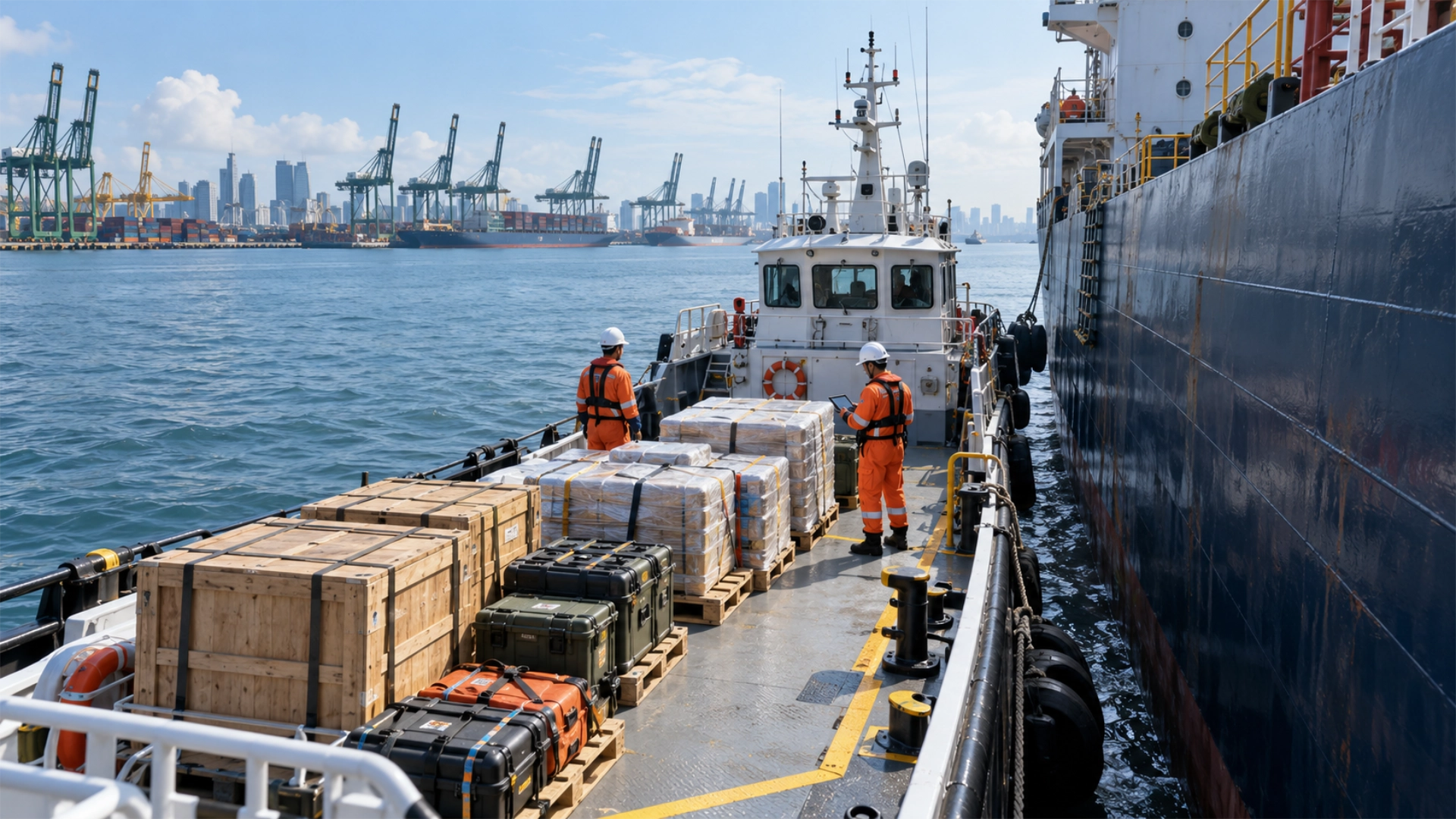
6. Door-to-Vessel Delivery: Plan for Berth, Anchorage, OPL or Shipyard
Door-to-vessel delivery is one of the most important stages of maritime logistics.
A shipment can travel thousands of kilometres successfully and still fail operationally if the final transfer is not coordinated with the vessel’s location and schedule.
EdTech Marine specifically lists ship spares and stores handling with door-to-vessel delivery at:
- Berth
- Anchorage
- OPL locations
- Shipyards
Each delivery environment requires different planning.
For a berth delivery, factors may include access arrangements, receiving instructions, delivery timing and cargo-handling requirements.
For anchorage or offshore operations, suitable marine transportation may also need to be arranged.
EdTech’s guide to OPL and cargo boat operations in Singapore explains how offshore movements can involve spares, stores, provisions and personnel for vessels that do not berth in Singapore.
Before dispatch, operators should confirm:
- Vessel location
- Latest ETA and ETD
- Package dimensions and weight
- Delivery contact
- Required handling equipment
- Launch or cargo-boat requirements
- Relevant documentation
- Cargo readiness
- Vessel readiness to receive delivery
Final delivery should therefore be planned from the beginning of the supply chain rather than only after the goods arrive in Singapore.
7. Marine Logistics Singapore: Integrate Logistics With Ship Agency Operations
One of the most effective ways to reduce fragmented communication is to connect marine logistics Singapore requirements with wider port-call planning.
Consider a vessel that requires:
- Arrival and departure clearance
- Ship spares
- Provisions
- Crew change
- Technician attendance
- Safety equipment
- Launch boat arrangements
A change to the vessel’s ETA can affect every one of these activities.
If each service provider is operating with different information, timing conflicts become more likely.
A ship agent can act as an operational coordination point between the vessel, owner, manager and local service providers.
EdTech Marine’s ship agency Singapore services include port clearance, immigration and customs coordination, crew changes, ship spares and stores, technician coordination, OPL services and logistics support.
For port calls involving a wider range of requirements, EdTech’s guide to ship husbandry services in Singapore also covers crew support, transport, spares, launch boats and local service coordination.
This integration allows logistics activities to be planned against the vessel’s latest operational information rather than being treated as an entirely separate process.
Digital Visibility in the Maritime Supply Chain
Accurate information is one of the most important components of modern maritime logistics.
Shore teams may be located in another country while the vessel, warehouse, freight provider, ship agent and supplier are all working in different locations.
Teams therefore need clear answers to questions such as:
- Has the spare arrived?
- Has the documentation been completed?
- Where is the shipment?
- Is it ready for vessel delivery?
- Has the vessel’s ETA changed?
- Has delivery been completed?
Singapore has also continued to digitalise port processes.
MPA’s digitalPORT@SG platform provides a useful example. MPA states that digitalPORT@SG streamlines vessel, immigration and port-health clearances across multiple agencies into a single application and consolidates 16 separate forms.
This should not be confused with Singapore Customs’ TradeNet, which is the national single window for trade documentation.
The distinction is important:
digitalPORT@SG: vessel, immigration and port-health clearance.
TradeNet: import, export and transhipment trade declarations.
For vessel operators, both systems demonstrate the importance of accurate information and timely documentation.
How Ship Supply Chain Management Can Help Reduce Vessel Delays
Every part of the ship supply chain eventually connects to vessel readiness.
Problems can arise when:
- A critical spare arrives late
- Documentation is incomplete
- Customs requirements have not been addressed
- The vessel’s location changes
- Suppliers have outdated ETA information
- A technician and replacement component arrive at different times
- Offshore transport is not ready
- A required item is unavailable
Many of these risks can be reduced through earlier planning and clearer coordination.
The procurement team, technical team, vessel, local agent and logistics provider should work from the latest available schedule and clearly identify which requirements are critical before departure.
EdTech Marine’s guide to reducing vessel turnaround time in Singapore Port explains how delayed spares, documentation, crew movements and other port-call requirements can affect vessel operations.
Building a More Resilient Ship Supply Chain
Supply chain resilience does not mean holding excessive inventory or using more suppliers than necessary.
It means identifying operational dependencies before they become urgent.
Categorise spares by criticality
Critical machinery and safety requirements should receive greater planning attention than easily replaceable consumables.
Identify longer-lead-time items
Equipment requiring international transport, specialist manufacture or certification should be identified early.
Maintain alternative sourcing options
Where operationally appropriate, teams should know whether suitable alternatives or substitute suppliers exist.
Improve inventory visibility
Better visibility can help procurement teams identify shortages sooner and reduce unnecessary emergency orders.
Consolidate shipments where practical
Consolidation can reduce the number of deliveries that must be coordinated during a port call.
Keep vessel information current
Suppliers and logistics providers should receive updated ETA, ETD and location information when schedules change.
Resilience is therefore primarily about preparation, information and coordination.
Choosing a Maritime Supply Chain Partner in Singapore
Vessel operators should assess both logistics capability and maritime operating knowledge when selecting a local partner.
Useful capabilities to consider include:
- Air and sea freight
- International routing
- Customs documentation
- Ship spares handling
- Warehousing
- Inventory visibility
- Ship supplies
- Dangerous-goods handling
- Door-to-vessel delivery
- Anchorage delivery
- OPL operations
- Launch and cargo-boat coordination
- Ship agency services
- 24/7 operational communication
The right arrangement depends on the vessel and port call.
The objective is not simply to reduce the number of suppliers. It is to ensure responsibilities are clear and information flows efficiently between every party involved.
For a more detailed comparison of provider capabilities, see EdTech Marine’s guide to choosing a maritime logistics company in Singapore.
How EdTech Marine Supports Ship Supply Chain Management
EdTech Marine supports shipowners, managers and vessel operators with integrated ship agency and logistics services in Singapore.
Its published logistics capabilities include:
- Air and sea freight
- International routing
- Ship spares and stores handling
- Door-to-vessel delivery
- Import and export consolidation
- Customs clearance and documentation
- Warehousing and distribution
- Project cargo handling
- Dangerous-goods transportation and handling
These capabilities sit alongside EdTech’s ship agency, husbandry, crew-change, ship-supply and technical-support services.
Combining these functions can provide clearer coordination between the vessel’s operating schedule and the movement of the goods and services it requires.
Operators looking specifically at spare parts can read EdTech’s ship spares logistics guide, while those planning a broader port call can refer to its ship husbandry services guide.
Conclusion
Effective ship supply chain management requires much more than transporting goods.
For vessels calling Singapore, successful execution can involve maritime procurement, freight, Customs procedures, warehousing, ship spares logistics, ship supplies, agency coordination and final door-to-vessel delivery.
Each element needs to work around the vessel’s schedule.
Early planning helps identify problems before they become urgent. Warehousing can provide greater control over incoming spares. Accurate documentation supports smoother cargo movements. Properly coordinated berth, anchorage and OPL delivery helps complete the final transfer to the vessel.
Most importantly, connecting marine logistics Singapore activities with vessel operations gives owners and managers better visibility across the entire process.
For ship agency, marine logistics, ship spares, warehousing, ship supplies and vessel-delivery support in Singapore, contact EdTech Marine with the vessel details, schedule and operational requirements.
Frequently Asked Questions
What is ship supply chain management?
Ship supply chain management is the planning and coordination of goods, equipment, information, transport and services required to support vessel operations. It can include procurement, freight, customs documentation, warehousing, ship spares, stores and final vessel delivery.
Why is ship supply chain management different from ordinary logistics?
Ships are moving assets operating within changing schedules and different jurisdictions. Deliveries may need to reach a vessel at berth, anchorage, shipyard or offshore location within a limited operational window.
What is included in ship spares logistics?
Ship spares logistics can include transportation, customs processing, receiving, storage, inventory tracking, consolidation and final delivery of parts to the vessel. See EdTech Marine’s detailed ship spares logistics guide for more information.
Why is Singapore important for maritime supply chains?
Singapore is a major international maritime centre with extensive global connectivity. In 2025, the Port of Singapore recorded 44.66 million TEUs of container throughput and 3.22 billion gross tonnage of vessel arrivals. It is connected to more than 600 ports worldwide.
What is door-to-vessel delivery?
Door-to-vessel delivery refers to coordinating a shipment through the required logistics stages until it reaches the vessel. Depending on vessel location, this may involve delivery at berth, anchorage, OPL or shipyard.
Can ship spares be delivered to vessels at anchorage or OPL?
Yes, subject to applicable operational requirements. Delivery may involve suitable launch, supply or cargo boats depending on the cargo, vessel location and operating requirements. EdTech’s OPL and cargo boat operations guide explains this process in more detail.
What is the difference between digitalPORT@SG and TradeNet?
digitalPORT@SG supports vessel, immigration and port-health clearance while TradeNet is Singapore’s national single window for trade declarations.
How can ship supply chain management reduce delays?
Early procurement, accurate documentation, shipment visibility, warehousing, consolidation and properly coordinated final delivery can reduce avoidable problems that could otherwise affect a vessel’s operational schedule.