
Singapore’s position as one of the world’s busiest port hubs makes choosing the right logistics company Singapore businesses partner with a decision that carries serious weight. Whether you are managing bulk cargo, container shipments, or specialized freight, the maritime logistics provider you select can directly impact your supply chain efficiency, compliance standing, and bottom line.
Yet with dozens of providers competing for your business, the selection process can feel overwhelming. Not every company that claims maritime expertise actually delivers it. Some fall short on technology infrastructure, others lack the regulatory knowledge needed to navigate Singapore’s complex port environment, and many simply cannot scale to meet growing business demands.
That is why having a clear evaluation framework matters. In this post, we break down the seven most critical factors you should examine before signing on with any maritime logistics partner in Singapore. From licensing and certifications to digital tracking capabilities and customer support quality, this guide gives you the insight you need to make a confident, well-informed choice. By the end, you will know exactly what separates a reliable maritime partner from one that will cost you more than it saves.
Why Choosing the Right Logistics Partner in Singapore Matters
Singapore has held the top position in the 2026 Xinhua-Baltic International Shipping Centre Development Index for the 13th consecutive year, cementing its status as the most scrutinised and competitive maritime market in Asia. The port handled a record 44.66 million TEUs in 2025 and remains the world’s largest bunkering hub, connected to over 600 ports globally. This scale creates both opportunity and complexity for vessel operators and ship managers sourcing logistics support in the region.
The commercial stakes are significant. The global maritime logistics and services market is valued at $232.5 billion in 2026 and is forecast to reach $386.18 billion by 2035 at a 5.80% CAGR, with Singapore and Port Klang identified as the primary Southeast Asian growth nodes within that expansion. Inside a market this large, provider categories diverge sharply. Enterprise-scale container carriers, road and air freight generalists extending into maritime, and specialist marine agencies all compete for the same procurement budgets, but they serve fundamentally different operational functions.
Generalist logistics providers typically lack the port-specific regulatory knowledge, ship chandling capability, and safety equipment expertise that vessel operators require. A company built around road freight corridors does not carry the same depth in Baltic Exchange-benchmarked maritime services.pdf) as a dedicated marine agency with decades of port-side experience. For procurement leads and ship managers, the shortlisting process therefore requires clear, defensible criteria. The seven factors outlined in this guide are designed to help you distinguish a capable maritime logistics specialist from a general-purpose provider operating at the edges of its competence.
1. Depth of Maritime-Specific Experience
Years of operational experience within the maritime sector carries a fundamentally different weight than a broad logistics track record. Vessel operators and ship managers operate within rigid, time-critical service windows governed by berth schedules, port agent protocols, and supply timelines that general freight providers are structurally unprepared to manage. When evaluating a logistics company in Singapore, the first question to ask any prospective partner is not how long they have been in logistics, but how long they have been serving vessel operators specifically.
This distinction matters because institutional knowledge in maritime logistics accumulates differently. A provider that has spent years coordinating ship chandling deliveries, managing vessel turnarounds, and navigating MPA clearance requirements develops protocol familiarity and vendor relationships that newer entrants simply cannot replicate through general operational experience. Edtech Marine, for instance, draws on 40 years of maritime industry experience, even though the company itself was formally established in 2015. That founding-team heritage translates into trained personnel, established supplier networks, and embedded knowledge of how Singapore’s port ecosystem actually functions at the operational level.
Genuine specialisation also leaves visible markers. Look for dedicated marine divisions rather than logistics generalists who handle vessel supply as one freight vertical among many. Recognised industry memberships, a client base drawn primarily from the maritime sector, and demonstrated familiarity with Singapore Maritime Institute’s evolving technology and regulatory frameworks all signal that a provider has remained an active, current participant in Singapore’s maritime environment rather than a peripheral one. Longevity in this specific market means practical fluency with MPA regulations, port agent requirements, and the local vendor ecosystem, each of which is operationally critical to smooth vessel operations.
2. ISM Code and STCW Compliance Support
Regulatory compliance is not a peripheral concern for vessel operators; it sits at the core of every operational decision. The ISM Code, adopted by the IMO and enforced since 1998, requires shipping companies to establish and maintain a documented Safety Management System covering everything from emergency preparedness to internal audits and non-conformity reporting. For vessel operators and ship managers, administering this system is already demanding. A logistics and agency partner that genuinely understands ISM requirements removes a measurable layer of compliance overhead, because every supply order, equipment delivery, and agency interaction no longer requires the operator to translate regulatory context for the provider.
STCW compliance introduces a parallel layer of responsibility. Because STCW governs crew certification, watchkeeping standards, and onboard safety procedures, any partner supplying safety equipment or crew support materials must understand what those standards actually require in practice. Singapore’s Maritime and Port Authority administers ISM certification-code) for the Singapore Registry of Ships and conducts over 18,000 annual vessel inspections. Non-compliance carries significant financial exposure, with Port State Control detention costs reaching up to $150,000 per day and STCW violations attracting penalties between $50,000 and $250,000.
When evaluating a Singapore-based marine logistics company, ask a direct qualifying question: can your team supply or recommend compliant safety equipment without the vessel operator specifying every item? A provider that requires detailed technical briefs for each order is functioning as a transaction processor. A provider that anticipates regulatory requirements and sources accordingly is functioning as a compliance resource. This distinction matters significantly for vessel managers operating fleets across multiple flag states, where regulatory regimes vary and the administrative burden of maintaining compliance compounds with each additional registry. Partners who embed ISM and STCW knowledge into their day-to-day service delivery reduce that burden at scale, creating operational value that extends well beyond individual supply transactions.
3. Ship Chandling Capability
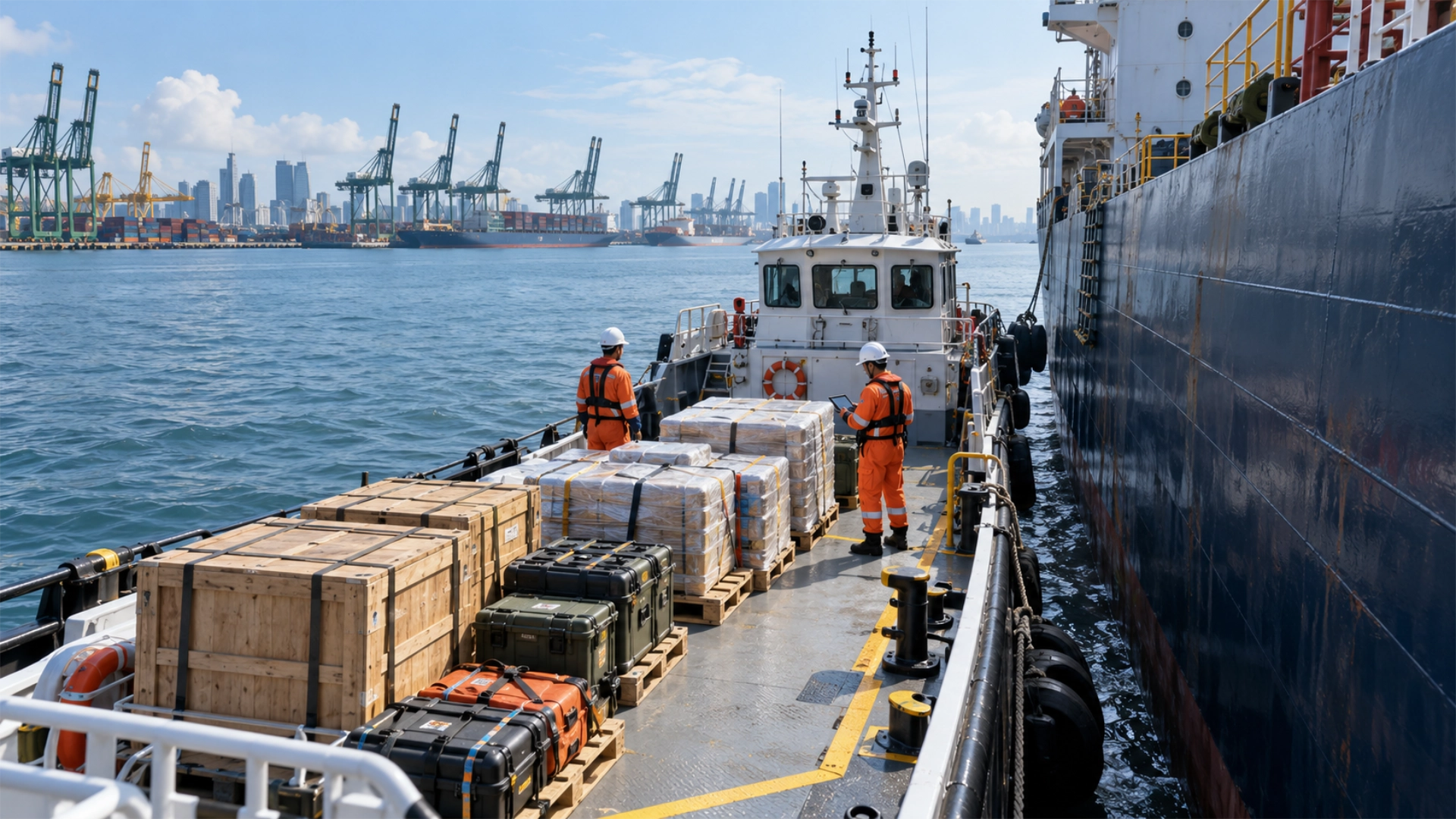
Ship chandling is a specialist maritime supply function that sits entirely outside the capabilities of most enterprise logistics carriers. Where a general freight forwarder manages cargo movements between fixed points, a ship chandler supplies the vessel itself: provisions, deck and engine stores, spare parts, safety equipment, consumables, and crew welfare items. The distinction matters because vessel operators cannot substitute one for the other. When a ship calls at Singapore, the chandling requirement is operational and immediate, not logistical in the conventional sense.
Speed of execution is the defining performance metric for any ship chandler. Commercial vessels operate on compressed port turnaround schedules, and a capable chandler must be ready to fulfil complete orders within hours of a vessel’s arrival, sometimes less. Meeting this standard requires local warehousing with sufficient stock depth, established supplier relationships that bypass procurement delays, and experienced logistics coordination that accounts for berth access, port authority requirements, and customs clearance. As documented in operational analyses of maritime logistics, a single missed item can derail an entire port schedule, with financial consequences that compound quickly.
Product range breadth is a practical evaluation criterion that ship managers should apply directly. A chandler capable of supplying IMPA deck stores, engine replacement parts, mooring equipment, SOLAS-certified lifejackets, immersion suits, SCBA systems, fire hoses, and fresh provisions through a single order significantly reduces vendor coordination overhead per port call. Edtech Marine’s ship chandling service covers this spectrum, including fire safety equipment and technical stores, structured around maritime-native supply chain management rather than generalist intermediary sourcing.
Singapore’s status as the world’s leading international shipping centre means vessel call volumes are consistently high and port windows are short. Only chandlers with deep local infrastructure, warehousing, supplier networks, and port authority relationships, can deliver reliably within these constraints. Partnering with a specialist like Edtech Marine ensures supply continuity without the coordination gaps that arise when ship managers attempt to manage multiple vendors across a single port call.
4. Marine and Fire Safety Equipment Supply
Sourcing marine and fire safety equipment through a single, specialist maritime logistics partner delivers measurable operational advantages over managing multiple disconnected vendors. When documentation, delivery scheduling, and compliance verification flow through one coordinated point of contact, the risk of certification gaps at Port State Control inspection is significantly reduced. Singapore operates one of the world’s most active PSC inspection regimes, and inspectors cross-reference onboard records against SOLAS Chapter III (Life-Saving Appliances) and Chapter II-2 (Fire Protection) with precision. A fragmented supply chain creates fragmented records; a consolidated supply partner creates a single, auditable compliance trail.
The four equipment categories that demand the closest attention from ship managers are SCBAs, immersion suits, marine pyrotechnics, and mooring tails. Each carries distinct regulatory service intervals and certification requirements. SOLAS safety equipment compliance mandates annual SCBA inspection under SOLAS II-2/Reg 10, monthly pyrotechnic expiry checks under SOLAS III/20.7.2, and annual life raft servicing under SOLAS III/20.8.1. Mooring tails require periodic inspection against OCIMF guidance, with MBL certification records maintained as part of the vessel’s safety documentation package.
SCBAs must meet flag state type-approval requirements, and a supplier who can confirm compliance at point of sale eliminates post-delivery verification work that delays crew readiness before departure. ClassNK flag approval guidance reinforces that immersion suits require the same level of traceable type-approval documentation, making supplier-level verification non-negotiable rather than optional.
Immersion suits and pyrotechnics carry finite service lives, and proactive expiry tracking is where account management quality becomes operationally visible. A logistics partner who flags renewal windows ahead of scheduled port calls allows ship managers to consolidate replacements into a single delivery, rather than responding reactively to inspection failures.
Edtech Marine’s combined safety equipment supply capability, covering SCBAs, immersion suits, pyrotechnics, and mooring tails alongside broader ship supply services, represents a service configuration that large container carriers operating in Singapore do not replicate. For vessel operators prioritising compliance efficiency, this consolidated offering reduces administrative burden at every port call.
5. Agency Services Responsiveness and Port Familiarity
Ship agency services extend far beyond basic port coordination. A capable agency partner manages port entry documentation, inward and outward clearance with immigration authorities, crew change arrangements, customs clearance, husbandry services, and continuous liaison with port authorities throughout a vessel call. These functions are tightly interdependent; a delay in berth application submission ripples forward into delayed cargo readiness confirmation, which then affects departure clearance timing. For vessel operators running fixed schedules, each delay compounds the next.
Responsiveness in this context is an operational metric with direct financial consequences. A missed communication window or a slow documentation turnaround can generate port demurrage charges that accumulate by the hour, or result in a vessel losing its departure clearance slot entirely. The breadth of agency coordination required at a high-throughput port demands round-the-clock availability, not standard business hours support.
When evaluating a potential agency partner, request concrete examples of how they have handled time-critical situations: an emergency crew change requiring last-minute immigration coordination, a late cargo amendment requiring rapid bill of lading revision, or an unplanned port authority requirement arising during a vessel call. Agencies with genuine operational depth will answer these questions with specifics, not generalities.
Local knowledge of Maritime and Port Authority of Singapore processes is a concrete operational advantage. Singapore posted record port performance in 2025, and MPA is actively developing future-readiness programmes for 2026, meaning port activity volumes and procedural demands continue to intensify. Established relationships with berth planners, port service providers, and MPA representatives reduce friction at every stage of a vessel call in ways that no global network can replicate without genuine on-the-ground presence.
The Singapore shipping agency services market is forecast to grow through 2035, signalling sustained commercial demand and increasing competition for reliable agency partners. Vessel operators who secure a dependable, responsive agency relationship now position themselves for operational continuity across a long horizon, rather than repeatedly evaluating providers in an increasingly competitive market.
6. Repair and Engineering Solutions Coordination
IMO carbon intensity regulations are reshaping maintenance priorities across the global merchant fleet. As operators accelerate fleet upgrade programmes to meet Carbon Intensity Indicator (CII) rating requirements, the demand for logistics partners capable of coordinating repair and engineering work alongside routine port call services has grown considerably. A partner who can handle only consumable supply and documentation falls short of what modern vessel operators now require during a Singapore port call.
The operational case for integrated repair coordination is straightforward. Managing separate technical contractors for engineering work, while simultaneously coordinating chandling deliveries and agency documentation through different contacts, multiplies the risk of scheduling conflicts and miscommunication during a time-constrained port call. A provider who bundles repair and engineering solutions within the same service framework eliminates that coordination overhead entirely. As demonstrated by integrated service models operating across the wider Asia Pacific region, the single-contact port call model actively reduces vessel downtime and strengthens operational reliability.
When evaluating a Singapore-based partner, the critical distinction is not whether they can make introductions to repair workshops, but whether they take operational responsibility for outcomes. Singapore’s maritime ecosystem, highlighted through events such as the Asia Pacific Maritime tradeshow, hosts a dense network of certified engineering specialists and repair facilities. A credible partner will have established working relationships within that network, not simply a directory of contacts.
For vessel managers overseeing multiple port calls across Southeast Asia, consolidating repair scheduling, parts procurement, and crew support under a single Singapore-based partner significantly reduces management load. Edtech Marine’s repair and engineering solutions are specifically designed to complement its chandling and agency services, giving vessel operators a single point of contact for the full scope of port call requirements.
7. Pricing Transparency and Service Documentation
Pricing transparency ranks consistently among the top decision criteria for maritime procurement leads, and for good reason. Off-hire penalties for large container vessels can exceed $60,000 per day, while idle costs for bulk carriers run between $30,000 and $40,000 daily. In this environment, a logistics company in Singapore that cannot produce itemised quotes upfront introduces compounding financial and operational risk. Every ambiguity in a cost structure becomes a potential delay, and delays in maritime procurement have immediate, measurable consequences for vessel operators managing tight port schedules.
Service documentation quality carries equal weight. Clear delivery notes, certificates of conformity for safety-critical equipment, and auditable supply records are not administrative preferences; they are operational requirements. Port state control inspectors and ISM auditors request supporting documentation for safety equipment at short notice, and a supply partner who cannot produce those records on demand creates direct compliance exposure. The IMPA ACT supply chain transparency framework reinforces this standard, identifying structured documentation as central to anti-fraud protection and procurement integrity across maritime supply chains.
When evaluating prospective partners, vessel managers should ask directly whether invoicing is itemised by product category, how quickly certificates of conformity can be retrieved for safety equipment, and whether service agreements are documented in writing before supply commences.
Bundled or vague invoices create two problems simultaneously. They obscure cost management across vessel cost centres, and they make it structurally difficult to benchmark pricing against alternative suppliers over time. That opacity is a disincentive to long-term partnership, not a foundation for one.
A logistics partner who voluntarily offers proactive cost breakdowns, detailed delivery documentation, and clear service agreements demonstrates operational maturity. It signals a track record of working alongside professionally managed fleets where compliance, accountability, and cost control are non-negotiable standards rather than optional additions.
Choosing a Specialist Over a Generalist: The Bottom Line
Large carriers command extraordinary scale, with the top ten shipping lines controlling over 84% of global fleet capacity. That scale is optimised for cargo volume and schedule reliability across trade lanes, not for vessel-level compliance support, safety equipment certification, or port-specific agency coordination. These are structurally different service categories, and no enterprise freight network is built to deliver them with the depth that specialist marine agencies provide.
Singapore’s position as the world’s leading international shipping centre is not static. The Singapore shipping agency services market carries a dedicated growth forecast through 2035, reflecting sustained commercial expansion across agency services, ship chandling, and maritime logistics. For vessel operators, this trajectory raises the quality standard: as the market matures, the partners who combine regulatory depth with integrated service delivery will separate clearly from those who simply offer transactional capacity.
Edtech Marine operates at that specialist level. Backed by 40 years of maritime industry experience and based in Singapore, the company integrates ship chandling, marine and fire safety equipment supply, agency services, and repair and engineering solutions within a single operation.
Before renewing any logistics or agency service agreement, vessel operators and ship managers should audit their current provider against each of the seven criteria covered in this guide. Where gaps appear, the cost of inaction compounds quickly.
To discuss specific supply requirements or to request a service consultation, contact Edtech Marine directly and speak with a team that understands maritime operations from the vessel upward.
Conclusion
Choosing the right maritime logistics company in Singapore is not a decision to rush. The right partner brings proper licensing and certifications, proven technology infrastructure, and the regulatory expertise needed to keep your shipments moving without costly delays. Equally important are scalability, transparent pricing, and a track record that holds up under scrutiny.
Taking the time to evaluate providers against these seven criteria protects your supply chain, your compliance standing, and your bottom line.
If you are ready to move forward, start by shortlisting two or three providers and requesting detailed capability assessments. Ask hard questions. Verify credentials. Speak to references.
Singapore’s maritime landscape rewards businesses that choose their partners wisely. Make your selection with confidence, and you will build a logistics foundation strong enough to support your growth for years to come.









3 thoughts on “7 Things to Look for in a Maritime Logistics Company in Singapore”
Pingback: What to Look for in a Transport Company: A Guide for Australian Businesses – Exltrans : Fast & Efficient Delivery
Pingback: Marine Logistics Services in Singapore: 7 Essential Steps for Smoother Vessel Deliveries -
Pingback: Ship Supply Chain Management: 7 Proven Ways Singapore Keeps Vessels Moving