
Introduction
Singapore is one of the world’s busiest and most important maritime hubs. In 2025, Singapore recorded 3.22 billion gross tonnage in vessel arrivals and 44.66 million TEUs in container throughput, according to the Maritime and Port Authority of Singapore. This level of activity shows why efficient port call planning is essential for shipowners, managers, charterers and operators using Singapore as a major maritime gateway.
For vessels calling Singapore, reducing vessel turnaround time in Singapore Port is not only about moving faster. It is about planning earlier, coordinating better and preventing avoidable delays before they affect the vessel’s schedule.
A port call can involve port clearance, cargo operations, crew change, spares delivery, bunkering, inspections, safety requirements and offshore support. When these activities are not properly coordinated, delays can quickly build up. This is why working with an experienced ship agency Singapore partner is important for smooth and predictable port operations.
Edtech Marine supports vessel operators with ship agency, marine logistics, ship spares handling, customs clearance, documentation, warehousing, distribution and door-to-vessel support at berth, anchorage, OPL and shipyard locations.
What Is Vessel Turnaround Time?
Vessel turnaround time refers to the total time a vessel spends completing port-related operations. This may include the period from arrival planning and anchorage waiting time to cargo work, service coordination, crew movement, documentation and final departure clearance.
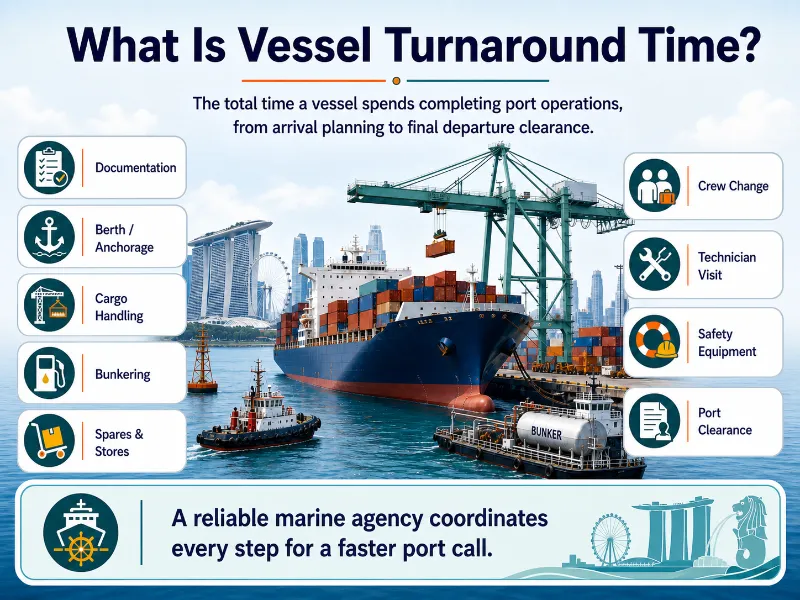
In Singapore, vessel turnaround time can be affected by:
- Arrival and departure documentation
- Berth or anchorage availability
- Cargo handling schedules
- Bunkering coordination
- Ship spares and stores delivery
- Crew change arrangements
- Technician attendance
- Safety equipment requirements
- Port clearance and departure formalities
A reliable marine agency Singapore team helps align these requirements so the vessel, owner, manager, charterer and local service providers work from the same operational plan.
Why Vessel Turnaround Time Matters in Singapore Port
Every hour in port has a commercial impact. Delays can affect charter schedules, cargo commitments, bunker planning, crew welfare, downstream port calls and operating costs.
In a high-volume port like Singapore, small delays can become expensive when documentation, launch boat timing, cargo readiness or vendor attendance is not properly managed. Efficient Singapore port operations depend on preparation before arrival, not last-minute coordination after the vessel reaches port limits.
Singapore’s digitalPORT@SG platform supports digital port clearance and port-related transactions. MPA also describes the digitalPORT@SG Just-In-Time Planning and Coordination Platform as supporting optimal vessel arrivals and departures, faster ship turnaround time and reduced dwell time at anchorages.
This reinforces a key point for vessel operators: faster turnaround begins with better pre-arrival planning.
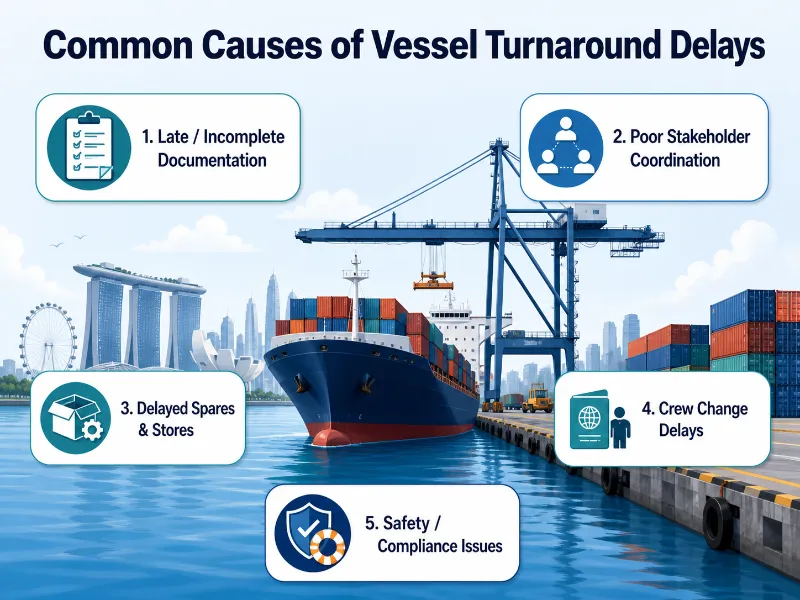
Common Causes of Vessel Turnaround Delays
1. Late or incomplete documentation
Documentation issues can delay arrival clearance, immigration processing, customs coordination and departure approval. Even when digital systems are available, the process still depends on accurate and complete information.
Ship agents help reduce this risk by checking required documents early, coordinating with relevant authorities and ensuring the vessel’s port call requirements are submitted correctly.
2. Poor coordination between stakeholders
A single Singapore port call can involve many parties. These may include the vessel master, owner, charterer, terminal, bunker supplier, ship chandler, repair team, launch boat operator, immigration officers, customs representatives and port authority.
If each party works separately, delays become more likely. An experienced port agent acts as the central coordinator, keeping every stakeholder aligned around the vessel’s actual schedule.
This is one of the main reasons owners and charterers use a professional port agency Singapore service for time-sensitive port calls.
3. Delayed ship spares or stores
Ship spares, provisions, technical supplies and safety equipment must reach the vessel at the right time and location. A delayed spare part can affect maintenance, inspections, class requirements or departure readiness.
Reliable ship spares logistics helps reduce this risk by coordinating vendor collection, customs handling, storage, packing, transport and final delivery to the vessel.
Edtech Marine’s ship agency service page specifically highlights ship spares and stores handling, including door-to-vessel delivery at berth, anchorage, OPL and shipyard locations.
4. Crew change delays
Crew change requires careful coordination between the crewing team, vessel, agent, immigration requirements, transport providers and launch boat operators.
A smooth crew change in Singapore depends on correct documentation, accurate timing and clear communication with the vessel. Edtech Marine’s crew change content positions crew movement support as part of keeping vessels moving and crew members properly supported in Singapore.
When crew change is planned early, it can be completed without disrupting the vessel’s departure window. When it is planned late, it can become a major source of avoidable delay.
5. Last-minute safety or compliance requirements
Safety equipment, lifesaving appliances, fire safety products and inspection-related supplies should be checked before arrival. If essential items are missing or expired, the vessel may need urgent supply before sailing.
Vessel operators should plan these requirements through reliable marine safety and offshore operations support. Edtech Marine’s marine safety and offshore operations category covers marine safety, compliance support and vessel safety solutions in Singapore.
How Ship Agency Services Reduce Vessel Turnaround Time
A professional ship agent does more than submit forms. The agent helps manage the full port call from pre-arrival planning to departure.
A strong ship agency Singapore partner helps with:
- Pre-arrival planning
- Port clearance documentation
- Communication with authorities
- Berth, anchorage or OPL coordination
- Ship spares and stores delivery
- Crew change support
- Launch boat and cargo boat arrangements
- Technician attendance
- Vendor coordination
- Departure formalities
The aim is to reduce uncertainty. When the agent has a clear view of the vessel’s ETA, cargo plan, service requirements and departure target, the port call becomes easier to manage.
For shipowners, managers and charterers, this can mean fewer delays, better communication and stronger control over port call execution.
The Role of OPL Services Singapore
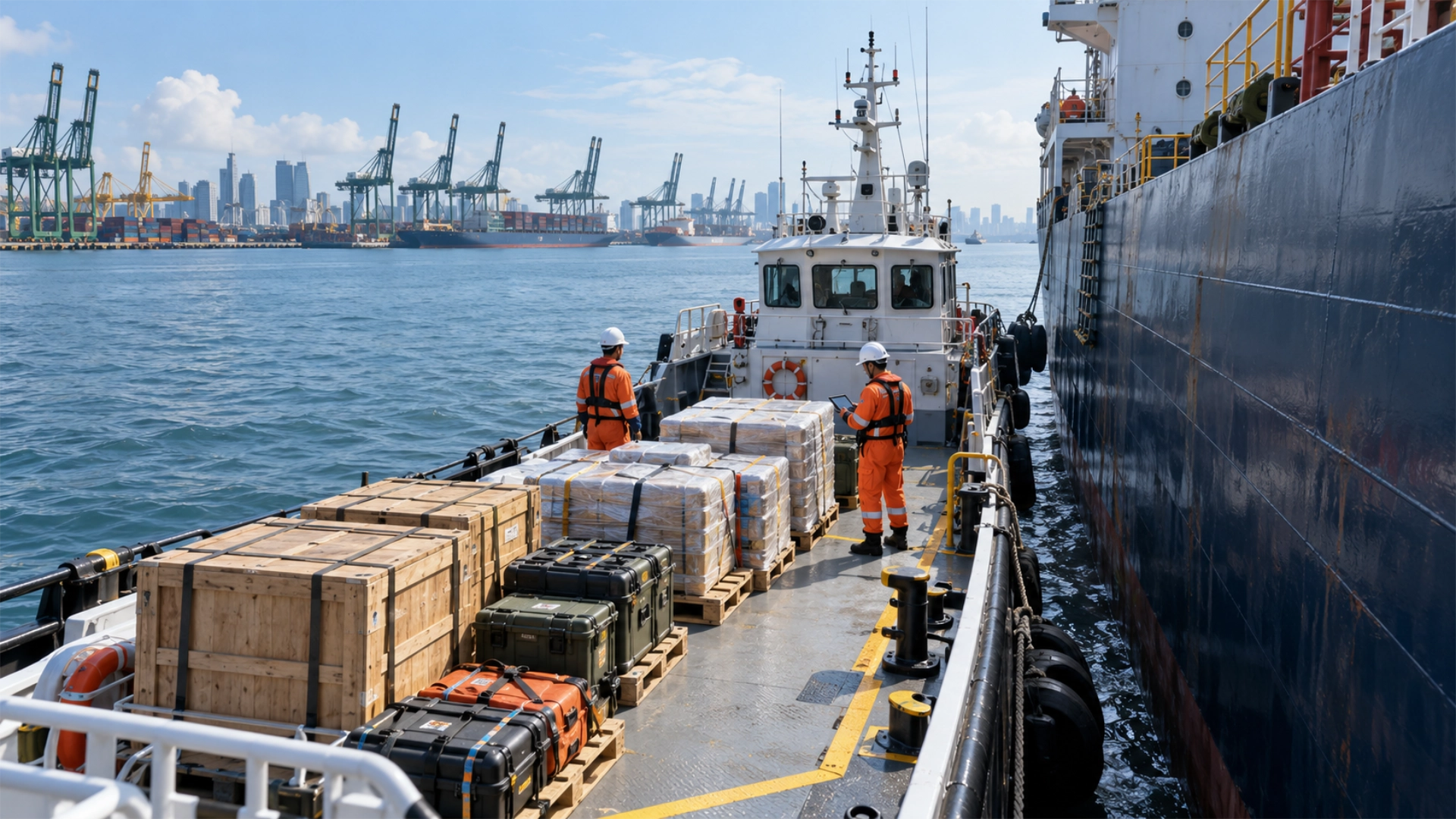
Not every vessel needs to go alongside berth. Many vessels passing Singapore require support at anchorage or OPL for urgent spares, provisions, documents, crew movement or technician transfer.
This is where OPL and cargo boat operations in Singapore become important. OPL (Off port limits) support can help vessels receive essential services offshore, reducing the need for unnecessary berth calls when the required work can be completed safely and legally outside the terminal.
Edtech Marine’s OPL content explains that OPL and anchorage operations may involve cargo transfer, bunkering, provisioning, spares delivery and selected crew or technician movements under approved conditions. It also states that Edtech Marine owns and operates its own OPL fast craft and cargo boats, giving the company tighter control over offshore execution.
For time-sensitive port calls, this matters. When a vessel has a narrow service window, direct coordination can reduce the risk of missed deliveries, late transfers or unclear accountability.
Digitalisation and Just-In-Time Port Planning
Singapore continues to invest in digital port systems to improve vessel movement and port resource planning.
The digitalPORT@SG platform supports digital port services and regulatory transactions. MPA has also described the Just-In-Time Planning and Coordination Platform as a tool for enabling faster ship turnaround time and reducing dwell time at anchorages.
For vessel operators, digitalisation creates an important responsibility. Digital systems can speed up clearance and planning, but only when the vessel’s information is accurate, complete and submitted on time.
A vessel with late documents, unclear service requirements or unconfirmed vendor arrangements can still face delays, even in a highly digital port environment.
Ship Spares Logistics and Door-to-Vessel Delivery
Ship spares logistics is one of the most practical ways to reduce avoidable vessel delay. If a spare part is needed before departure, every step must be coordinated properly.
A reliable ship spares logistics process should include:
- Vendor coordination
- Import and customs handling
- Warehouse receipt
- Spare part inspection and checking
- Repacking where required
- Transport planning
- Launch boat or cargo boat coordination
- Delivery to berth, anchorage, OPL or shipyard
- Confirmation with the vessel and superintendent
Edtech Marine also offers marine products and ship supplies, including marine products, safety equipment, ship supplies and offshore support solutions.
The key question is not only whether a spare is available. The real question is whether it can reach the vessel safely, correctly and within the operating window.
Crew Change Planning in Singapore
Crew change can affect turnaround time if it is not planned properly. A crew change may involve flights, immigration documentation, hotel arrangements, medical checks, land transport, launch boat coordination and communication with the vessel.
A smooth crew change in Singapore should include:
- Crew travel details
- Immigration and port documentation
- Vessel ETA and operating location
- Launch boat timing
- Airport or hotel transfer coordination
- Communication with the master and crewing team
- Backup plans for schedule changes
Handled well, crew change can be completed without delaying departure. Handled poorly, it can cause waiting time, missed service windows and unnecessary operational pressure.
Safety and Compliance Should Not Be Compromised
Reducing vessel turnaround time does not mean cutting corners. Safety, compliance and proper documentation must remain central to every port call.
Vessels should review lifesaving appliances, fire safety products, marine safety equipment and inspection-related requirements before arrival. If replacement equipment is needed, it should be arranged early so delivery can be coordinated with the vessel’s port stay.
Edtech Marine’s broader service offering includes chandling, agency services, product distribution and repair or engineering solutions for the maritime industry. The company positions these services around efficient supply chain management, seamless vessel operations and reliable technical support.
Efficient turnaround is achieved through better planning, not by rushing critical safety requirements.
Practical Strategies to Reduce Vessel Turnaround Time in Singapore Port
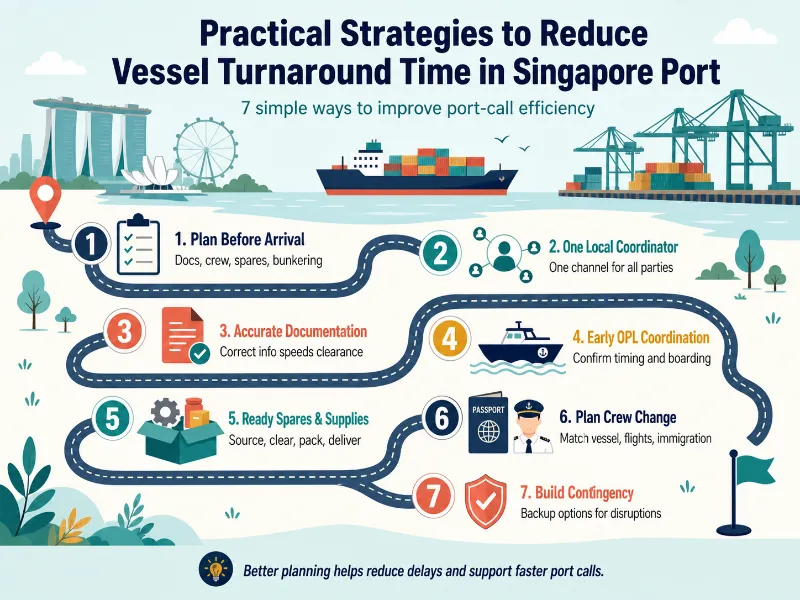
1. Start planning before arrival
Confirm documentation, crew movements, spares, stores, bunkering, repairs, inspections and safety requirements before the vessel arrives.
2. Use one accountable local coordinator
A reliable ship agent reduces confusion by coordinating the vessel, owner, manager, charterer, suppliers and port service providers through one communication channel.
3. Prepare documentation accurately
Digital platforms help speed up clearance, but they depend on correct information. Late corrections can still delay the port call.
4. Coordinate OPL operations early
If the vessel requires offshore support, confirm launch boat timing, cargo readiness, boarding arrangements and vessel availability before the service window.
5. Keep spares and supplies ready
Urgent spares should be identified, sourced, cleared, packed and delivered according to the vessel’s schedule.
6. Plan crew change around the vessel’s actual movements
Crew change should be coordinated with port access, immigration requirements, flight timing and launch boat availability.
7. Build contingency into the port call plan
Weather, traffic, service delays and schedule changes can happen. A good port call plan includes backup options.
Why Work With Edtech Marine?
Edtech Marine supports vessel operators with practical maritime services in Singapore, including ship agency, port coordination, marine logistics, ship supplies, OPL support, crew change arrangements and safety product supply.
The company presents itself as a trusted marine agency in Singapore, established in 2015 and backed by maritime experience across vessel and logistics solutions.
For owners, managers and charterers, the value lies in fewer handovers, clearer communication and stronger control over time-sensitive port activities.
To learn more, explore Edtech Marine services or contact Edtech Marine for vessel support in Singapore.
Conclusion
Reducing vessel turnaround time in Singapore Port requires more than efficient terminals. It depends on early planning, accurate documentation, reliable ship agency support, coordinated OPL operations, timely ship spares logistics, crew change planning and safety readiness.
Singapore continues to strengthen its port ecosystem through digitalisation and operational coordination. However, vessel-level execution remains essential. Shipowners, managers and charterers who prepare early and work with the right local partner can reduce avoidable delays and keep port calls moving efficiently.
For vessels calling Singapore, Edtech Marine provides support across ship agency, marine logistics, OPL operations, crew change, ship supplies and safety solutions.
Key Takeaways
- Vessel turnaround time affects vessel cost, schedule reliability and port efficiency.
- Singapore’s high port volume makes pre-arrival planning essential.
- Ship agency support helps align documentation, vendors, crew logistics and port services.
- OPL services Singapore can support vessels that do not need to go alongside berth.
- Ship spares logistics Singapore should be planned before the vessel arrives.
- Crew change Singapore requires early documentation, transport and launch boat coordination.
- Safety and compliance should be planned early, not handled at the last minute.
Frequently Asked Questions
What is vessel turnaround time?
Vessel turnaround time is the total period a vessel spends completing port-related operations. This can include arrival planning, anchorage waiting time, cargo work, bunkering, spares delivery, crew change, documentation and departure clearance.
How can a ship agent reduce vessel turnaround time in Singapore?
A ship agent reduces vessel turnaround time by coordinating documentation, port clearance, suppliers, service providers, launch boats, crew change, spares delivery and communication between the vessel and local stakeholders.
Why is documentation important for faster port clearance?
Incorrect or incomplete documentation can delay arrival, clearance, immigration processes or departure. Digital systems such as digitalPORT@SG help streamline port-related processes, but the information submitted must still be accurate and timely.
What are OPL services Singapore?
OPL services Singapore refer to offshore vessel support services outside port limits or at approved anchorage areas. These may include spares delivery, provisions, documents, technician transfers and other vessel support operations.
Why are ship spares logistics important?
Ship spares logistics ensures that spare parts and technical supplies reach the vessel on time. Delays in spares delivery can affect maintenance, safety compliance, sailing schedules and vessel readiness.
Can crew change affect vessel turnaround time?
Yes. Crew change can affect turnaround time if documentation, immigration requirements, transport, launch boat timing or vessel schedules are not properly coordinated.
Why choose Edtech Marine for vessel support in Singapore?
Edtech Marine provides ship agency, marine logistics, OPL support, ship supplies, crew change coordination and safety product support for vessels calling Singapore. This makes it a practical local partner for owners, managers and charterers seeking efficient port operations.









6 thoughts on “Reducing Vessel Turnaround Time in Singapore Port: Practical Strategies for Faster Port Calls”
Pingback: 7 Essential Ship Husbandry Services in Singapore for Smooth Port Calls
Pingback: Ship Chandler Singapore: 8 Proven Signs of Reliable Service
Pingback: Marine Repair in Singapore: 8 Steps for Efficient Work
Pingback: Maritime Logistics Company Singapore: 7 Proven Best Tips
Pingback: Marine Logistics Services in Singapore: 7 Essential Steps for Smoother Vessel Deliveries -
Pingback: Ship Supply Chain Management: 7 Proven Ways Singapore Keeps Vessels Moving