
Introduction
Singapore is a major global maritime hub where vessels frequently operate within short and tightly managed service windows. The Maritime and Port Authority of Singapore states that the port receives an annual average of approximately 140,000 vessel calls. For vessel operators, this level of activity makes accurate planning and dependable local support essential.
A reliable ship chandler in Singapore does more than deliver provisions. The supplier must help coordinate the sourcing, preparation and delivery of marine stores according to the vessel’s schedule, location and operational requirements.
Whether a vessel needs fresh provisions, deck consumables, engine stores, safety equipment or urgent replacement items, the objective remains the same: supply the correct goods, in the required condition, to the correct delivery point and within the available operating window.
This guide explains what vessel operators should expect when selecting a ship chandler in Singapore and what information should be confirmed before an order is placed.
What Is a Ship Chandler?
A ship chandler is a specialist supplier that provides vessels with the goods required for crew welfare, maintenance and day-to-day operations.
Depending on the vessel and purpose of the port call, ship chandlery services may include:
- Fresh, frozen and dry provisions
- Cabin and galley stores
- Deck and engine consumables
- Tools and maintenance equipment
- Cleaning materials
- Personal protective equipment
- Marine safety products
- Electrical and plumbing supplies
- Mooring equipment
- Navigation-related products
- Bonded or dutiable sea stores, where permitted
- Delivery coordination at berth, anchorage, shipyard or other approved locations
The role therefore combines procurement, product checking, documentation and last-mile marine logistics.
A suitable supplier must understand not only what the vessel needs, but also when, where and under what conditions the goods can be delivered.
Why Ship Chandlery Requires Careful Planning in Singapore
Singapore offers extensive maritime infrastructure and access to a broad supply network. However, a busy port does not eliminate operational risks.
A chandlery order can still be delayed by:
- An incomplete or inaccurate requisition
- A late purchase confirmation
- Changes to the vessel’s estimated arrival or departure time
- Incorrect delivery-location details
- Customs or controlled-goods requirements
- Limited launch or cargo-boat availability
- Product substitutions that were not approved
- Missing dimensions, model numbers or technical specifications
- Failure to separate urgent items from routine stores
These problems are more likely when the order is treated as a simple shopping list. A professional ship chandler in Singapore should review the operational details surrounding the order before confirming delivery.
What Should a Reliable Ship Chandler in Singapore Provide?

1. Clear and Accurate Quotations
A reliable quotation should make it easy for the vessel operator or purchasing team to understand what is being offered.
The quotation should identify:
- Product descriptions
- Brands or manufacturers, where relevant
- Specifications, grades or model numbers
- Quantities and units of measurement
- Country of origin, if requested or operationally important
- Proposed substitutions
- Prices and applicable taxes
- Delivery charges
- Launch or cargo-boat costs, where required
- Expected availability
- Quotation validity
- Payment terms
Unclear quotations create a risk of unsuitable products being delivered. For technical stores, similar-looking items may have different pressure ratings, dimensions, materials or operating specifications. These details should be confirmed before the purchase order is issued.
2. A Practical Range of Marine Stores
A capable ship chandler should be able to support multiple departments on board instead of supplying only food and household products.
Provisions and galley stores
Provision supply may include:
- Fresh fruit and vegetables
- Chilled and frozen products
- Meat, seafood and poultry
- Rice, flour, noodles and grains
- Canned and packaged food
- Dairy products
- Beverages
- Cooking ingredients
- Galley utensils and consumables
The supplier should confirm dietary, cultural and religious requirements where applicable. Cold-chain products should also be handled and delivered under suitable temperature conditions.
Cabin and housekeeping stores
Common requirements include:
- Bedding and linen
- Towels
- Toiletries
- Laundry products
- Cleaning chemicals
- Refuse bags
- Paper products
- Pantry supplies
Product sizes and pack quantities should be stated clearly, particularly when the vessel is ordering supplies for an extended voyage.
Deck and engine stores
Technical and maintenance requirements may include:
- Hand tools
- Fasteners
- Hoses and couplings
- Gaskets and sealing materials
- Lubrication equipment
- Paint and maintenance consumables
- Electrical components
- Welding supplies
- Pipes and fittings
- Measuring equipment
- Ropes and mooring products
Technical requests should include sufficient specifications. Photographs can help, but they should not replace part numbers, dimensions, drawings or equipment details when these are available.
Safety and protective equipment
Depending on the vessel’s requirements, the order may include:
- Personal protective equipment
- Lifejackets and accessories
- Lifebuoys and accessories
- Immersion suits
- Emergency escape breathing devices
- Self-contained breathing apparatus and spares
- Firefighting equipment
- Safety signage
- Marine pyrotechnics
Safety-critical products must be checked carefully against the vessel’s specifications and applicable certification requirements. Vessel operators can review Edtech Marine’s range of marine products and ship supplies before submitting an enquiry.
3. Substitution Control
Product substitutions are sometimes necessary when the requested brand, pack size or model is unavailable. However, substitutions should never be made without clear communication.
A dependable ship chandler should:
- Identify the unavailable item.
- Explain the proposed alternative.
- Provide its brand, specifications, size and price.
- Supply a photograph or technical data where useful.
- Obtain approval before dispatch.
For food and cabin stores, an unapproved substitution may create cost or crew-satisfaction issues. For technical or safety products, it may make the item unsuitable for use.
4. Quality Checks Before Dispatch
A reliable supplier should check the order before it leaves the warehouse.
Checks may include:
- Quantity verification
- Product-condition inspection
- Expiry-date review
- Packaging integrity
- Label and specification checks
- Temperature control for chilled or frozen goods
- Segregation of food, chemicals and technical products
- Confirmation of certificates or product documents where required
Operators should ask how discrepancies, damaged goods or rejected items will be handled. The process for notifying the supplier and arranging a replacement should be agreed in advance.
5. Customs and Documentation Knowledge
Singapore Customs defines sea stores as goods supplied for use or consumption by crew or passengers outside Singapore waters. Examples include food, water, cleaning and medical supplies, safety equipment and certain spare parts.
However, the Customs treatment depends on the goods and their intended use. For example, Singapore Customs states that ship spares intended for installation on vessels in Singapore are not treated as sea stores. Different permit and Goods and Services Tax requirements may apply.
Dutiable sea stores are also subject to specific controls, including restrictions on eligible vessels, permit requirements and crew-based allowances.
A reliable ship chandler or coordinating agent should therefore determine:
- Whether the goods qualify as sea stores
- Whether they are dutiable or controlled
- What permits or authorisations are required
- Whether the delivery timing is permitted
- What acknowledgement of receipt is needed
- Whether the items must remain secured within Singapore port limits
The vessel operator should not assume that every product delivered to a ship receives the same Customs treatment.
6. Appropriate Handling of Chemicals and Dangerous Goods
When chemicals, paints, compressed products or other regulated materials are requested, the supplier should identify the relevant handling and transport requirements.
Depending on the product and movement, this may include:
- A current safety data sheet
- Correct product labelling
- Suitable packaging
- Transport documentation
- Dangerous-goods classification
- Segregation from incompatible goods
- Use of appropriately licensed transport or handling providers
The International Maritime Organization’s dangerous-goods framework covers matters such as classification, packaging, marking, documentation, stowage and segregation for applicable cargoes. The precise requirements should be checked for the product and type of movement rather than assumed to apply identically to every ship-store item.
7. Delivery to the Vessel’s Actual Location
A quotation is only useful if the goods can reach the vessel within the available window.
Before confirming an order, the ship chandler should establish:
- The vessel’s name and International Maritime Organization number
- Estimated time of arrival and departure
- Berth, anchorage, shipyard or offshore location
- Boarding and access requirements
- Delivery deadline
- Agent and master’s contact details
- Launch or cargo-boat requirements
- Number, dimensions and weight of packages
- Requirements for lifting or handling heavy items
- Whether hazardous or temperature-controlled goods are included
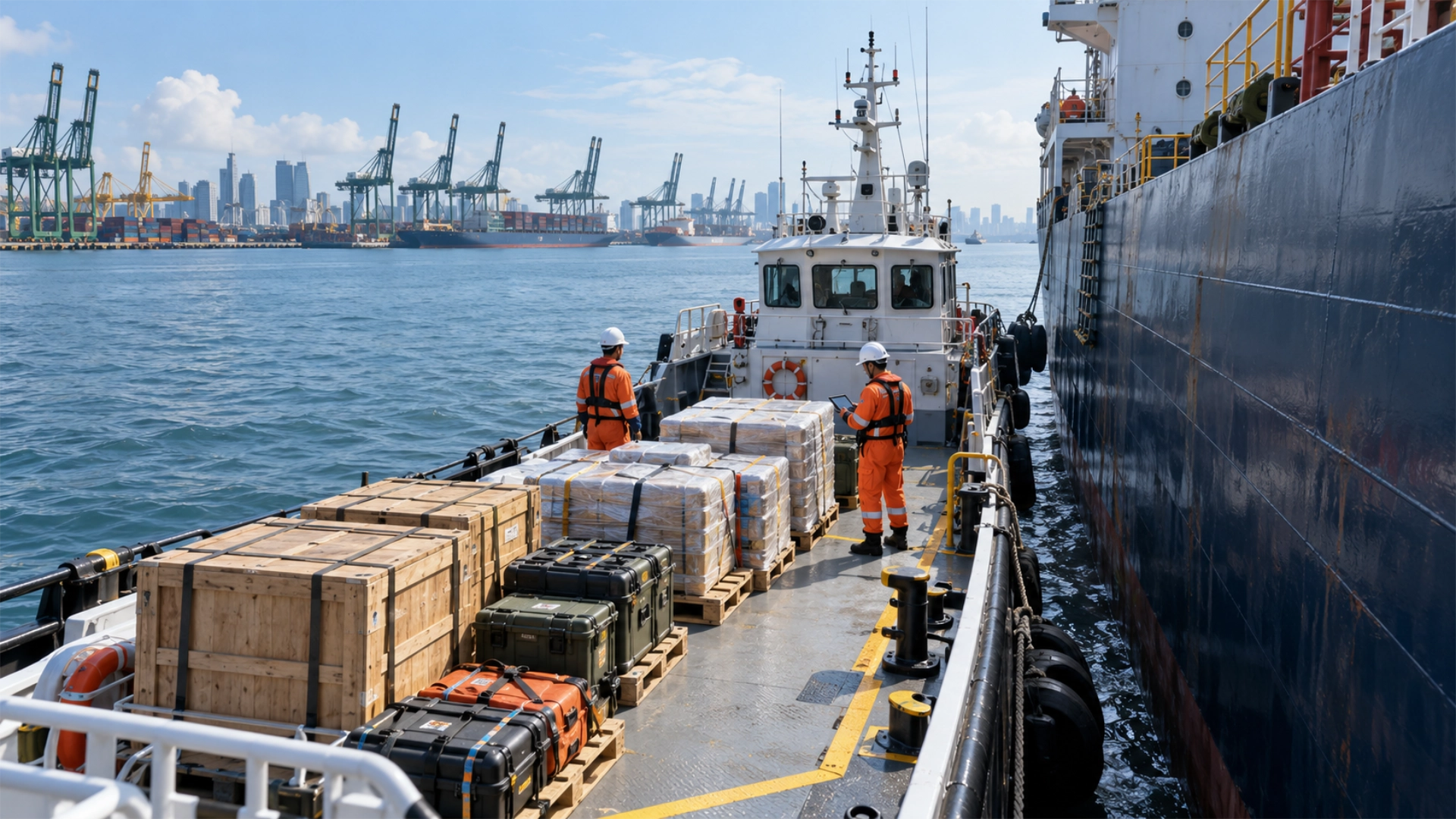
Delivery at anchorage involves different coordination from delivery alongside a berth. Launch timing, package dimensions, sea conditions and vessel-side receiving arrangements may all affect whether the transfer can be completed.
8. Prompt Communication and Delivery Updates
A vessel schedule can change quickly. The supplier should therefore maintain a clear line of communication with the purchaser, local agent and vessel.
Useful updates include:
- Order acknowledgement
- Confirmation of available and unavailable items
- Substitution requests
- Estimated packing completion
- Customs or documentation status
- Dispatch confirmation
- Revised delivery timing
- Proof of delivery
- Details of rejected or undelivered items
The operator does not necessarily need a complex digital platform. What matters is receiving accurate information early enough to make decisions.
Information Vessel Operators Should Send with an Enquiry
A complete enquiry helps the ship chandler quote accurately and plan the delivery.
The initial request should include:
- Vessel name and International Maritime Organization number
- Vessel type
- Local agent’s details
- Estimated arrival and departure times
- Expected delivery location
- Required delivery date and time
- Complete requisition list
- Product specifications and preferred brands
- Acceptable alternatives
- Required certificates or documents
- Details of chemicals or regulated goods
- Package or lifting restrictions
- Billing entity and invoicing instructions
- Contact details for approval of substitutions
- Clear identification of urgent or critical items
Where possible, the operator should separate the order into provisions, cabin stores, deck stores, engine stores and safety products. This makes it easier to identify missing information and route each requirement to the correct supplier.
How to Evaluate a Ship Chandler in Singapore
Price is important, but the lowest initial quotation may not produce the lowest total port-call cost.
Before appointing a supplier, vessel operators should consider the following questions.
Can the supplier demonstrate local operating capability?
Check whether the company has a physical presence, appropriate storage arrangements and experience coordinating deliveries within Singapore’s maritime environment.
Does the supplier understand vessel-specific requirements?
A chandler that regularly supports the relevant vessel type may be better prepared to anticipate technical, storage and delivery constraints.
Are quotations sufficiently detailed?
The operator should be able to identify exactly what is included, excluded or proposed as an alternative.
How are urgent orders handled?
Ask about after-hours communication, stock confirmation, sourcing limitations and the process for approving additional charges.
What quality-control process is used?
The supplier should be able to explain how quantities, specifications, condition and expiry dates are checked.
Can the supplier coordinate different delivery points?
Confirm whether it can support delivery at berth, anchorage, shipyard or other required locations and whether marine transport must be arranged separately.
How does the supplier manage errors and rejected goods?
A clear escalation and replacement process is a stronger indicator of reliability than broad promises of perfect service.
A Practical Pre-Delivery Checklist
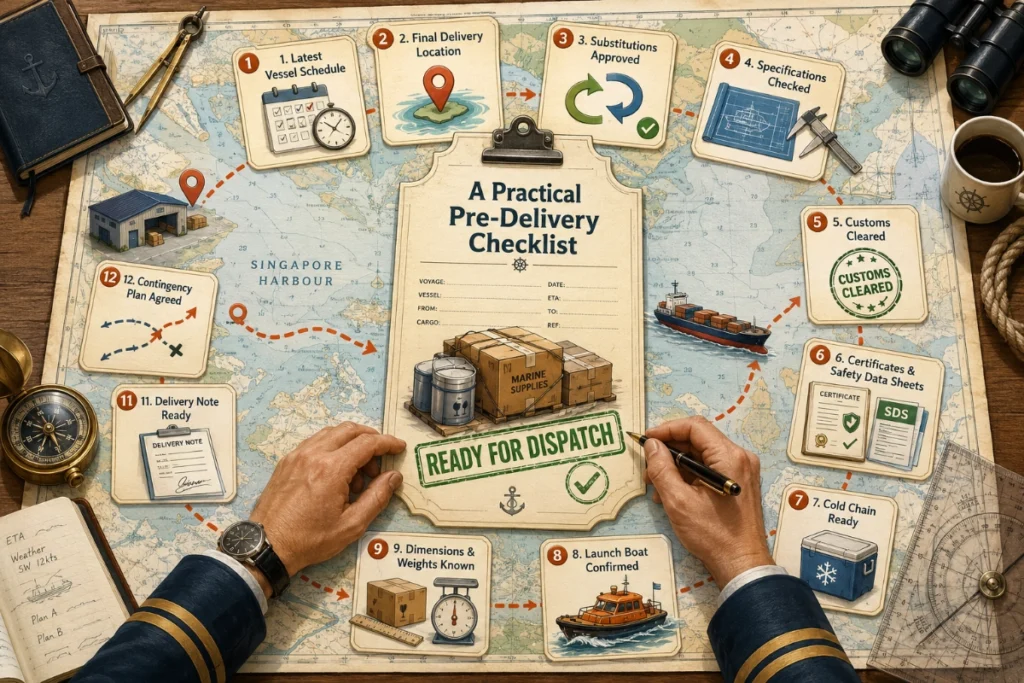
Before the goods are dispatched, confirm that:
- The vessel’s latest schedule has been provided.
- The final delivery location is confirmed.
- All substitutions have been approved.
- Technical specifications have been checked.
- Customs and controlled-goods requirements have been addressed.
- Certificates and safety data sheets are ready where required.
- Chilled and frozen items have suitable delivery arrangements.
- Launch or cargo-boat arrangements are confirmed.
- Package dimensions and weights are known.
- The vessel has nominated a receiving contact.
- A delivery note and acknowledgement process are in place.
- Contingency arrangements have been discussed if the schedule changes.
Working with Edtech Marine for Ship Supplies in Singapore
Edtech Marine supports shipowners, managers and operators with ship supplies in Singapore, marine products, spares handling and vessel-delivery coordination.
Its published service information includes a purpose-built logistics warehouse, updated stock and delivery information, Customs documentation support, dangerous-goods transportation and handling, and door-to-vessel delivery at berth, anchorage, off-port-limits locations and shipyards. These services can be coordinated with its broader ship agency services in Singapore.
Combining supply and local agency coordination can reduce handovers between the purchaser, supplier, transport provider and vessel. It also creates a clearer point of accountability when the vessel’s schedule or delivery requirements change.
Operators can contact Edtech Marine with the vessel details, delivery window and requisition list for review.
Frequently Asked Questions
What does a ship chandler in Singapore supply?
A ship chandler may provide provisions, cabin stores, deck and engine consumables, cleaning materials, tools, personal protective equipment and marine safety products. The available range differs between suppliers.
How early should a vessel place its chandlery order?
Orders should be submitted as early as the vessel’s schedule allows. Technical products, controlled goods, large quantities and special dietary requirements generally require more preparation than standard locally stocked items.
Can ship stores be delivered at a Singapore anchorage?
They may be delivered at an anchorage when the required arrangements and approvals are in place. The delivery may require coordination with the local agent and an appropriate launch or cargo boat.
Are ship spares treated as sea stores in Singapore?
Not always. Singapore Customs states that ship spares intended for installation on vessels in Singapore are not treated as sea stores and are subject to the relevant tax and permit requirements.
Should operators choose a ship chandler based on price alone?
No. Operators should also assess product accuracy, availability, quality control, documentation knowledge, delivery capability and responsiveness. An inexpensive but incorrect or late order can create significantly higher operational costs.
What information is needed for an accurate quotation?
The ship chandler should receive the vessel details, schedule, delivery location, requisition list, technical specifications, acceptable alternatives and any certification, Customs or special-handling requirements.
Conclusion
Selecting a reliable ship chandler in Singapore is an operational decision, not merely a purchasing decision. The supplier must be able to translate a vessel’s requisition into correctly sourced, checked and documented goods and then coordinate delivery within the vessel’s service window.
The strongest results come from early planning, complete specifications, controlled substitutions and continuous communication between the purchaser, local agent, supplier and vessel.
When these elements are in place, ship chandlery becomes an important part of maintaining crew welfare, vessel readiness and a well-coordinated Singapore port call.









1 thought on “Ship Chandler in Singapore: What Vessel Operators Should Expect from a Reliable Supplier”
Pingback: Ship Supply Chain Management: 7 Proven Ways Singapore Keeps Vessels Moving -