
Introduction
Singapore is one of the world’s most important maritime hubs. In 2025, the Port of Singapore recorded 3.22 billion gross tonnage of vessel arrivals and 44.66 million TEUs of container throughput, underlining the scale and intensity of vessel activity handled through Singapore waters. (MPA)
For shipowners, managers, charterers and masters, this means one thing: port clearance in Singapore must be planned carefully. A vessel may be arriving for cargo operations, bunkering, repairs, crew change, ship supplies, spares delivery or OPL coordination. In every case, accurate documentation and timely coordination are essential.
Port clearance is not just an administrative step. It affects berth planning, cargo readiness, crew movement, launch boat coordination, supplier access and departure schedules. When documents are incomplete, declarations are late or operational details are unclear, avoidable delays can quickly increase vessel costs.
This guide explains the key documents, process flow and role of a local ship agent in supporting smooth Singapore port clearance.
What Is Port Clearance in Singapore?
Port clearance is the process of obtaining the necessary approvals for a vessel to enter, operate within and depart from Singapore port limits.
In practical terms, it includes:
- Pre-arrival notification
- Arrival and inward clearance
- Submission of vessel, crew and cargo information
- Immigration and port health clearance where applicable
- Coordination with the Maritime and Port Authority of Singapore
- Customs-related declarations for cargo where required
- Departure and outward clearance before the vessel leaves Singapore
MPA states that vessels arriving in Singapore must make the required notifications and declarations before and upon arrival. For arrival reporting, vessels generally need to comply with notification procedures at least 12 hours before arrival, or once they depart a nearby port if the steaming time to Singapore is less than 12 hours. Vessels carrying hazardous and noxious substances in bulk may require at least 24 hours’ advance notification. (MPA)
Why Port Clearance Matters for Vessel Operators
Singapore’s efficiency is one of its greatest advantages, but it also means vessel operators must be ready before arrival. A port call can involve many moving parts, including pilotage, anchorage, cargo work, bunkering, stores delivery, crew change, inspection, repairs and final departure clearance.
Good port clearance planning helps vessel operators:
- Reduce avoidable waiting time
- Prevent documentation-related delays
- Coordinate with authorities and service providers
- Support faster vessel turnaround
- Maintain compliance with Singapore port procedures
- Improve communication between the vessel, owner, charterer and local stakeholders
For vessel operators trying to reduce port stay, port clearance should be managed alongside berth planning, crew logistics, spares delivery and service coordination. This also links closely with Edtech Marine’s existing guide on reducing vessel turnaround time in Singapore Port.
Key Documents Required for Port Clearance in Singapore
The exact documents required may vary depending on the vessel type, cargo, voyage, port activity and regulatory requirements. However, the following categories are commonly involved in port documentation Singapore processes.
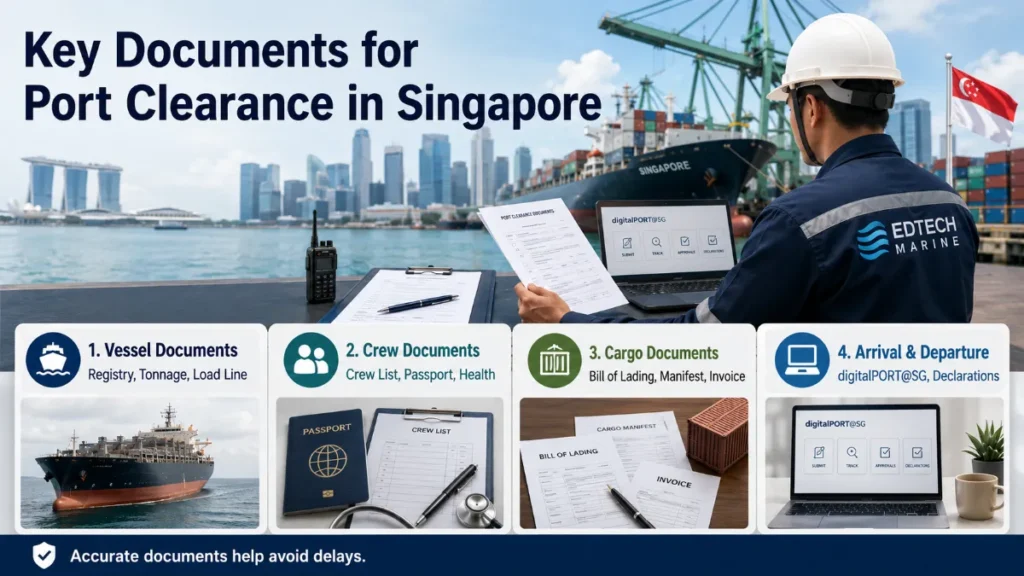
1. Vessel Documents and Certificates
Vessel certificates help authorities verify the ship’s identity, flag, safety status and regulatory compliance. Common documents may include:
- Certificate of Registry
- International Tonnage Certificate
- Load Line Certificate
- Safety Construction Certificate
- Safety Equipment Certificate
- Safety Radio Certificate
- International Ship Security Certificate
- Classification certificate
- International Oil Pollution Prevention certificate, where applicable
- Minimum Safe Manning document
- Last port clearance from the previous port
These documents must be valid, consistent and available when required. Expired certificates, mismatched vessel particulars or unclear scanned copies can create unnecessary follow-up.
2. Crew and Passenger Documents
Crew documentation supports immigration, health and operational checks. Depending on the vessel’s activity, required information may include:
- Crew list
- Passenger list, if applicable
- Seafarer passport or travel document details
- Seaman book details
- Crew sign-on or sign-off details
- Visa or immigration support documents, where applicable
- Maritime Labour Convention-related documents, where relevant
- Health declarations, where required
Crew change requires especially careful planning because port clearance, immigration clearance, transport, launch boat timing and flight arrangements may all need to align. Edtech Marine’s crew change in Singapore article can be used as a supporting internal link where relevant.
3. Cargo Documents
Cargo documents are needed to support customs, terminal and operational requirements. These may include:
- Bill of lading
- Cargo manifest
- Packing list
- Commercial invoice
- Dangerous goods declaration, where applicable
- Reefer cargo details, where applicable
- Transhipment, import or export declarations, where applicable
- Permits or approvals for controlled goods, where applicable
For cargo-related customs declarations, TradeNet® remains important. Singapore Customs states that TradeNet® allows traders to submit trade declarations to fulfil import, export and transhipment regulatory requirements. (TradeNet)
4. Arrival and Departure Declarations
For vessel movement and port formalities, digital submissions are central to Singapore’s clearance process. MPA’s digitalPORT@SG allows shipmasters and ship agents to submit, track and receive approvals for arriving and departing vessels through a single portal. It consolidates multiple forms across vessel, immigration and port health clearances. (MPA)
For departure, MPA states that the owner, agent or master must make a declaration before the vessel departs Singapore through digitalPORT@SG. For vessels staying in port for three days or less, the applicant may choose to submit a combined Arrival and Departure General Declaration. (MPA)
The Port Clearance Process in Singapore
Although every port call is different, the clearance process generally follows a structured operational flow.
Step 1: Pre-Arrival Planning
Before the vessel arrives, the master, owner or ship agent should confirm the vessel’s purpose of call, ETA, cargo status, crew movement, required services and documentation readiness.
At this stage, the ship agent typically checks:
- Vessel particulars
- Previous port details
- Estimated arrival and departure timing
- Cargo or service requirements
- Crew change plans
- Bunkering, repairs or supply arrangements
- Any special cargo or hazardous cargo declarations
- Required certificates and supporting documents
This is where delays can often be prevented. Early document checking gives the agent time to identify missing certificates, incomplete crew details or mismatched information before the vessel reaches Singapore.
Step 2: Arrival Notification and Inward Clearance
The relevant arrival notifications and declarations are submitted according to Singapore port requirements. MPA’s guidance confirms that vessels arriving in Singapore must follow notification and reporting procedures before and when they arrive. (MPA)
The local ship agent supports this stage by ensuring that submissions are made through the correct platform, required supporting documents are attached and the master receives clear instructions on reporting requirements.
Step 3: Coordination During Port Stay
Once the vessel is in Singapore waters, port clearance is connected to wider vessel operations. Depending on the call, this may involve:
- Anchorage or berth coordination
- Pilotage and tug arrangements
- Cargo operations
- Bunkering coordination
- Stores or spares delivery
- Cash to Master arrangements
- Crew change support
- Medical assistance
- Repairs or technical attendance
- Waste disposal
- OPL or launch boat coordination
A ship agent Singapore team acts as the communication bridge between the vessel, owner, charterer, port authorities, suppliers and service providers.
Edtech Marine’s ship agency Singapore service page is the main internal link to include here.
Step 4: Documentation Verification and Follow-Up
During the vessel’s stay, documents and declarations may need to be updated if operational details change. For example:
- ETA or ETD changes
- Crew movement changes
- Cargo changes
- Bunkering changes
- Additional services requested by the owner or charterer
- Inspection or authority follow-up
- Delayed supplier attendance
The agent monitors these changes and helps ensure that declarations remain aligned with the actual port call.
Step 5: Outward Clearance and Departure
Before departure, the vessel must complete the necessary outward clearance requirements. This includes departure declaration, confirmation of completed services and any required final documentation.
If there are unresolved issues such as unpaid dues, incomplete declarations, customs queries, crew documentation problems or missing operational confirmations, departure may be delayed.
A reliable port clearance agent in Singapore reduces this risk by tracking open items before the vessel’s scheduled sailing time.
Common Causes of Port Clearance Delays
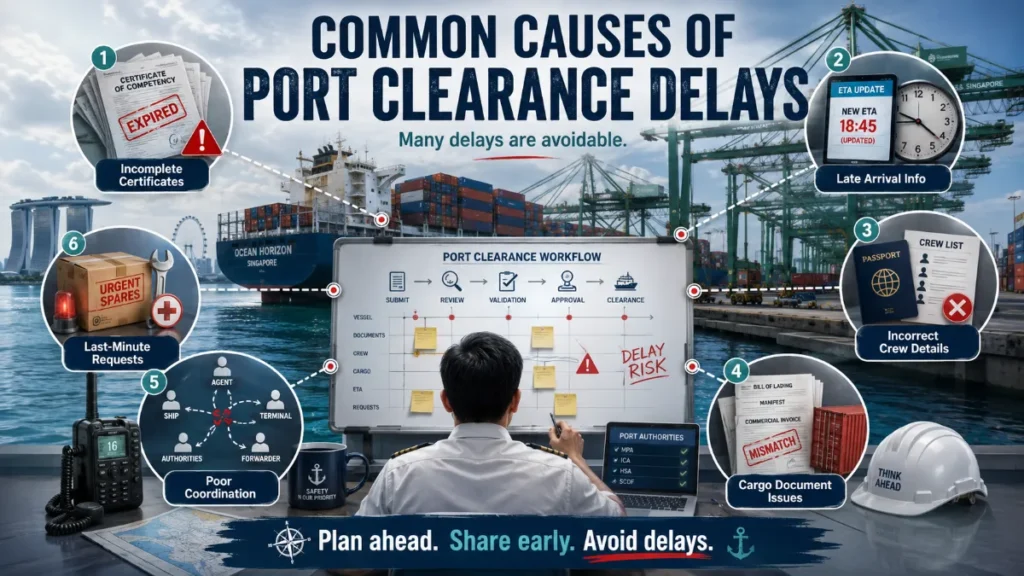
Many clearance delays are avoidable. Common causes include:
Incomplete Vessel Certificates
Missing, expired or unclear vessel certificates can trigger follow-up before approval is granted.
Late Submission of Arrival Information
Singapore’s port environment is highly coordinated. Late information can affect planning, approvals and service scheduling.
Incorrect Crew Details
Errors in names, passport numbers, seaman book details, sign-on/sign-off plans or immigration information may delay crew movement.
Cargo Documentation Issues
Cargo manifests, bills of lading, dangerous goods declarations and customs permits must be accurate and consistent.
Poor Coordination Between Stakeholders
Owners, charterers, masters, suppliers and service providers may all be working on different parts of the port call. Without one accountable local coordinator, information gaps can cause delay.
Last-Minute Service Requests
Urgent spares, repairs, medical attendance, crew change or supply requests can still be handled, but they are easier to coordinate when planned early.
Role of a Ship Agent in Port Clearance Singapore
A local ship agent plays a central role in vessel clearance Singapore because the agent understands local procedures, authority expectations and practical port operations.
1. Documentation Management
The agent checks, prepares and submits required documents for inward and outward clearance. This reduces the risk of incomplete submissions and repeated follow-up.
2. Liaison With Authorities
The agent acts as the operational contact between the vessel and relevant Singapore authorities, including MPA, immigration, customs-related parties and port health where applicable.
3. Port Call Coordination
Port clearance is only one part of the port call. A ship agent also coordinates related services such as pilotage, launch boat, crew change, spares delivery, bunkering, repairs and stores supply.
4. Delay Prevention
Experienced agents identify issues early. This may include missing documents, unclear cargo details, crew change risks, supplier timing conflicts or departure clearance concerns.
5. Communication With Owners and Managers
A good agent keeps owners, managers and charterers updated throughout the port call. This gives decision-makers better visibility over vessel status, cost exposure and departure readiness.
How Edtech Marine Supports Port Clearance in Singapore
Edtech Marine provides ship agency and port operations support for vessels calling Singapore. Through its ship agency Singapore services, Edtech Marine supports port clearance, inward and outward documentation, immigration and customs coordination, crew changes, ship supplies, logistics and port call supervision.
For shipowners, managers and charterers, the value is practical: one accountable local team coordinating the vessel’s requirements from pre-arrival planning to departure.
Edtech Marine can support vessels requiring:
- Port clearance in Singapore
- Ship agency services
- Inward and outward clearance coordination
- Crew change support
- Ship supplies and spares coordination
- OPL and launch boat arrangements
- Port call supervision
- Communication with local stakeholders
For related reading, link this article to Edtech Marine’s existing guide on marine agency Singapore and the article on reducing vessel turnaround time in Singapore Port.
Port Clearance Checklist for Ship Managers
Before a vessel arrives in Singapore, ship managers should prepare:
- Vessel name, IMO number, call sign and flag
- ETA and ETD
- Last port and next port
- Purpose of call
- Vessel certificates
- Crew list
- Passenger list, if applicable
- Cargo manifest
- Bill of lading, where applicable
- Dangerous goods declaration, where applicable
- Bunkering details, if applicable
- Crew change plans, if applicable
- Spares, stores or repair requirements
- Contact details for master, owner, charterer and operator
This checklist can also be converted into a downloadable lead magnet for the article: “Singapore Port Clearance Checklist for Ship Managers.”
Conclusion
Port clearance in Singapore is a critical part of every vessel call. It affects arrival approval, port operations, crew movement, cargo handling and departure readiness.
While Singapore’s digital systems and port infrastructure support efficient vessel movement, successful clearance still depends on accurate documents, early planning and strong local coordination. For shipowners, managers and charterers, working with an experienced ship agent in Singapore helps reduce avoidable delays and keeps the port call moving smoothly.
Contact Edtech Marine for Singapore port clearance, ship agency and port call support.
FAQs
What documents are needed for port clearance in Singapore?
Common documents include vessel certificates, crew list, passenger list if applicable, cargo manifest, bill of lading, dangerous goods declaration where applicable and arrival or departure declarations. Exact requirements depend on vessel type, cargo, voyage and port activity.
How does a ship agent support port clearance in Singapore?
A ship agent supports port clearance by preparing and submitting documents, liaising with authorities, coordinating port services, managing crew or cargo-related requirements and keeping the owner, manager and master updated throughout the port call.
What causes port clearance delays?
Common causes include missing vessel certificates, inaccurate crew details, late arrival notification, incomplete cargo documents, dangerous goods declaration issues, customs queries and poor coordination between stakeholders.
Is digitalPORT@SG used for Singapore port clearance?
Yes. MPA describes digitalPORT@SG as a single window platform that allows shipmasters and ship agents to submit, track and receive approvals for arriving and departing vessels. (MPA)
Is TradeNet® still relevant to port clearance?
TradeNet® is relevant for trade and customs declarations, especially import, export and transhipment permit requirements. It should not be confused with digitalPORT@SG, which is the key platform for vessel arrival and departure port clearance. (TradeNet)
Internal Links to Add
- Ship Agency Singapore
Anchor text:ship agency Singapore
URL:https://edtech.com.sg/ship-agency-singapore/ - Marine Agency Singapore
Anchor text:marine agency Singapore
URL:https://edtech.com.sg/marine-agency-singapore/ - Reducing Vessel Turnaround Time in Singapore Port
Anchor text:reducing vessel turnaround time in Singapore Port
URL:https://edtech.com.sg/reducing-vessel-turnaround-time-in-singapore-port-practical-strategies-for-faster-port-calls/ - Crew Change in Singapore
Anchor text:crew change in Singapore
URL:https://edtech.com.sg/crew-change-in-singapore/
External Links to Add
- MPA – Vessels Arriving in Singapore
Use for arrival notification and reporting procedures.https://www.mpa.gov.sg/port-marine-ops/arrivals-and-departures - MPA – Vessels Departing Singapore
Use for outward clearance and departure declaration context.https://www.mpa.gov.sg/port-marine-ops/arrivals-and-departures/vessels-departing-singapore - MPA – digitalPORT@SG
Use when explaining the single window port clearance platform.https://www.mpa.gov.sg/finance-e-services/digitalport%40sg - Singapore Customs – TradeNet®
Use when explaining customs declarations for import, export and transhipment.https://www.tradenet.gov.sg/
Future Cluster Links to Add Later
- Vessel Port Call Checklist in Singapore
- Choosing a Ship Agent in Singapore
- Inward and Outward Clearance for Vessels in Singapore
- Singapore Port Call Planning Guide for Ship Managers
- Common Causes of Vessel Delay in Singapore Port








4 thoughts on “Port Clearance in Singapore: Documents, Process and Agent Role”
Pingback: Ship Husbandry Services in Singapore: Complete Checklist
Pingback: Ship Chandler Singapore: 8 Proven Signs of Reliable Service
Pingback: Marine Logistics Services in Singapore: 7 Essential Steps
Pingback: Ship Supply Chain Management: 7 Proven Ways Singapore Keeps Vessels Moving