
Introduction
Singapore is one of the world’s most important maritime hubs. Every day, container ships, tankers, offshore vessels, harbour craft and specialist marine assets move through its waters. Behind this constant movement is a network of marine support services that keeps vessels supplied, compliant and ready for their next voyage.
One of the most important parts of this network is the role played by supply boats in Singapore. These vessels may not always receive the same attention as large cargo ships or oil tankers, but they are essential to the smooth running of vessel operations, port calls and offshore logistics.
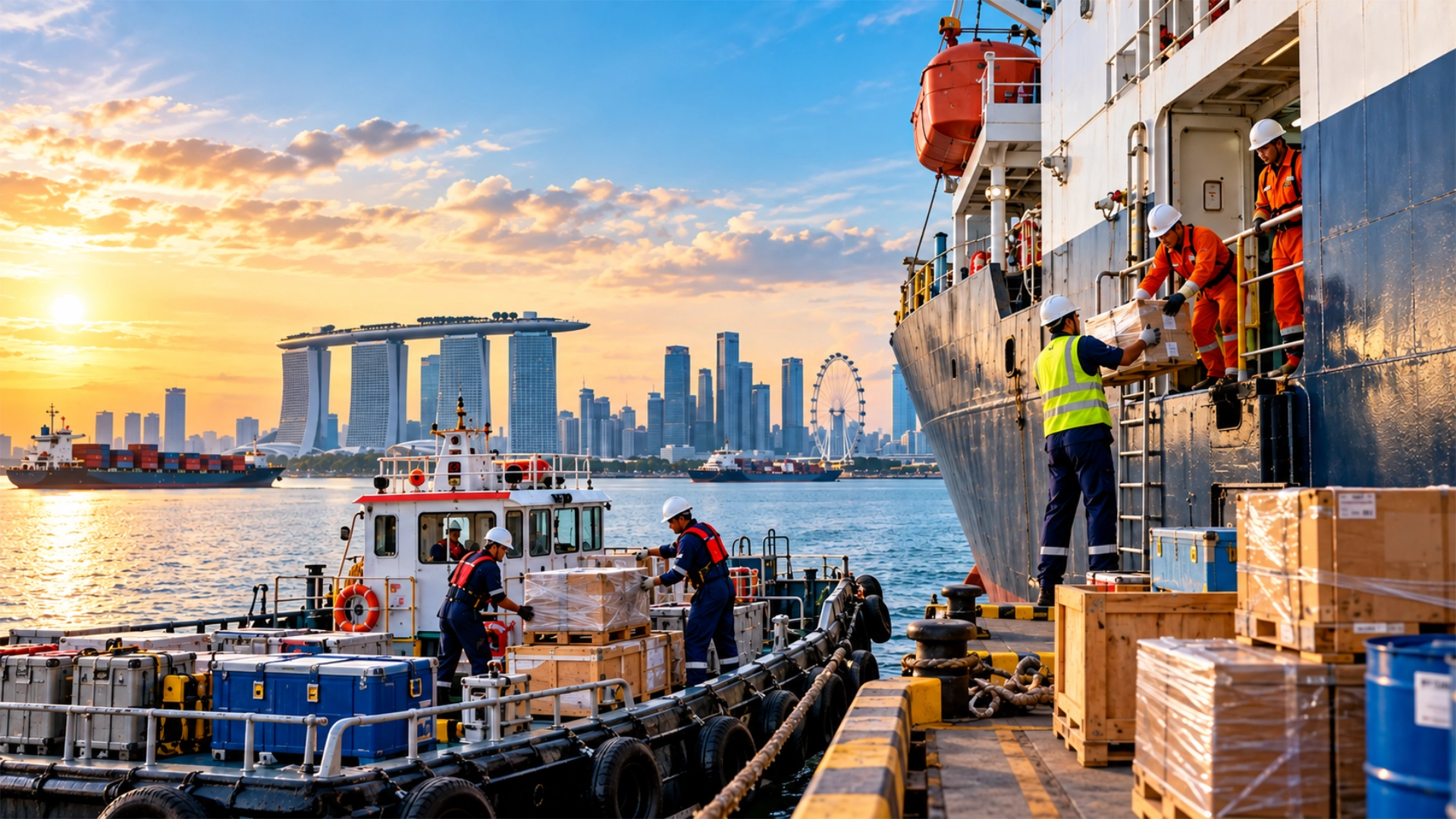
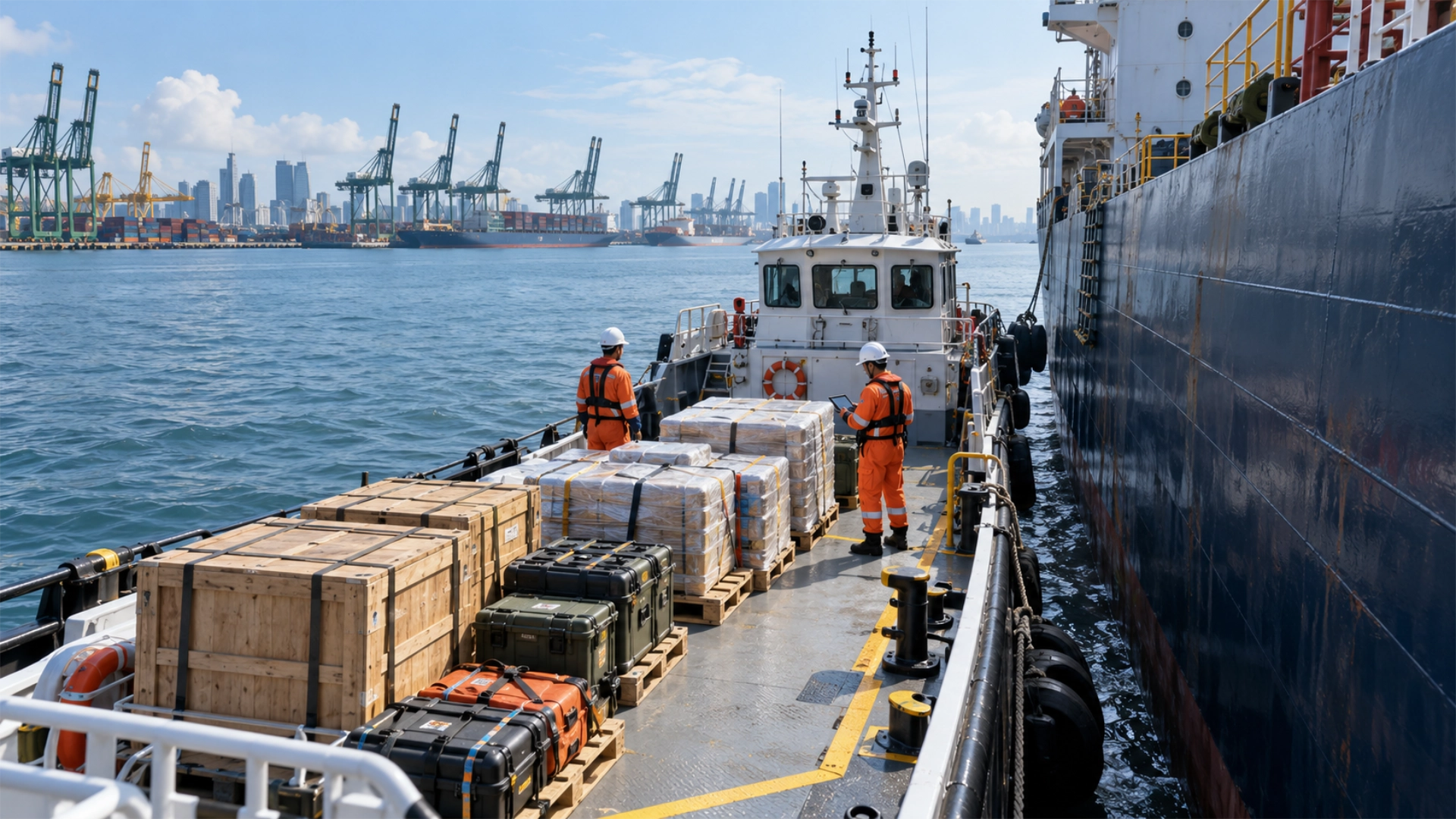
Supply boats deliver fuel, food, water, spare parts, equipment, crew and other essential items to vessels. They also support waste removal, technical assistance, crew transfer and offshore operations. Without reliable supply boat services, vessel turnaround times would be longer, shipping schedules would be harder to maintain and marine logistics would become less efficient.
For shipowners, operators, marine contractors and agents, understanding how supply boats work is important. These vessels form the practical link between shore-based suppliers and ships at anchorage, in port or offshore.
In a busy port environment, efficient ship agency services in Singapore also play an important role in coordinating port calls, crew changes, bunkering, fresh water supply, spares, stores, provisions and other vessel requirements.
What Are Supply Boats?
Supply boats are marine service vessels designed to deliver goods, equipment or personnel to other vessels or offshore locations. They are also commonly known as support vessels, service vessels, marine supply vessels or offshore supply vessels, depending on their function and operating environment.
In Singapore, supply boats support a wide range of maritime activities. Some are used mainly for bunkering, while others focus on provisioning, crew transfer, ship stores delivery, spare parts transport, waste collection or offshore logistics.
The main purpose is simple: supply boats help vessels get what they need without unnecessary delay.
A vessel calling at Singapore may need bunker fuel, fresh provisions, safety equipment, spare parts, technical support or crew transfer before continuing its journey. If these services are delayed, the vessel may miss its schedule, increase operating costs or disrupt a wider supply chain.
That is why supply boats in Singapore are more than just small harbour craft. They are an important part of the marine logistics system that keeps shipping operations moving.
Why Supply Boats Matter in Singapore’s Maritime Industry
Singapore’s maritime sector depends on speed, coordination and reliability. As a major transhipment hub and bunkering centre, Singapore handles significant vessel traffic and time-sensitive port activity.
Supply boats support this ecosystem by reducing the need for vessels to come alongside for every service. Instead, essential supplies and personnel can often be brought directly to vessels at anchorage, outer port limits or approved operating areas.
This helps ship operators in several ways.
First, supply boats reduce downtime. A vessel waiting for fuel, food, spare parts or crew changes can lose valuable time. Efficient supply boat services help keep vessels moving.
Second, they improve operational planning. Marine logistics teams can schedule deliveries around cargo operations, port call windows, bunkering arrangements and crew requirements.
Third, they support safety and compliance. Properly equipped service vessels help ensure that fuel, waste, stores and equipment are handled according to maritime regulations and industry standards.
Finally, supply boats strengthen Singapore’s position as a trusted maritime hub. A port is not judged only by its terminals and cranes. It is also judged by the quality of its supporting marine services.
Key Functions of Supply Boats in Singapore
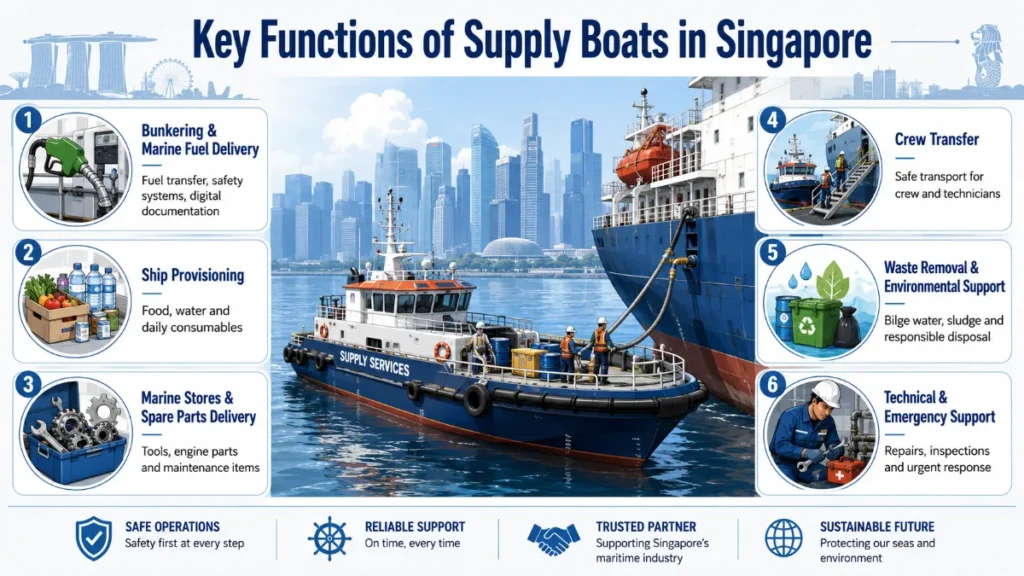
1. Bunkering and Marine Fuel Delivery
One of the most important uses of supply boats in Singapore is bunkering. Bunkering refers to the supply of marine fuel to vessels. In Singapore, this is often carried out by bunker barges or bunker tankers that deliver fuel directly to ships.
Bunker barges are equipped with pumps, hoses, meters and safety systems to support controlled fuel transfer. These vessels play a vital role in helping ships refuel without unnecessary disruption to their port stay.
Singapore remains one of the world’s most important bunkering hubs. Marine fuel sales in Singapore reached record levels in 2024, supported by high vessel activity, container throughput and growing demand for alternative marine fuels, according to Reuters reporting on Singapore bunker sales.
Because bunkering involves fuel transfer, safety, accuracy and documentation are critical. Fuel quantity disputes, contamination risks or spill incidents can create serious operational and financial problems. This is why bunkering services in Singapore must be supported by well-maintained bunker barges, trained crews, clear communication and proper documentation.
The sector is also becoming more digital. Singapore has moved towards digital bunkering and electronic bunker delivery notes, improving efficiency, transparency and data sharing in marine fuel delivery.
2. Ship Provisioning
Ships require regular supplies of food, drinking water and daily consumables for crew members. Provisioning vessels help deliver these items from shore suppliers to vessels.
In Singapore’s busy waters, provisioning vessels must be fast, organised and reliable. They often carry fresh produce, dry goods, bottled water, cleaning supplies and other shipboard necessities.
For vessels on long voyages, provisioning is not a minor task. Poor planning can affect crew welfare and operational readiness. Reliable ship supplies in Singapore help ensure that vessels receive essential stores, provisions, safety equipment, maintenance tools and operational items before departure.
In some cases, provisioning may be coordinated together with other services such as bunkering, stores delivery, spare parts transport or crew transfer. This helps shipping companies reduce waiting time and make better use of each port call.
3. Marine Stores and Spare Parts Delivery
Another important function of supply boats is the delivery of ship stores and spare parts. These can include engine components, deck equipment, filters, hoses, electrical parts, tools, lubricants, safety products and maintenance items.
When a vessel has a technical issue, quick access to spare parts can make a major difference. A small component delivered on time may prevent a long delay or help the crew complete urgent maintenance before departure.
This is where marine supply vessels in Singapore play a practical role. They allow parts and equipment to be sent directly to vessels, reducing the need for more complicated logistics arrangements.
For ship managers, this service supports preventive maintenance, emergency repairs and routine vessel upkeep. Where further technical work is needed, marine repairs and engineering services can support maintenance, fabrication, emergency repairs and vessel readiness.
4. Crew Transfer
Crew transfer vessels are used to transport seafarers, technicians, surveyors and other personnel between shore and vessels. While crew transfer vessels may not always be described as traditional supply boats, they form an important part of marine logistics in Singapore.
These vessels are designed for safe boarding and disembarkation. They may include suitable fendering, safety equipment and seating arrangements to protect personnel during transfer.
Crew transfer is especially important when vessels are at anchorage or when direct access from port facilities is not available. It also supports offshore operations, inspections, repairs and emergency response.
For shipping companies, efficient crew transfer services help maintain schedules and support crew change requirements.
5. Waste Removal and Environmental Support
Supply boats do not only deliver items to ships. Some also remove waste from vessels. This may include general waste, oily waste, sewage, sludge, bilge water or other materials that must be handled responsibly.
Vessel waste removal in Singapore is an important part of environmental compliance. Ships must follow strict rules on how waste is stored, transferred and disposed of. Dedicated waste collection vessels and support boats help ensure that these materials are removed safely and sent for proper treatment.
Internationally, the MARPOL Convention is the main framework for preventing pollution from ships. For operators working in Singapore, environmental responsibility is not only about compliance. It also supports Singapore’s reputation as a clean, safe and reliable maritime hub.
Proper waste handling protects the marine environment, reduces regulatory risk and supports responsible port operations.
6. Technical and Emergency Support
Some supply boats are also used to transport technicians, tools and specialist equipment for repairs or inspections. This may include support for engines, electrical systems, navigation equipment, hull inspections, deck machinery or safety systems.
In urgent cases, fast delivery of technical personnel and equipment can help minimise disruption. Supply boats may also support emergency response, oil spill response or safety operations depending on their design and equipment.
For vessel operators, this makes supply boats a flexible part of Singapore’s marine support infrastructure.
Types of Supply Boats Operating in Singapore
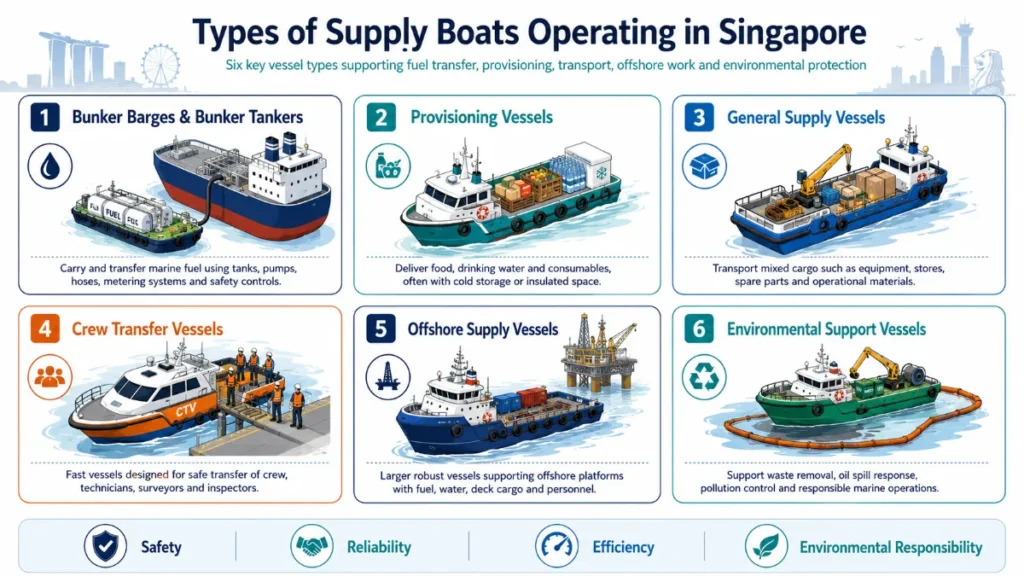
Bunker Barges and Bunker Tankers
Bunker barges are among the most important supply boats in Singapore. They are designed to carry and transfer marine fuel to vessels. Their equipment usually includes fuel tanks, transfer pumps, hoses, metering systems and safety controls.
Bunker tankers may be larger and more specialised, depending on the fuel type and delivery requirements. As the bunkering market evolves, these vessels must also adapt to changing fuel types, digital documentation requirements and higher expectations for measurement accuracy.
Provisioning Vessels
Provisioning vessels are used to deliver food, drinking water and consumables. They are often smaller and more agile than bunker barges, allowing them to navigate busy anchorages and complete deliveries efficiently.
Some may include cold storage or insulated areas to protect fresh provisions during transport.
General Supply Vessels
General supply vessels carry a mix of equipment, stores, spare parts and operational materials. They may be used by ship chandlers, marine contractors, offshore operators or port service providers.
These vessels are useful because they can support different types of delivery rather than being limited to one cargo type.
Crew Transfer Vessels
Crew transfer vessels are designed to move people safely. They are commonly used for crew changes, technician transfers, inspections, offshore support and ship attendance.
Speed, stability and safe access are important features for these vessels.
Offshore Supply Vessels
Offshore supply vessels are generally larger and more robust. They support offshore platforms, construction vessels, survey vessels and other marine assets operating beyond the immediate port area.
They may carry fuel, water, deck cargo, equipment and personnel. In offshore work, reliability is especially important because operations can be affected by weather, distance and project schedules.
Environmental Support Vessels
Environmental support vessels may be used for waste removal, oil spill response or pollution control. They form part of the wider safety and environmental protection system that supports responsible marine operations.
How Supply Boats Improve Marine Logistics
Faster Vessel Turnaround
Every hour matters in shipping. When a vessel is waiting for supplies, fuel or parts, the delay can affect cargo schedules, port planning and downstream logistics.
Supply boats help reduce waiting time by bringing essential items directly to the vessel. This allows ship operators to complete multiple tasks during a single port call.
For example, a vessel may receive bunker fuel, provisions and spare parts within the same operational window. This improves turnaround time and reduces idle periods.
Just-in-Time Marine Delivery
Modern shipping increasingly depends on just-in-time delivery. Instead of carrying large inventories, vessels and operators prefer to receive supplies when they are needed.
Supply boats make this possible by connecting shore-based suppliers to ships quickly and efficiently.
This approach can reduce storage pressure onboard, support better planning and help marine logistics teams respond to last-minute operational requirements.
Better Coordination Between Shore and Sea
Supply boat operations require coordination between many parties. These may include ship agents, port authorities, bunker suppliers, ship chandlers, crew managers, marine contractors and vessel masters.
When this coordination is handled well, deliveries are smoother, documentation is clearer and operations are safer.
In Singapore, where vessel traffic is high, coordination is central to efficient port operations. The Maritime and Port Authority of Singapore plays a key role in Singapore’s wider port and maritime ecosystem.
Support for Offshore and Specialist Marine Work
Supply boats also support offshore construction, oil and gas, marine surveying, dredging, repair work and other specialist activities.
These operations often require equipment, materials and personnel to be moved between shore and offshore locations. Supply boats provide the practical link that keeps these projects running.
Safety Considerations for Supply Boat Operations
Safety is a major priority for supply boat services in Singapore. These vessels often operate near larger ships, in busy waters and under time-sensitive conditions.
For bunkering, safety procedures are especially strict because marine fuel transfer involves fire, spill and contamination risks. Proper communication, emergency readiness and crew training are essential.
For crew transfer, safe boarding arrangements and vessel stability are important. For waste removal, correct handling and documentation are required to prevent environmental harm.
The International Maritime Organization provides global frameworks for maritime safety, security and pollution prevention. Safety standards such as the SOLAS Convention also shape how vessels approach safety equipment, emergency readiness and crew protection.
Supply boat operators and ship managers should ensure that crews have access to suitable marine safety products, including lifejackets, breathing apparatus, emergency escape devices and other essential safety equipment.
For operations involving hazardous environments, SCBA equipment and spare parts may be required to protect personnel from toxic gases, smoke or oxygen-deficient conditions. In emergency evacuation scenarios, Emergency Escape Breathing Devices can also support respiratory protection during escape.
Good supply boat operators must therefore focus on:
- Crew training and certification
- Vessel maintenance
- Clear communication with receiving vessels
- Safe cargo handling
- Emergency response readiness
- Compliance with port and maritime regulations
- Accurate documentation
A well-maintained supply boat is not only more efficient. It is also safer for crew, cargo, customers and the marine environment.
Technology and Digitalisation in Supply Boat Services
Technology is changing how supply boats operate. In Singapore, the maritime sector is moving towards greater digitalisation, automation and transparency.
For supply boat operations, this can include:
- GPS tracking and route optimisation
- Digital job scheduling
- Electronic documentation
- Real-time delivery updates
- Automated metering for bunkering
- Remote monitoring of vessel systems
- Digital communication between suppliers, vessels and agents
Digitalisation is especially important in bunkering. Electronic bunker delivery notes and digital fuel documentation can improve transparency, reduce paperwork and lower the risk of disputes.
For ship operators, this means better visibility over deliveries, timing, quantities and records. For suppliers, it supports efficiency and compliance.
As Singapore continues to strengthen its maritime digital infrastructure, supply boat services will likely become more connected to wider port logistics platforms.
Sustainability and the Future of Supply Boats in Singapore
The future of supply boats in Singapore will be shaped by sustainability, safety and technology.
The maritime industry is under pressure to reduce emissions, improve fuel efficiency and adopt cleaner practices. This affects both the vessels being served and the supply boats providing support.
Future supply boat operations may include more fuel-efficient engines, cleaner fuels, hybrid propulsion, better waste handling systems and improved route planning. Alternative marine fuels such as biofuels, LNG and methanol may also change the way bunkering and supply services are delivered.
At the same time, customers will expect better documentation, faster coordination and stronger compliance standards.
This means supply boat operators will need to invest not only in vessels, but also in training, technology, safety systems and environmental performance.
Choosing the Right Supply Boat Service in Singapore
For shipowners, agents, marine contractors and offshore operators, choosing the right supply boat service is important. The wrong choice can lead to delays, safety issues or poor service quality.
When selecting a supplier or service partner, consider the following factors:
- Experience in Singapore port and anchorage operations
- Type and condition of vessels available
- Ability to handle the required cargo or service
- Safety record and crew training
- Response time and scheduling reliability
- Knowledge of local maritime regulations
- Documentation and reporting standards
- Ability to coordinate time-sensitive marine deliveries
- Access to related ship supplies, repairs and technical support
A reliable supply boat partner should understand that marine logistics is time-sensitive. The best operators are not just transport providers. They are operational partners who help vessels stay on schedule.
Why Supply Boats Will Remain Essential
Even as ports become more automated and maritime systems become more digital, supply boats will remain essential. Ships will still need fuel, provisions, spare parts, crew movement, waste removal and technical support.
What will change is how these services are managed.
Supply boats in Singapore will need to become smarter, cleaner and more integrated with digital port systems. Operators that can combine reliable vessels with strong coordination, transparent documentation and high safety standards will be better positioned for the future.
For Singapore’s maritime industry, supply boats are more than small support craft. They are part of the operational backbone that keeps global trade moving.
Conclusion
Supply boats in Singapore play a vital role in marine logistics and vessel operations. They support bunkering, provisioning, spare parts delivery, crew transfer, waste removal, technical assistance and offshore support.
In a busy maritime hub like Singapore, these services help reduce vessel downtime, improve port efficiency and support safe, compliant operations. From bunker barges and provisioning vessels to crew transfer vessels and offshore supply vessels, each type of craft has a specific role in keeping ships operational.
As the maritime industry moves towards digitalisation and sustainability, supply boat services will continue to evolve. The future will require better technology, cleaner operations, stronger safety practices and closer coordination across the marine supply chain.
For vessel owners, operators and marine businesses, reliable supply boat services are not just convenient. They are essential to efficient and responsible maritime operations.
Need support with ship supplies, vessel services, marine safety equipment or technical support in Singapore? Contact Edtech Marine to discuss your operational requirements.
Frequently Asked Questions
What are supply boats used for in Singapore?
Supply boats in Singapore are used to deliver fuel, provisions, spare parts, equipment and personnel to vessels. They may also support waste removal, technical assistance, crew transfer and offshore logistics.
Are supply boats the same as support vessels?
The terms are closely related. Supply boats are often described as support vessels or service vessels because they support the daily needs of ships, offshore platforms and marine operations.
What is the role of bunker barges in Singapore?
Bunker barges deliver marine fuel to vessels. They are equipped with tanks, pumps, hoses, meters and safety systems to support marine fuel transfer during bunkering operations.
Why are supply boats important for marine logistics?
Supply boats help reduce vessel downtime by bringing essential supplies and services directly to ships. This improves turnaround time, supports port efficiency and helps vessels stay on schedule.
What types of supply boats operate in Singapore?
Common types include bunker barges, provisioning vessels, general supply vessels, crew transfer vessels, offshore supply vessels and environmental support vessels.
How do supply boats support environmental compliance?
Some supply boats help remove waste such as bilge water, sludge, sewage and general waste from ships. This supports proper disposal and helps vessels comply with environmental regulations.
What should companies look for in a supply boat service provider?
Companies should look for reliability, vessel condition, safety standards, crew experience, local port knowledge, proper documentation and the ability to coordinate time-sensitive marine deliveries.






2 thoughts on “Supply Boats in Singapore: Essential Support for Marine Logistics and Vessel Operations”
Pingback: Marine Repair in Singapore: 8 Steps for Efficient Work
Pingback: Marine Logistics Services in Singapore: 7 Essential Steps