
Why OPL and Cargo Boat Operations in Singapore Matter
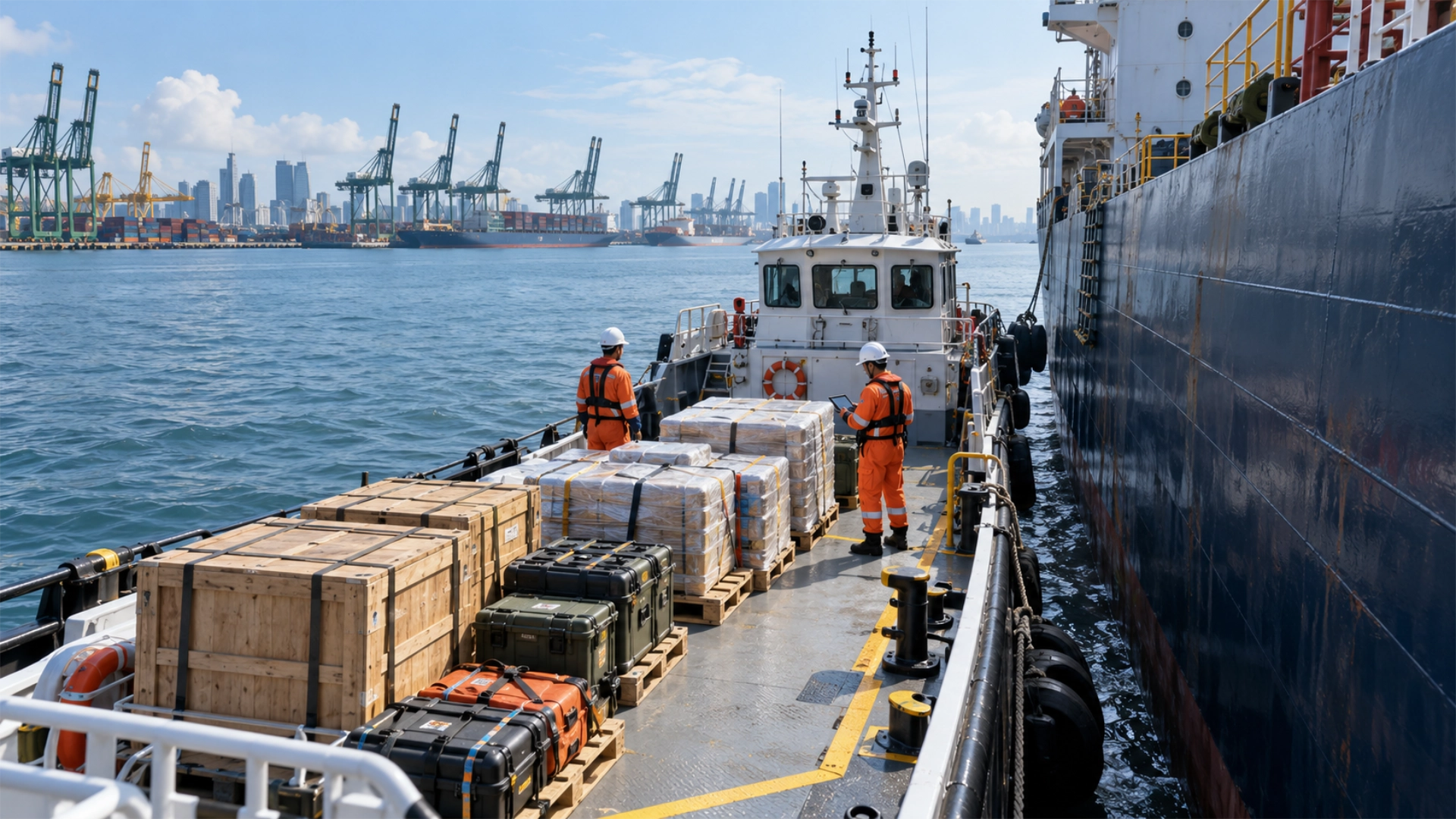
OPL and cargo boat operations in Singapore are a critical part of keeping vessels moving through one of the world’s busiest maritime hubs. Many ships passing through Singapore do not berth, yet they still require spares, provisions, freshwater, and crew movements. These needs must be met offshore, often within narrow time windows and in highly congested waters.
In this environment, success depends less on coordination alone and more on how well offshore execution is controlled. Boats, crews, timing, and communication shape the outcome of every OPL operation. When these elements are aligned, offshore support runs smoothly. When they are fragmented, delays and risk quickly appear.
This article explains how OPL and anchorage operations work in Singapore, why boat control is central to execution, and how Edtech Marine delivers a different, execution-driven model by owning and operating its own OPL fast craft and cargo boats.
Outer Port Limits Explained
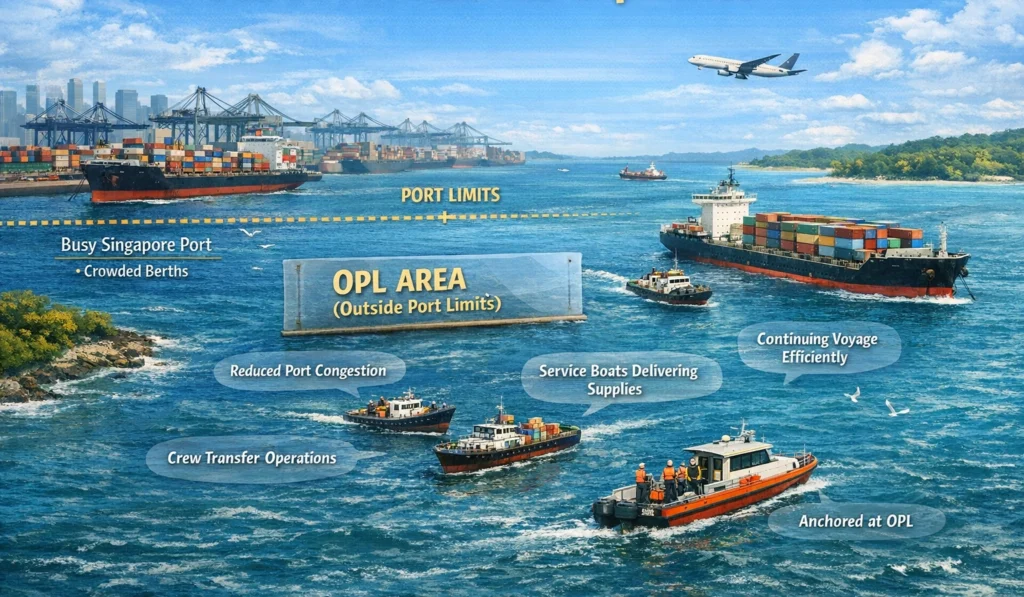
OPL, or Outer Port Limits, refers to designated offshore areas outside Singapore’s main port where vessels can legally anchor and receive services without going alongside a berth. These areas are heavily used due to Singapore’s high vessel traffic and limited berthing availability, making opl and cargo boat operations a critical part of daily maritime activity.
OPL allows vessels to:
Minimise port congestion
Receive essential services efficiently
Continue voyages without unnecessary delay
Because Singapore handles an exceptionally high volume of vessel movements each year, OPL has become a standard operational solution rather than an exception.
What Happens at OPL?
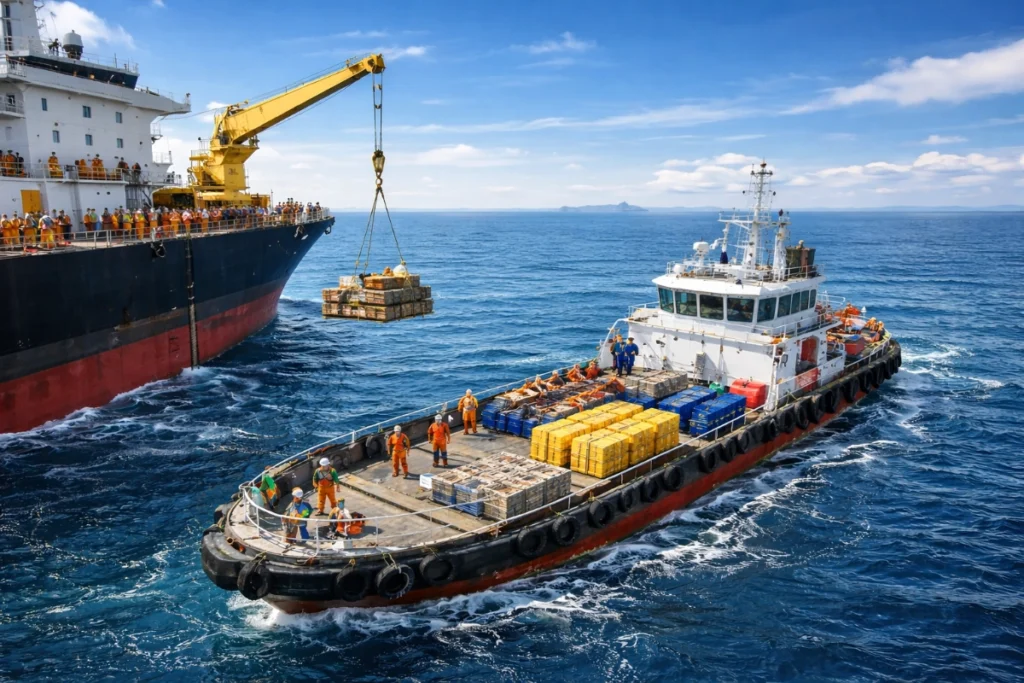
At OPL, various essential activities take place as part of coordinated opl and cargo boat operations that support vessels waiting offshore:
- Cargo Transfer: This is a primary function. Smaller vessels, known as barges or lighters, ferry cargo to and from the larger ships anchored at OPL. This allows for the efficient loading and unloading of goods, especially for bulk commodities or when port berths are congested.
- Bunkering: Ships often refuel at OPL. This involves smaller bunker tankers supplying fuel oil to the waiting vessels, forming a key component of opl and cargo boat operations.
- Provisioning: Ships can receive essential supplies such as food water and spare parts through organized OPL service providers.
- Crew Changes: While less common due to stringent regulations, crew changes can sometimes be facilitated at OPL under approved conditions.
- Maintenance and Repairs: Minor maintenance work or inspections may be carried out on vessels while they are at OPL to ensure operational readiness.
Why OPL is Important for Singapore
Singapore’s strategic location and its status as a major transshipment hub mean that it constantly deals with a high volume of vessel traffic. OPL and cargo boat operations play a vital role in managing this demand by supporting offshore activities and reducing pressure on port infrastructure. OPL services offer several advantages:
- Efficiency: By allowing operations outside the main berths, OPL helps to decongest the port, reducing waiting times for vessels and speeding up the turnaround time.
- Flexibility: It provides a flexible solution for vessels that cannot berth immediately due to congestion, size, or the nature of their operations.
- Cost-Effectiveness: For certain operations, conducting them at OPL can be more cost-effective than paying for prime berth time.
- Specialized Operations: It caters to specialized needs, such as the transfer of specific types of cargo or the servicing of very large vessels.
Navigating the Anchorage
The Anchorage is a designated area within or near a port where vessels can anchor and wait. Singapore has numerous anchorage areas, each serving specific purposes and accommodating different types of vessels. Unlike OPL, which is generally further offshore, anchorages can be closer to the port facilities while still supporting essential opl and cargo boat operations.
Functions of Anchorage Areas
Anchorage areas serve similar purposes to OPL but are often used for vessels that are closer to the port and awaiting specific instructions or berth availability, forming an important extension of opl and cargo boat operations within port limits.
Waiting for Berth: The most common reason for a ship to anchor is to wait for an available berth in the port. Singapore’s busy port necessitates significant anchorage capacity to support ongoing opl and cargo boat operations.
Cargo Operations: Similar to OPL, cargo can be transferred between vessels at anchor. This is often done using barges and tugs as part of coordinated opl and cargo boat operations.
Ship-to-Ship Transfers (STS): Larger vessels may transfer cargo to smaller vessels at anchor, a process known as Ship-to-Ship transfer, which is closely linked to opl and cargo boat operations.
Storage: In some cases, anchorages can be used for temporary storage of certain types of cargo while vessels await further instructions.
Safety and Security: Vessels may anchor for safety reasons such as during adverse weather conditions or while awaiting security clearance, ensuring continuity of opl and cargo boat operations.
Types of Anchorages in Singapore
Singapore manages several distinct anchorage areas, each with its own regulations and designated uses. These include:
Eastern Anchorage: Often used for container vessels and general cargo ships awaiting berths and supporting nearby opl and cargo boat operations.
Western Anchorage: Typically accommodates tankers and bulk carriers engaged in fuel and bulk commodity movements.
Specialized Anchorages: Designated areas for specific operations such as ship repair or lay up activities linked to specialized opl and cargo boat operations.
The Maritime and Port Authority of Singapore manages these anchorages to ensure safety efficiency and environmental protection. The positioning and management of these areas are critical to the port’s operational flow and the smooth execution of opl and cargo boat operations.
How OPL and Anchorage Services Are Often Handled
The Arranging-Agent Model
Many ship agents provide OPL services by arranging third-party boats. They coordinate documentation and pass instructions between vessel, suppliers, and marine operators. While this can work for routine tasks, it becomes fragile when schedules are tight or conditions change.
Boat availability, crew readiness, and execution quality often sit outside the agent’s direct control. When delays occur, responsibility is spread across multiple parties.
Where Problems Usually Arise
Common issues in subcontracted OPL operations include:
Boat schedules changing at short notice
Spares or provisions not ready when the boat arrives
Limited ability to adjust plans once offshore
For owners, charterers, and managers, these gaps translate into risk.
A Boat-Centric Model Built for Offshore Execution
Some operators take a different approach. Instead of only arranging services, they own and operate the boats themselves, aligning planning, logistics, and offshore execution under one structure.
This is the model applied by Edtech Marine.
Edtech Marine is not merely an arranging agent. The company owns and operates its own OPL fast craft and cargo boats, allowing deliveries and transfers to be executed directly rather than through layers of subcontracting. This creates a single accountable service provider with tighter control over timelines, safety and operational outcomes.
OPL and Anchorage Cargo Boat Services in Singapore
Fast Craft and Supply Boat Operations
Edtech Marine supports passing and calling vessels with a range of reliable services for OPL and cargo boat operations in Singapore:
OPL fast craft for personnel transfers and urgent movements
Supply and cargo boat hire for spares, stores, and provisions
Launch boat arrangements for crew changes and technician transport
All operations are coordinated by a 24/7 agency team, ensuring clear, continuous communication before, during, and after every offshore operation.
What Is Supported at Anchorage and OPL
Ship Spares and Stores Delivery
Edtech Marine provides door-to-vessel delivery of ship spares and stores across:
Berths
Anchorage
OPL
Shipyards
This includes managing spares from arrival onshore through to offshore delivery, reducing handovers and avoiding last-minute confusion.
Provisions and Husbandry Support
Both planned and urgent provisioning runs are supported. Cargo and supply boats are deployed based on volume, urgency and vessel readiness, ensuring deliveries are practical and safe offshore.
Crew Change and Personnel Transfers
Crew changes at Singapore and OPL require precision. Edtech Marine arranges:
Crew embarkation and disembarkation
Personnel transfers for riding squads and superintendents
Launch boat coordination aligned with vessel schedules
Direct control of fast craft allows flexibility when vessel ETAs shift.
Freshwater Supply
Where required, freshwater supply is arranged within port limits and at OPL. Deliveries are planned to integrate smoothly with other offshore activities.
Warehousing and Spares Staging
A key operational strength is warehousing and staging of ship spares in transit. Spares are:
Received and checked
Consolidated where possible
Prepared with stocklists and delivery notes
This ensures offshore deliveries are organised and ready to meet sailing windows.

Why Operators Choose Edtech Marine for OPL and Anchorage Runs
One Point of Coordination
Agency, logistics, and delivery are planned together. This reduces handovers and avoids last-minute surprises. Vessel schedules, documentation, spares readiness, and boat deployment are aligned from the start.
24/7 Execution with Direct Communication
Offshore operations do not follow office hours. Edtech Marine’s agency and logistics teams operate 24/7, maintaining direct communication throughout the port stay or passing window. Decisions are made in real time, not escalated across companies.
Built for Time-Critical Spares
Ship spares often define the urgency of an OPL call. Edtech Marine’s logistics team works around the clock to connect spares in transit to vessels offshore. Purpose-built warehousing and visibility tools support precise execution.
The Key Differentiator: Owning and Operating the Boats
The most important difference is structural.
Edtech Marine is not merely an arranging agent. By owning and operating OPL fast craft and cargo boats, the company:
Executes deliveries directly
Avoids dependency on multiple subcontractors
Maintains consistent safety and crew standards
Takes clear responsibility for outcomes
For charterers, owners, and managers, this means one accountable provider with real control offshore.
Safety, Compliance, and Accountability
Offshore Safety Through Direct Control
Safety offshore depends on trained crews, suitable vessels, and clear procedures. Direct operation allows consistent standards across all OPL and anchorage activities.
Regulatory Alignment
All offshore work in Singapore must comply with port and maritime regulations issued by the Maritime and Port Authority of Singapore, available at https://www.mpa.gov.sg. Direct operators maintain closer alignment with these requirements through hands-on execution.
Who This Model Is Best Suited For
This approach is ideal for people who regularly manage vessel movements or other time-sensitive operations in Singapore.
Owners who frequently transit vessels through Singapore
Charterers working to tight schedules
Technical managers coordinating urgent repairs or spare-part delivery
For these stakeholders, clear procedures and well-defined responsibilities improve efficiency and reduce delays when managing OPL and cargo boat operations in Singapore, often yielding better results than overly complex coordination.
Conclusion
Success or failure in OPL and cargo boat operations in Singapore is decided offshore. The condition of the boats, the skill of the crews, timing, and clear communication have a far greater impact on outcomes than paper-based arrangements.
By owning and operating OPL fast craft and cargo boats, Edtech Marine provides a practical, execution-focused model. This integrated approach gives charterers, owners, and managers a single accountable service provider, enabling tighter control over schedules, safety, and operational performance.
In Singapore’s congested, time-sensitive maritime environment, that advantage makes a meaningful difference.







4 thoughts on “OPL and Cargo Boat Operations in Singapore: Built for Offshore Execution”
Pingback: Ship Husbandry Services in Singapore: Complete Checklist
Pingback: Maritime Logistics Company Singapore: 7 Proven Best Tips
Pingback: Marine Logistics Services in Singapore: 7 Essential Steps
Pingback: Ship Supply Chain Management: 7 Proven Ways Singapore Keeps Vessels Moving