Every day, thousands of tonnes of goods move silently across the world’s oceans, packed inside steel boxes stacked dozens of meters high. The container ship is the unsung backbone of global trade, responsible for carrying approximately 90% of the world’s manufactured goods from one continent to another. Yet few people stop to consider where the critical decisions about these vessels are made, or which cities hold the power to keep this system running.
Singapore sits at the heart of this conversation. Positioned at the crossroads of major East-West shipping lanes, this small island nation has quietly become one of the most influential players in global maritime logistics. Its port consistently ranks among the busiest in the world, and its influence stretches far beyond simply loading and unloading cargo.
In this analysis, we will examine how Singapore shaped its role in global shipping, why container ship traffic continues to flow through its waters, and what this means for the broader patterns of international trade. Whether you work in logistics or simply want to understand how global commerce actually functions, this is a story worth knowing.
What Is a Container Ship?
A container ship is a purpose-built cargo vessel engineered to transport standardised intermodal containers in fixed cellular holds. Unlike general cargo ships that accommodate irregularly shaped freight, container ships are designed around a single universal unit of measurement: the twenty-foot equivalent unit (TEU). One standard 20-foot container equals one TEU, while a 40-foot container counts as two TEUs. This standardisation is what made modern global trade possible, enabling seamless cargo transfer between ships, trucks, and rail without unpacking goods at each point of transit.
Vessel Size Categories
The global container fleet spans a wide spectrum of vessel classes, each serving distinct trade routes and port infrastructure. Feeder vessels (under 1,000 TEU) are the smallest class, connecting regional ports to major hub terminals where larger ships cannot call. Sub-Panamax vessels (1,000 to 3,000 TEU) distribute cargo from primary hubs to secondary markets across shorter trade corridors. Panamax vessels (3,000 to 5,100 TEU) were historically the largest ships able to transit the original Panama Canal, constrained by its 32-metre beam limit. Post-Panamax vessels exceed those dimensions and operate primarily on major intercontinental lanes. At the top of the size scale, ultra-large container vessels (ULCVs) exceeding 20,000 TEU now dominate the Asia-Europe trades, with some vessels surpassing 23,000 TEU. According to Global Maritime Hub, the container shipping sector has continued to hit new fleet and capacity milestones, with ULCVs accounting for a growing share of total deployed TEU capacity even as smaller vessels outnumber them in vessel count.
Structural Features That Define the Vessel Type
Container ships are architecturally distinct from all other commercial vessel types. Cell guides run vertically through cargo holds, creating fixed structural channels that stack containers with precision and prevent shifting at sea. Hatch covers seal each cargo bay, protecting below-deck containers from weather and seawater ingress. Above deck, on-deck lashing systems comprising twist-locks, lashing rods, and bridge fittings secure container stacks against the dynamic forces of ocean swells. Additionally, reefer container plugs are integrated directly into vessel infrastructure at designated bays, supplying electrical power to refrigerated containers carrying perishables, pharmaceuticals, and temperature-sensitive cargo. The density and placement of reefer plug points is a key design variable that differentiates vessels serving perishable-heavy trade routes.
How Container Ships Differ from Bulk Carriers and Tankers
Where bulk carriers are optimised for loose dry commodities such as grain and iron ore, and tankers are configured for liquid cargoes in sealed tanks, container ships are engineered for maximum cargo versatility and rapid port turnaround. Bulk carriers and tankers typically carry single commodity types per voyage, with loading and discharge handled by fixed terminal infrastructure or ship-mounted pumps. Container ships, by contrast, can carry thousands of different consignments simultaneously, from electronics to frozen seafood, managed through precise cargo planning software. This operational flexibility is the core reason container ships dominate general cargo trade globally, handling the vast majority of manufactured goods moving between continents.
TEU Capacity as the Industry’s Core Metric
TEU capacity functions as the primary benchmark for fleet sizing decisions, port berth planning, and supply chain infrastructure investment. Port authorities use aggregate TEU throughput to justify capital expenditure on cranes, deepwater channels, and terminal expansion. Shipping lines use fleet TEU totals to price slot capacity and plan alliance deployments. AXS Marine’s February 2026 data tracking confirms that global fleet capacity has continued expanding into 2026, reflecting sustained orderbook deliveries despite broader market volatility. For vessel operators and ship managers operating within this growing fleet, understanding the TEU framework is foundational to every procurement, provisioning, and port agency decision that follows.
Singapore as the Global Container Shipping Hub
Singapore’s port authority delivered a landmark performance in 2025 that reshaped expectations for what a major transshipment hub can operationally sustain. According to MPA Singapore’s 2025 maritime performance summary, the port recorded 44.66 million TEUs of container throughput, representing an 8.6% year-on-year increase, alongside 3.22 billion gross tonnes of vessel arrivals, up 3.5% year-on-year. Translating these figures into operational reality: 44.66 million TEUs processed across a calendar year equates to approximately 122,000 TEUs moving through the port every single day. At that density, berth allocation becomes a precision exercise rather than a routine scheduling task. Ultra-large container vessels (ULCVs) deployed on Asia-Europe strings demand coordinated pre-berthing planning, tightly sequenced crane gangs, and real-time yard management to prevent dwell-time creep that would cascade across feeder connections and downstream delivery windows. The simultaneous record in vessel arrival gross tonnage confirms the port absorbed not just greater box volumes, but larger and heavier vessel calls, placing sustained pressure on turnaround efficiency across every container ship visit.
Geographic Position as a Structural Advantage
Singapore’s dominance is not incidental; it is geographic and structural. Positioned at the confluence of the Strait of Malacca, the South China Sea, and the Indian Ocean, the port sits at the natural chokepoint connecting East-West mainlane trade (Asia-Europe, Transpacific) with intra-Asian feeder networks. Cargo moving between large motherships and smaller regional vessels serving Southeast Asian, South Asian, and Indian Ocean ports must pass through or near this node. Singapore’s port network connects to over 600 global ports, and this density of connectivity is precisely what makes it the default redistribution point rather than merely a waypoint. Strong Chinese export diversion away from US-bound routes in 2025 further amplified regional hub volumes, a trend MPA projects will persist through 2026 as trade tension-driven re-routing continues to reshape demand patterns across Southeast Asian container corridors.
Convening Power and Future-Readiness
Singapore’s influence extends beyond physical throughput into the institutional fabric of the global maritime industry. Singapore Maritime Week 2026 reinforced the city-state’s role as the premier convening forum for shipowners, ship managers, and container line operators seeking to establish partnerships, negotiate service agreements, and align on regulatory and technology priorities. This convening power translates directly into commercial relationships that drive vessel call decisions long after the event concludes.
MPA’s forward-looking agenda for 2026 reflects the same ambition. New LNG bunker supply licences opened for application in January 2026, responding to a 44% surge in alternative marine fuel sales to 1.95 million tonnes in 2025. The Tuas Mega Port development, integrating advanced automation and 5G technology with a projected capacity of 65 million TEUs annually, positions Singapore’s infrastructure well beyond current throughput requirements and signals a long-term commitment that vessel operators can factor into routing and fleet deployment decisions.
Agency Services as a Commercial Indicator
Every container ship call at Singapore generates a chain of agency-level activity: port clearance, berth pre-planning, customs documentation, bunkering coordination, crew logistics, and cargo monitoring. The scale of this activity is measurable. With 35 maritime companies opening or expanding Singapore operations in 2025, and key maritime firms collectively contributing approximately S$5 billion in annual business spending to the economy, the commercial ecosystem anchored to container ship visits is substantial and growing. During high-traffic periods, when berth windows compress and vessel schedules allow minimal margin, reliable local agency support shifts from a convenience to a critical operational dependency. Marine service providers with established Singapore presence, deep port authority relationships, and responsive supply chains are positioned to absorb the operational complexity that record throughput inevitably generates.
The Container Shipping Market in 2026: Recovery and Resilience
The Seatrade Maritime Podcast in January 2026 signalled what industry observers had been cautiously anticipating: a broad return to activity across container shipping markets. In operational terms, a “full return” carries specific meaning for vessel operators and service providers. It translates into higher fleet deployment density, with more vessels active across primary and secondary trade lanes simultaneously, and a corresponding lift in port call volumes at major transshipment hubs. For Singapore, already operating at record throughput levels following its landmark 2025 port performance, this recovery dynamic compounds an already elevated provisioning environment. More vessels calling more frequently means compressed planning windows and greater aggregate demand for marine services across every berth.
Schedule Reliability and What It Means for Provisioning
One of the more operationally significant shifts entering 2026 has been the measurable rebound in container shipping schedule reliability. As reported by Global Maritime Hub, global shipping schedules have been stabilising following years of disruption driven by port congestion, pandemic-era demand surges, and geopolitical rerouting events. Improved schedule adherence directly benefits ship provisioning lead-time calculations. When vessel arrival windows tighten from multi-day uncertainty bands to narrower, more predictable ranges, chandlers and marine agencies can plan procurement cycles with greater precision, reducing both emergency stock deployment and wasteful overstocking. For vessel operators, this reliability improvement supports tighter operational budgeting and more efficient coordination with port agents and suppliers.
Fleet Deployment Patterns in Early 2026
AXS Marine’s February 2026 container shipping data trends captured a market in active reconfiguration. Vessel movement data pointed to continued high activity levels across Asia-Europe and intra-Asia corridors, with fleet deployment shifts reflecting carriers’ responses to capacity oversupply conditions. Global cargo volume growth is projected at approximately 2 to 3.5% for 2026, a modest but positive trajectory. Importantly, overcapacity conditions increase the total number of active vessel deployments even as individual freight rates come under pressure, meaning port call volumes remain elevated. Vessel operators should factor these fleet deployment shifts into operational planning, particularly as alliance restructuring continues to alter which vessels serve which routes and at what frequency.
Stability Does Not Mean Certainty
The transition from post-pandemic disruption toward a more stable operating environment is real but should not be mistaken for a friction-free market. Geopolitical pressures, including ongoing Red Sea routing constraints and US-China trade policy volatility, continue to create sudden lane disruptions and freight rate swings well into mid-2026. Contingency supply arrangements remain essential operational infrastructure rather than optional buffers. Marine agencies positioned to provide emergency chandling, rapid procurement, and flexible logistics support retain significant value precisely because the stable baseline can be interrupted without warning.
Singapore’s Port Volume and Chandling Demand
Demand for ship supply and chandling services tracks closely with vessel call volumes, making Singapore’s record port performance directly consequential for marine service providers operating in the region. Higher throughput means more vessels requiring provisioning, safety equipment replenishment, and technical supplies within tighter turnaround windows. For agencies like Edtech Marine, this environment reinforces the importance of maintaining deep inventory readiness, reliable supplier networks, and rapid response capabilities to serve the full breadth of container vessel operators transiting one of the world’s busiest maritime corridors.
Geopolitical Disruptions and Their Operational Impact on Container Ships
The compounding effect of two simultaneous chokepoint crises has fundamentally altered the operational calculus for container ship operators in 2026. The Strait of Hormuz crisis escalated sharply following U.S.-Israeli strikes on Iran, prompting Iran to close the strait to commercial traffic and triggering immediate operational guidance from major carriers suspending transits “until further notice.” The strait carries approximately 20.9 million barrels of petroleum per day, representing roughly 20% of global petroleum liquids consumption, making any closure immediately price-reactive. Freight rates responded within days, and operators found themselves tearing up contingency plans as Xeneta’s chief analyst Peter Sand observed: “The risk of geopolitics has shown its ugly face with higher frequency and more severity over the past years than ever before.” For ship managers, this pattern of rapid route suspension and emergency rerouting compresses the window for revising bunkering schedules, provisions orders, and supply strategies to a matter of hours rather than weeks.
The Houthi threat in the Red Sea has reinforced this volatility from a second direction. Persistent drone, missile, and small boat attacks on commercial vessels through the Bab el-Mandeb Strait, which accounts for approximately 12% of global seaborne trade by volume, have driven Suez Canal throughput to 50 to 60% below pre-2024 levels. The Council on Foreign Relations analysis of conflict-driven chokepoint disruptions concludes that two years of U.S. and UK airstrikes failed to neutralise Houthi operational capacity, confirming that naval countermeasures alone cannot restore safe transit. Cape of Good Hope routing has consequently become the structural baseline for most Asia-to-Europe cargo rather than a temporary workaround. This diversion adds approximately 3,500 nautical miles per round trip and 10 to 14 additional transit days per voyage, carrying a persistent 25 to 30% cost premium on freight all kinds rates that operators must absorb across every voyage cycle.
The operational consequences at the vessel level are significant and often underestimated in planning frameworks built around stable routings. Extended passages consume proportionally more bunker fuel, fresh water, deck stores, provisions, and safety consumables than standard voyage plans account for. Unplanned port diversions triggered mid-voyage by route reassessments create acute demand for emergency chandling at short notice, sometimes at ports where supply relationships have not been pre-established. Singapore sits at a strategically critical juncture in this context: positioned at the eastern entry to the Indian Ocean leg and at the throat of the Strait of Malacca, it functions as the last well-stocked, reliable provisioning hub before vessels commit westward into either high-risk or significantly extended routing scenarios. Its bonded store depth, port infrastructure, and proximity to major East-West trade lanes make it a natural convergence point for vessels needing to top up stores before a long Cape passage.
For ship managers, the planning implications extend beyond provisions logistics. Extended voyages increase the probability that life-saving appliance servicing windows, EPIRB battery replacement cycles, and firefighting equipment recharge schedules will fall out of alignment with actual voyage durations. Vessels that miss scheduled port calls due to diversions may find statutory certificates, including SOLAS safety equipment certificates and ISM-related documentation, approaching validity limits before the vessel reaches a certificated service port. With East-West schedule reliability currently below 60%, procurement planning anchored to fixed port rotations is no longer a sound foundation. Ship managers need pre-established supply and compliance relationships at deviation hubs that will be accessible regardless of which route the vessel ultimately takes.
In this environment, having a confirmed chandling and ship agency relationship at a port like Singapore is less a convenience and more a contingency asset. Edtech Marine’s ship chandling and agency services in Singapore provide vessel operators with a locally anchored resource capable of fulfilling broad, short-notice orders across provisions, deck stores, safety equipment, and bonded goods. When voyage plans are being redrawn in response to chokepoint developments, the ability to confirm supply availability and coordinate port services through a single trusted local partner reduces the response burden on ship managers already managing a high-pressure operational picture.
Safety Compliance Requirements for Container Ships
Operating a container ship within international trade lanes means navigating one of the most rigorous safety compliance frameworks in global industry. The IMO’s Safety of Life at Sea Convention establishes the foundational obligations that every vessel must satisfy before departure, and Singapore enforces these provisions with a precision that few port states match. Understanding what SOLAS demands, and what MPA Singapore specifically scrutinises, is not optional preparation for vessel operators; it is a core operational competency.
SOLAS Obligations Every Container Ship Must Meet
SOLAS is structured across multiple chapters, each addressing a distinct safety domain. Chapter II-2 governs fire protection, detection, and extinction, mandating fixed firefighting systems, fire detection networks, and portable suppression equipment across defined vessel zones. Chapter III covers lifesaving appliances, requiring correctly sized and certified equipment for every crew member on board. Chapter IV addresses radiocommunications and emergency signalling, while Chapter V covers navigational safety obligations that must be satisfied prior to each departure. Compliance with all active chapters is a condition of valid certification, not a discretionary standard.
MPA Singapore’s Port State Control Regime
MPA Singapore conducts over 22,000 compliance verifications annually, placing it among the world’s most active port state control regimes. Inspectors board vessels and verify certificates, equipment condition, and operational readiness against SOLAS requirements and flag state obligations simultaneously. Non-compliance carries severe financial consequences; detention and associated disruptions can cost operators between $75,000 and $150,000 per day, while fraudulent certificates attract penalties exceeding $500,000 alongside potential criminal prosecution and permanent port access restrictions. Common deficiency categories flagged at Singapore include expired or improperly maintained lifesaving appliances, fire safety equipment failures, and documentation irregularities. MPA verifies certificate authenticity through international databases and authorises Recognised Organisations to conduct approvals on its behalf, leaving no margin for administrative oversights.
Mandatory Safety Equipment Categories
Container ships calling at Singapore must carry a specific range of safety equipment, each maintained to SOLAS and IMO standards. Self-Contained Breathing Apparatus units are required firefighting equipment under SOLAS Chapter II-2; they must be serviceable, tested, and documented. Immersion suits must be individually sized and certified for each crew member, with condition verified during PSC inspections as part of Chapter III compliance. Marine pyrotechnics, including handheld and parachute flares, EPIRBs, and Search and Rescue Transponders, are mandatory emergency signalling devices under Chapters III and IV. EPIRBs and SARTs carry defined service lives, typically between three and five years depending on manufacturer certification, and must be renewed before expiry. Fire detection systems must comply with the updated guidelines set under MPA Shipping Circular No. 13 of 2021, which became mandatory from 1 January 2022 and requires maintenance, testing, and inspections to follow IMO-developed guidelines.
Service Lives and Replacement Schedules
Safety equipment compliance is not a one-time procurement exercise. Immersion suits require periodic inspection and must be replaced when serviceability cannot be confirmed. SCBA cylinders are subject to hydrostatic pressure testing, typically every five years per manufacturer guidance, with records maintained in the vessel’s Safety Management System. Marine pyrotechnics carry expiry dates printed on each unit and must be tracked proactively; expired pyrotechnics represent one of the most commonly cited LSA deficiencies during PSC inspections globally. For CO2 firefighting systems, Singapore-registered vessels that completed 30th-anniversary maintenance prior to 1 January 2022 must complete hydrostatic testing of all cylinders by the next scheduled dry-docking, with a hard deadline of 1 January 2027. Liferafts require annual servicing including hydrostatic release unit testing and certification renewal at MPA-approved stations.
Edtech Marine as a Practical Compliance Solution
For container ship operators calling at Singapore’s port, the ability to source SOLAS-compliant safety equipment locally and efficiently is a genuine operational advantage. Edtech Marine, established in Singapore in 2015 and backed by four decades of maritime industry experience, supplies a range of critical safety equipment including SCBAs, immersion suits, and marine pyrotechnics that meet the compliance standards vessels must satisfy before departing port. Coordinating equipment renewal during routine Singapore port calls eliminates the need for dedicated voyages to service facilities, reducing both cost and scheduling complexity. For vessel operators managing tight turnarounds in one of the world’s busiest container ports, having a reliable, locally based safety equipment supplier is a practical compliance anchor, not a secondary consideration.
Decarbonisation and Green Operations: What Container Ship Operators Must Know
Singapore’s Maritime Decarbonisation Blueprint 2050 sets an ambitious framework for transforming the city-state into a leading green and digital maritime hub. The blueprint outlines targets aligned with the IMO’s updated climate strategy, including measurable reductions in port-level emissions and the development of green fuel bunkering infrastructure to support vessels calling at Singapore. For container ship operators using Singapore as a primary transshipment hub, these targets carry direct operational weight. Vessels that cannot demonstrate credible decarbonisation progress may face reduced access to green port incentives, higher port dues under future tiered pricing structures, and diminished competitiveness when calling at a port that is systematically embedding sustainability benchmarks into its operational framework.
CII Ratings and Fleet Performance Under Pressure
The IMO’s Carbon Intensity Indicator rating system grades vessels from A to E based on annual carbon intensity performance, and the thresholds tighten each year. Container ships rated D for three consecutive years, or E in a single year, are required to submit corrective action plans to flag state authorities. The commercial consequences extend beyond regulatory compliance: BIMCO has introduced standardised CII clauses into time charter templates, which means a vessel’s rating can now directly affect charter party negotiations, hire rates, and the willingness of quality charterers to engage. The Global Maritime Forum’s June 2026 data confirms that charterers and shipowners are actively tracking climate alignment scores as part of commercial negotiations, signalling that CII performance has moved from a compliance checkbox into a core commercial variable for container ship operators.
Alternative Fuels, Provisioning, and Crew Training
The shift toward alternative fuels is reshaping the provisioning requirements of every vessel in a modern container ship fleet. LNG currently delivers 20 to 30 percent lower CO2 emissions compared to heavy fuel oil and remains the most commercially deployed alternative, but it demands cryogenic storage systems, specialised bunkering arrangements, and revised maintenance schedules for dual-fuel engines. Methanol and ammonia represent the next frontier; green ammonia-fuelled routes between South Africa and Europe are projected to become commercially viable by 2029, but ammonia’s acute toxicity creates significant crew safety challenges that demand updated STCW competency certification. Slow steaming, which reduces fuel consumption and emissions at minimal additional cost, also changes voyage scheduling assumptions and affects spare parts consumption rates, since engines operating at reduced load require different maintenance intervals. The role transformation required of seafarers throughout this fuel transition is substantial, creating documented protection deficits and placing pressure on ship managers to invest in structured retraining programmes.
Digital Infrastructure and ESG as Competitive Differentiation
MPA’s Maritime Digital Twin initiative exemplifies how Singapore is building port-wide data infrastructure to monitor vessel emissions at scale. By integrating AIS data, fuel consumption reporting, and port call records into a unified digital environment, the programme enables ship managers to verify and report compliance with greater precision, reducing the risk of discrepancies between onboard records and port-state expectations. This matters because the EU’s Monitoring, Reporting and Verification framework and the IMO Data Collection System both require documented emissions data that can withstand audit scrutiny. Beyond regulatory compliance, green shipping is increasingly the future of sustainable maritime industry, with major beneficial cargo owners and retailers embedding Scope 3 emissions requirements into their procurement criteria. Container ship operators who can provide verified CII ratings, documented fuel type data, and auditable ESG performance records are positioning themselves as preferred partners in an environment where green credentials are becoming a commercial prerequisite rather than a voluntary distinction.
How Edtech Marine Supports Container Ship Operators in Singapore
For container ship operators calling at Singapore, the challenge of managing multiple service requirements within compressed port windows demands a partner capable of delivering across every operational dimension without delay or fragmentation. Edtech Marine, established in Singapore in 2015 and backed by over 40 years of combined maritime industry experience, is structured precisely to meet that demand through an integrated single-point-of-contact service model.
Ship Chandling and Supply Services
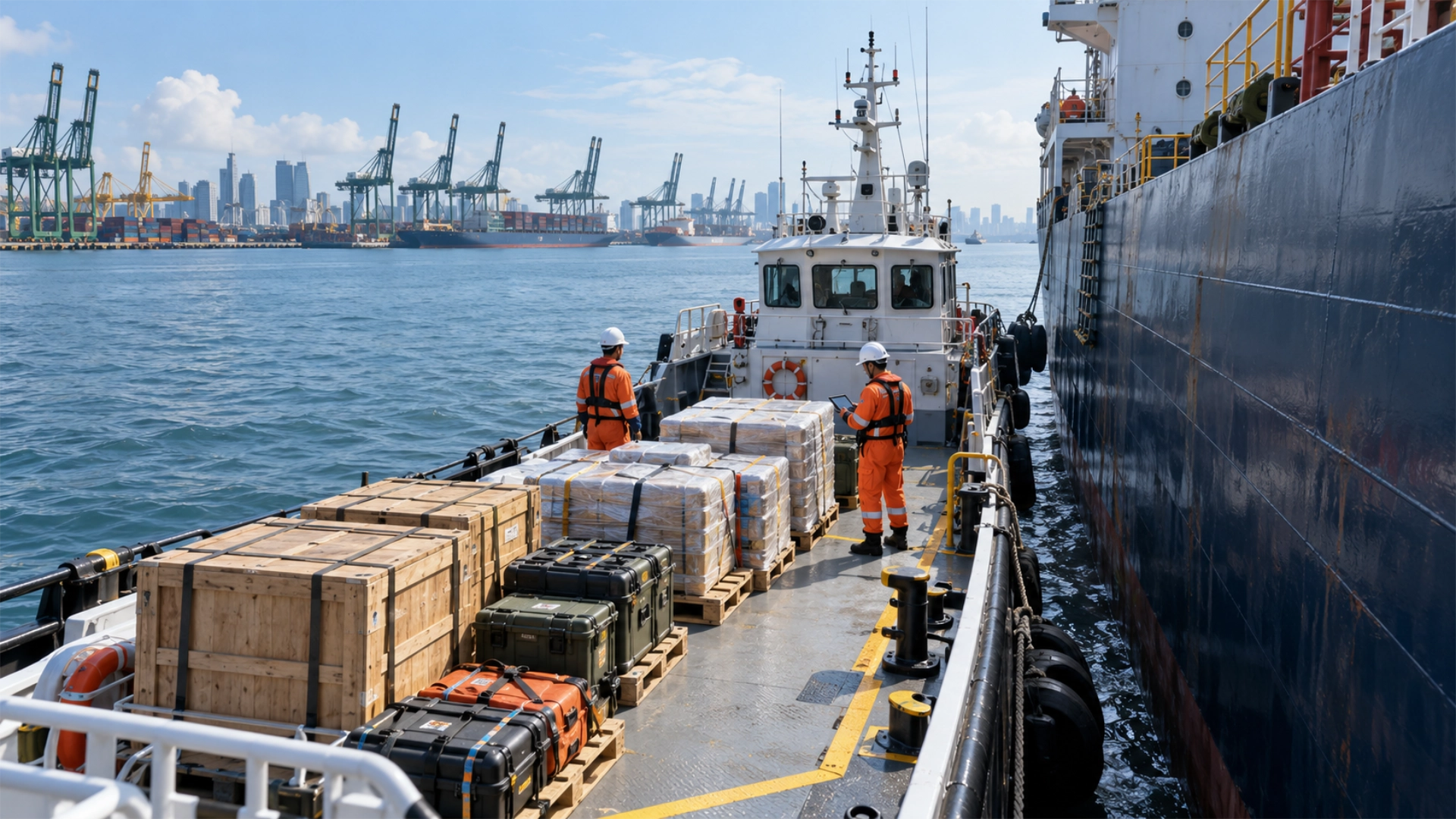
Ship chandling sits at the core of Edtech Marine’s offering for container vessels. The company sources and delivers a comprehensive range of provisions, deck stores, engine room consumables, and ship spares, covering everything a vessel crew requires during a Singapore port call. For container ships operating on tight rotational schedules, the ability to consolidate supply requirements under one vendor eliminates the coordination overhead of managing multiple suppliers simultaneously. Edtech Marine’s spares logistics function extends this further, handling the planning, sourcing, storage, and last-mile delivery of critical components that keep vessels compliant and seaworthy across global routes. In a port environment where Singapore recorded record throughput performance in 2025 and vessel traffic shows no sign of slowing, responsive and reliable chandling is not a convenience; it is an operational necessity.
Agency Services: Managing the Port Call from Arrival to Departure
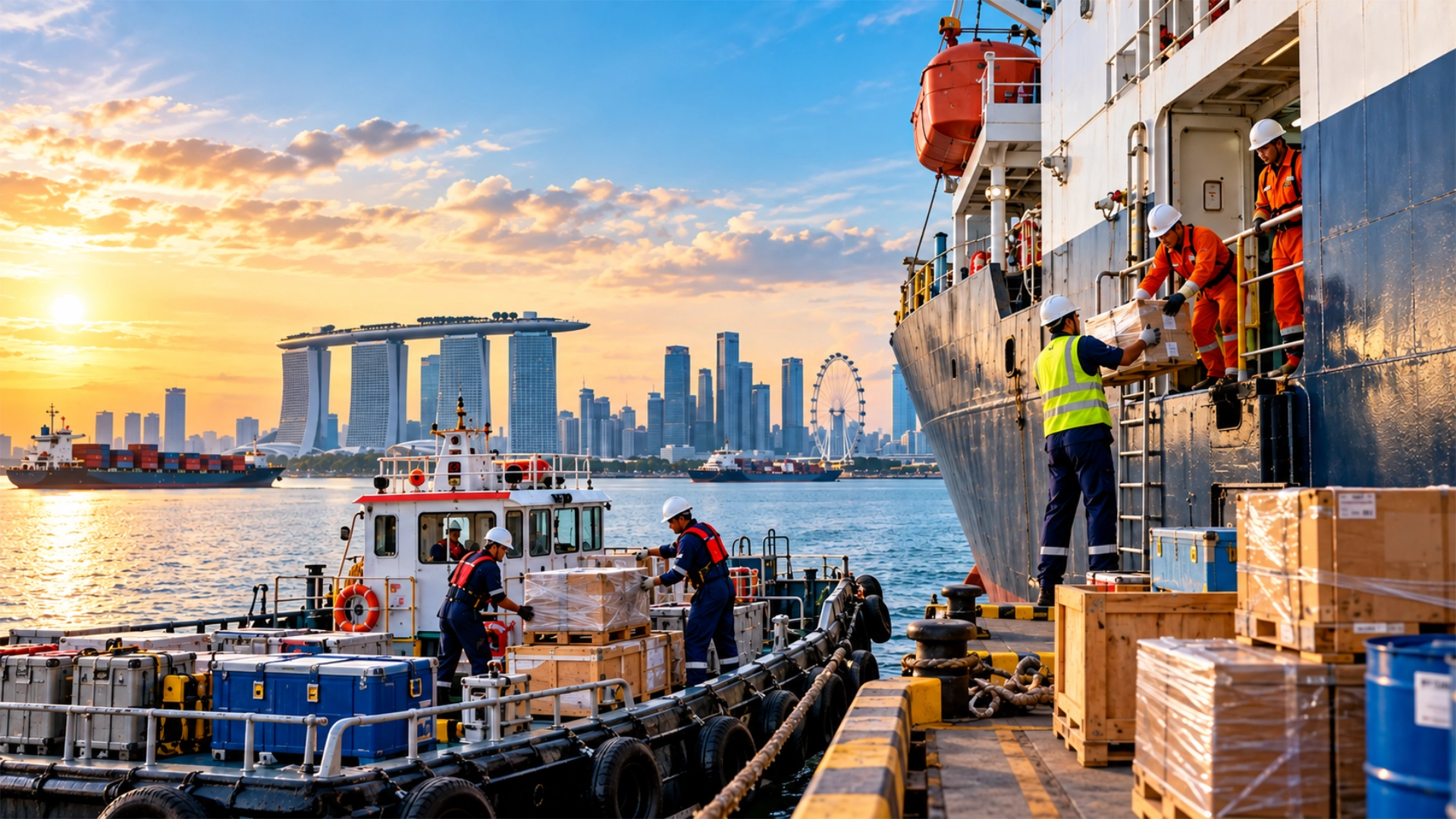
Edtech Marine’s agency services cover the complete lifecycle of a port call. From the moment a vessel enters Singapore waters, the team coordinates port formalities, documentation, and liaison with the Maritime and Port Authority of Singapore and terminal operators, reducing the administrative burden that falls on vessel operators during high-traffic periods. Crew changes, a logistically complex requirement for any container ship on an extended trade lane rotation, are managed as part of the same integrated service. The agency function also covers off-port-limits and in-port-limits launch services, cargo boat arrangements, and marine surveys including condition and bunker surveys. For operators managing vessels across multiple Asia-Pacific ports, Edtech Marine’s agency coverage extending to Malaysia and Australia provides meaningful continuity across rotations.
Marine and Fire Safety Equipment: PSC Compliance Support
Port State Control inspections in Singapore consistently identify deficiencies in fire-fighting and life-saving appliances as among the most cited categories. Edtech Marine addresses this compliance pressure directly through a dedicated marine and fire safety equipment supply service. The product range includes Self-Contained Breathing Apparatus (SCBA) and associated spare parts, immersion suits, mooring tails, and marine pyrotechnics, alongside lifejackets, lifebuoys, fireman suits, Emergency Escape Breathing Devices, and navigation lights. Container ship operators preparing for PSC inspections can source replacement or upgrade equipment through a single supplier familiar with the regulatory standards enforced at Singapore, reducing the risk of detentions or deficiency notices that carry schedule and commercial consequences.
Repair and Engineering Solutions
Unplanned maintenance during a port call can rapidly translate into off-hire costs and schedule disruption. Edtech Marine’s repair and engineering capability allows vessel operators to mobilise technical support during a Singapore call, addressing issues that might otherwise require a dedicated drydock or specialist engagement. The company’s registered business classifications include marine engine repair and ship repair, reflecting a scope that spans mechanical, structural, and engineering disciplines relevant to container vessel maintenance cycles.
A Trusted Partner Built on Experience
What distinguishes Edtech Marine within Singapore’s competitive marine services landscape is the depth of founder-level expertise embedded in its operations. The company was established by pioneers of Singapore’s maritime industry carrying over 40 years of combined experience, giving its teams a working knowledge of port dynamics, regulatory frameworks, and operational requirements that newer entrants cannot replicate. For international container ship operators seeking to consolidate port-call management, reduce vendor complexity, and work with a partner that genuinely understands the pressures of modern container shipping, Edtech Marine’s positioning as a single-point maritime service provider reflects both a commercial offer and an operational reality.
Conclusion: Navigating Container Shipping with the Right Partners
Singapore’s enduring position as the world’s premier container shipping hub, the 2026 market recovery, persistent geopolitical volatility, and mounting compliance obligations around safety and decarbonisation collectively define the operating environment every vessel operator must now navigate. These pressures do not ease at the berth; they intensify under the compressed turnaround windows that characterise Singapore port calls.
Container ship operators calling at Singapore require a dependable local marine agency capable of coordinating chandling, safety equipment certification and supply, port agency formalities, and repair or engineering requirements without delays that erode the schedule reliability the market has worked hard to rebuild.
For ship managers, the actionable priority is clear: initiate a pre-port-call checklist at least 72 hours before arrival. This checklist should confirm safety equipment certification status, provisioning and spare parts requirements, and agency briefing details to ensure zero procedural gaps on arrival.
Edtech Marine supports vessel operators and ship managers across all of these operational dimensions from its Singapore base. Contact Edtech Marine today to discuss your upcoming vessel call or to arrange a service consultation.