When a container ship misses its port window by just a few hours, the ripple effects can cost millions and disrupt cargo flows across multiple continents. In the world of maritime operations, precision is not optional. It is the foundation upon which entire trade networks are built.
Singapore, home to one of the busiest ports on the planet, has become a global benchmark for how ship operators master the complexities of supply chain management. From fuel procurement and crew logistics to cargo scheduling and vendor coordination, Singapore-based operators have developed systems and strategies that keep vessels moving efficiently even when global disruptions threaten to derail operations.
But what exactly sets these operators apart? And what can maritime professionals learn from their approach?
In this analysis, we break down the core supply chain management practices driving operational excellence among Singapore’s ship operators. You will gain insight into the frameworks they rely on, the technologies reshaping their workflows, and the lessons that apply whether you are managing a single vessel or an entire fleet. If you are ready to sharpen your understanding of maritime logistics, this is where to start.
What Supply Chain Management Actually Means for Maritime Operations
Supply chain management is formally defined as the end-to-end coordination of goods, services, information, and finances flowing from raw material suppliers through to the final customer. In a maritime context, this definition takes on a far more operationally demanding character. For vessel operators and ship managers, the supply chain encompasses every link connecting shore-based suppliers to a vessel at berth: procurement of provisions and spare parts, sourcing of certified marine safety equipment, movement of documentation and compliance records, and the financial settlements that keep each transaction traceable and auditable.
The practical implications become tangible when you map SCM principles onto ship chandling and safety equipment procurement specifically. Sourcing self-contained breathing apparatus (SCBAs), immersion suits, marine pyrotechnics, and mooring tails is not a simple purchasing exercise. Each product carries certification requirements under SOLAS and flag-state regulations, meaning the supply chain must simultaneously manage physical delivery, inspection records, batch traceability, and expiry documentation. A failure at any single link does not merely inconvenience operations; it can render a vessel non-compliant before departure.
This is precisely where maritime SCM diverges fundamentally from general logistics. A manufacturer awaiting a delayed component can reschedule production. A vessel cannot reschedule the tide. Port windows frequently span 12 to 48 hours, within which chandlery deliveries, safety equipment replenishment, and all supporting documentation must be completed and receipted. Zero tolerance for shortfalls is not a preference; it is a regulatory and safety reality enforced by Port State Control inspections.
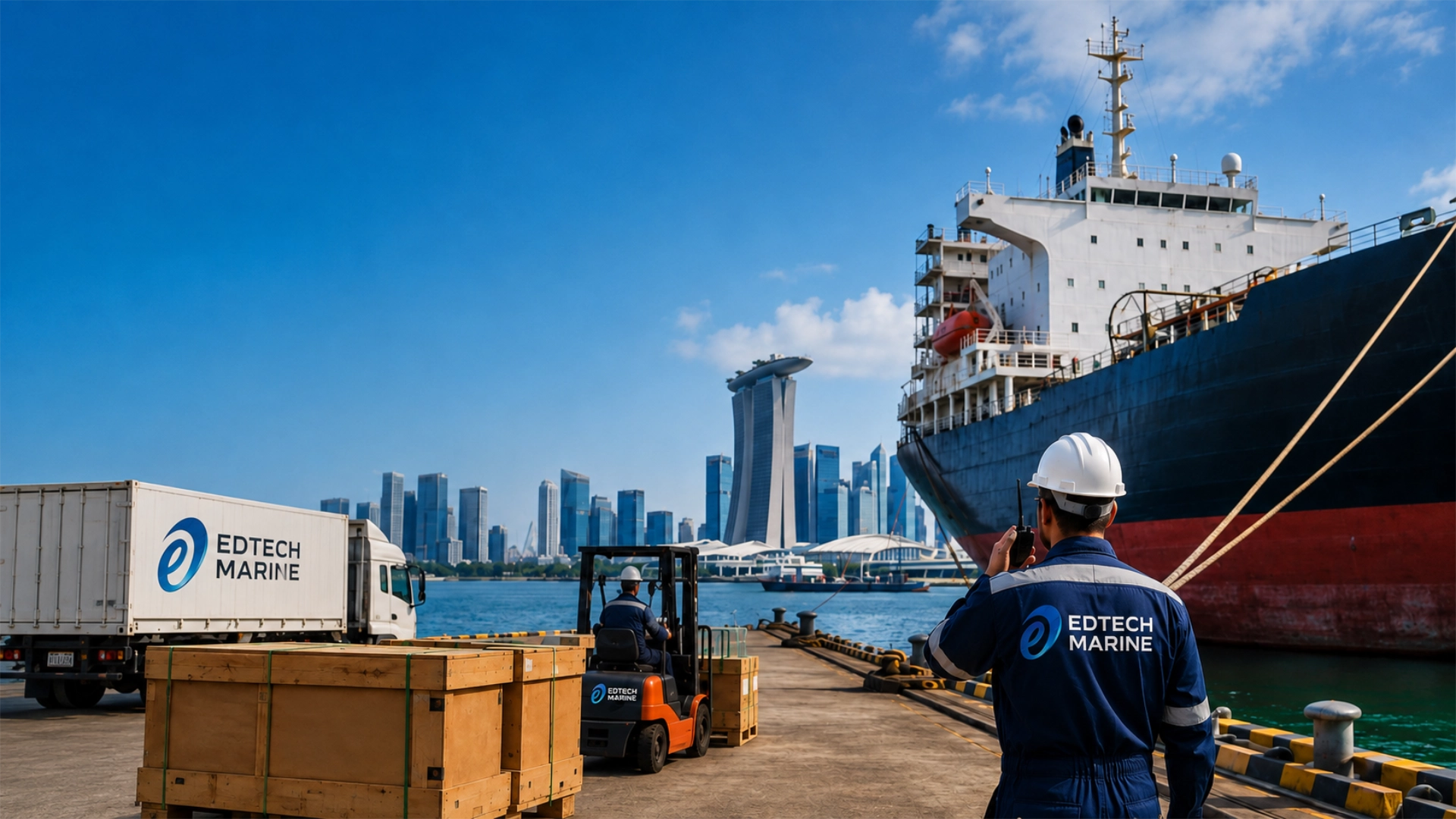
Operating from Singapore, ranked the world’s leading maritime centre, Edtech Marine functions as an integrated supply chain partner across the Asia-Pacific region, not simply a product vendor. Its combination of ship chandling, marine safety equipment supply, and logistics solutions reflects the full scope of maritime SCM in practice. Supply chain management, understood correctly, is the invisible infrastructure that determines whether every voyage departs on schedule, fully crewed, and completely safe.
Why SCM Has Become a Strategic Priority for Vessel Operators
The scale of what is unfolding in Singapore’s maritime sector makes supply chain management impossible to treat as secondary. The sector was valued at USD 4.978 billion in 2024 and is projected to reach USD 8.516 billion by 2035, growing at a CAGR of 5.0% over that period. In a market expanding at this pace, supply chain inefficiencies do not hold steady; they compound annually, eroding margins and widening the gap between operators who have their procurement infrastructure in order and those who do not. For vessel operators embedded in this ecosystem, tolerating gaps in supplier visibility or procurement reliability is no longer a manageable inconvenience. It is a strategic liability with measurable commercial consequences.
Singapore’s confirmed ranking as the world’s leading maritime centre in 2026 raises the baseline for what operational excellence actually looks like. Operators working within this ecosystem are benchmarked against the most sophisticated maritime players globally, and the competitive standards they face reflect that reality. Being headquartered or active in the world’s top maritime hub carries implicit performance expectations around turnaround times, compliance readiness, and supply continuity that operators in less prominent hubs simply do not face to the same degree.
Against this backdrop, five supply chain value drivers have become central to how ship managers assess and structure their operations. Cost control comes first, as strategic procurement alignment directly reduces expenditure across consumables, safety equipment, and logistics. Operational efficiency follows closely; companies that invest in supply chain digitisation report improvements of up to 30% in operational throughput, according to McKinsey’s 2025 Supply Chain Report. Supplier visibility enables ship managers to evaluate vendors on price, reliability, and service quality rather than defaulting to familiar but underperforming relationships. Disruption resilience is perhaps the most critical variable; supply chain disruptions cost businesses an average of 6 to 10% of annual revenues, according to the World Economic Forum, and in maritime operations that exposure is acute because a vessel only generates revenue when it is moving. Data-driven procurement decisions, supported by AI and predictive analytics, close the loop by enabling proactive rather than reactive purchasing.
The consequences of SCM failure are not abstract for vessel operators. A delayed critical spare can ground a vessel for days. A supplier relationship that collapses without a qualified alternative in place can force a departure without adequate safety equipment onboard, introducing serious liability exposure. Charter penalties for missed schedules compound the financial damage further.
Strategic supply chain management is fundamentally forward-thinking and proactive, in direct contrast to the reactive purchasing habits many operators still rely on. In a sector growing toward USD 8.5 billion, operators who treat SCM as a back-office administrative function leave cost savings, uptime improvements, and competitive positioning on the table. Those who invest in it as a strategic capability build the operational foundation that a high-performance maritime environment demands.
Why Maritime Supply Chains Are Uniquely Challenging
Maritime supply chains operate under a set of structural constraints that simply do not apply to land-based logistics. Understanding these constraints is not academic; it is a prerequisite for any vessel operator or ship manager responsible for keeping vessels compliant, operational, and on schedule.
The Last-Mile Problem Has No Parallel on Land
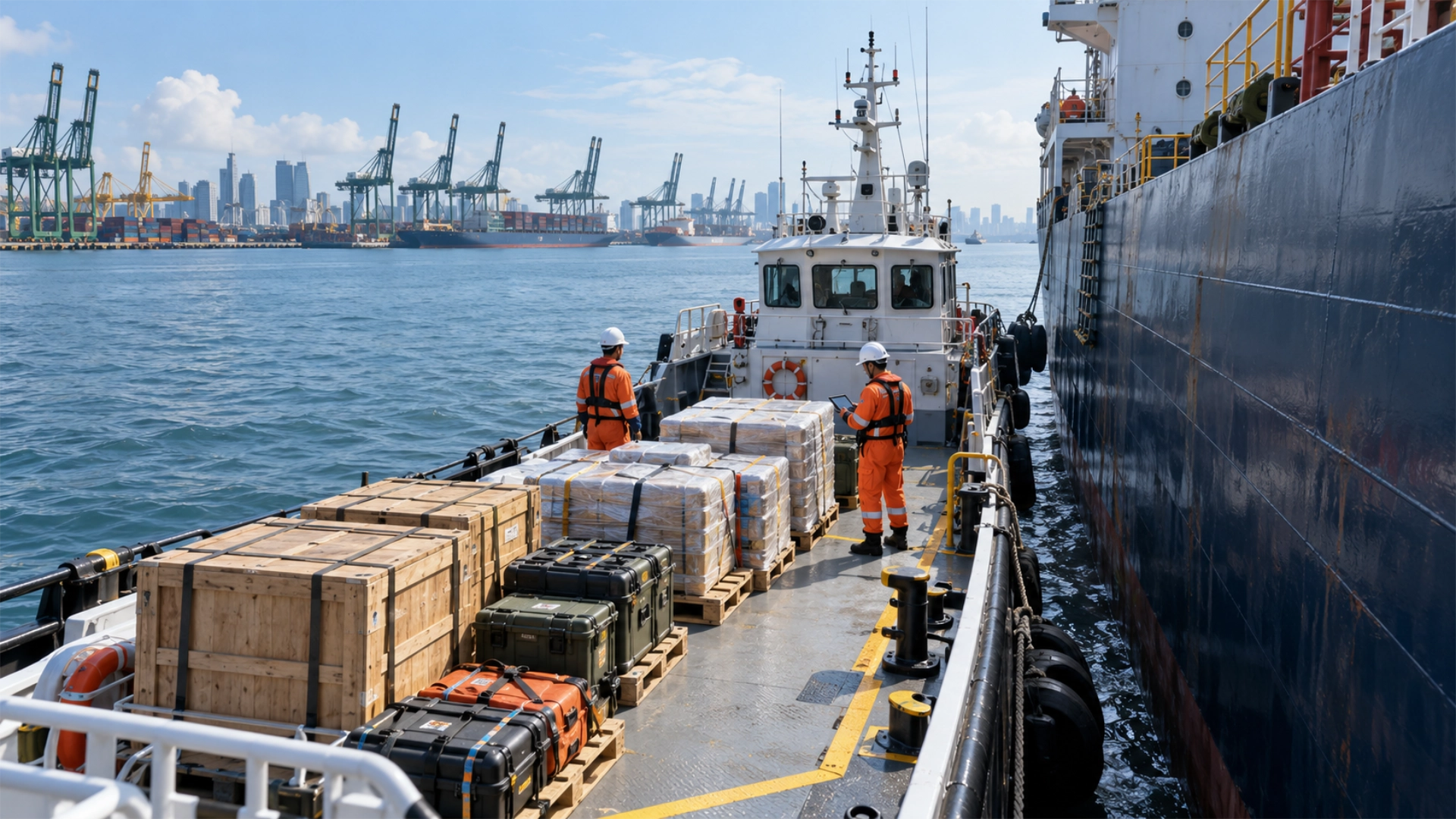
In conventional logistics, a missed delivery can be rescheduled. In maritime supply chain management, that option does not exist. Vessels operate within fixed port call windows, often measured in hours rather than days, and suppliers must synchronise deliveries against those windows with precision. As Nicom Maritime outlines in its analysis of port operations complexity, successful port supply requires simultaneous coordination across port agents, customs authorities, freight forwarders, and physical transfer logistics. Every element must align before departure. For vessels at anchor rather than berth, the challenge is compounded further; supplies require launch boat transfers coordinated with port authority approvals, adding both cost and failure points that have no equivalent in terrestrial logistics models.
Safety Equipment Operates on Hard Regulatory Deadlines
Unlike most commercial inventory, safety-critical equipment aboard commercial vessels carries mandatory certification and service intervals under SOLAS and flag state regulations. SCBAs, immersion suits, and marine pyrotechnics do not simply become less effective when overdue for inspection; they become non-compliant. A supply delay of even a few days can shift equipment status from compliant to deficient. There is no grace period built into these regulatory windows, and no administrative workaround available at the point of a Port State Control inspection. Vessel operators cannot afford to work with suppliers whose lead times are uncertain or whose stock availability depends on distant warehouse replenishment cycles.
Fragmentation Multiplies Documentation and Inspection Risk
Sourcing from multiple uncoordinated vendors is one of the most avoidable risk factors in maritime procurement, yet it remains common practice. When safety equipment, provisions, spare parts, and technical stores arrive under separate documentation trails from separate suppliers, the probability of conflicting delivery windows, missing certificates of conformity, or incorrect customs declarations increases with each additional vendor added to the chain. A single documentation gap is sufficient to hold an entire shipment in port customs, stalling delivery against a fixed schedule.
Geographic Complexity Demands In-Market Depth
Ships calling at Singapore require supplies that are physically available in-market, not merely orderable. Shipping industry analysts consistently identify regulatory compliance and supply chain coordination as compounding pressures on vessel operators, particularly where inventory is held regionally rather than locally. A supplier without bonded, in-market stock of certified safety equipment cannot reliably guarantee delivery within a port call window regardless of order lead time.
The consequences of failure in this environment extend well beyond financial loss. An expired immersion suit or an unserviced SCBA does not represent a procurement shortfall; it constitutes a potential flag state deficiency and grounds for vessel detention under Tokyo MOU or Paris MOU inspection regimes. Detention costs can run into tens of thousands of dollars per day in lost charter revenue, port dues, and crew costs, and safety equipment deficiencies attract heightened scrutiny in all subsequent inspections.
When Safety Equipment Supply Chains Fail: The Risks No Operator Can Afford
Not all supply chain failures carry equal consequences. A delayed shipment of engine spare parts creates operational disruption and financial cost. A delayed immersion suit replacement, an expired set of marine pyrotechnics, or an out-of-service SCBA on a vessel undergoing Port State Control inspection creates something categorically different: regulatory liability, potential crew fatality, and consequences no cost saving elsewhere in the procurement budget can absorb.
PSC detention is among the most immediate and damaging outcomes of safety equipment supply chain failure. Fire safety and life-saving appliance deficiencies consistently rank among the most cited deficiency categories in annual reports from the Paris MOU and Tokyo MOU inspection regimes. A single detention can expose ship managers to port costs and charter party penalties typically estimated between USD 10,000 and USD 50,000 or more per day, alongside reputational damage that affects future commercial relationships. Beyond the financial exposure, SOLAS Chapter III and Chapter II-2 establish mandatory carriage, servicing, and documentation requirements for life-saving appliances and fire protection equipment. Non-compliance does not merely trigger a deficiency citation; it can invalidate P&I cover and create direct personal liability for Masters and Designated Person Ashore.
The risks compound significantly when safety-critical items are sourced from multiple, uncoordinated suppliers with no single point of accountability. When SCBAs, immersion suits, fire extinguishers, and marine pyrotechnics are procured separately across different vendors, the result is fragmented documentation, mismatched certification records, and no unified oversight of replacement intervals. Research from supply chain risk management literature confirms that multi-tier supplier dependencies create compounding failure points. In a safety equipment context, those failure points have a direct regulatory dimension: a PSC inspector examining life-saving appliance records is not interested in which vendor caused the documentation gap. The ship manager owns the outcome entirely.
The mitigation logic is straightforward, though execution requires genuine commitment. A consolidated supply chain partner holding in-market stock reduces lead times against fixed regulatory replacement intervals, eliminates the documentation fragmentation that creates compliance exposure, and provides a single point of accountability across the full safety equipment inventory. This is not a theoretical efficiency gain; it is the structural difference between a vessel that passes PSC inspection and one that does not. The supply chain risks facing operators in 2026, including geopolitical disruption, tariff volatility, and unpredictable lead times, make the case for consolidation more urgent, not less.
This is precisely where Edtech Marine’s position in the safety-critical supply segment becomes operationally significant. Supplying SCBAs, immersion suits, fire safety equipment, and marine pyrotechnics from Singapore, backed by 40 years of maritime industry experience, Edtech Marine functions as a consolidated, compliance-aware partner rather than a transactional vendor. For vessel operators and ship managers who cannot afford the regulatory, legal, and human cost of supply chain failure in this category, that distinction is not marginal. It is fundamental.
Regulatory Compliance Is a Supply Chain Obligation, Not Just a Legal One
Regulatory obligations in maritime operations do not sit passively in a compliance folder. They generate active, time-bound procurement requirements that must be embedded into supply chain planning from the outset. Every vessel operating under SOLAS, MLC 2006, and IMO frameworks carries a non-negotiable procurement calendar, one shaped by inspection cycles, certification expiry dates, and mandatory replacement intervals. Treating these as legal formalities rather than supply chain triggers is a structural error that consistently surfaces during port state control inspections.
SOLAS Requirements and the Procurement Calendar They Create
SOLAS Chapter III governs life-saving appliances with specific servicing obligations that translate directly into recurring procurement events. Life rafts require annual servicing at approved service stations. Immersion suits must be inspected at defined intervals, with deteriorated units requiring replacement before the next survey window. Marine pyrotechnics, including line-throwing appliances and distress signals, carry a standard three-year replacement cycle, a hard deadline that cannot be deferred. SOLAS Chapter V extends these obligations into navigation safety systems, requiring that EPIRBs, SARTs, and other emergency signaling devices maintain current certification at all times. Fire safety equipment, including emergency escape breathing devices and fixed fire-fighting systems, is among the top categories cited in PSC detention records, making its procurement timeline a direct operational risk variable. The IMO’s Procedures for Port State Control, 2025, adopted in December 2025 under Resolution A.1206(34), reinforces how systematically inspectors assess these areas, with structured appendices covering life-saving appliance maintenance records, drill documentation, and deficiency close-out procedures.
MLC 2006 as a Procurement Standard, Not Just a Labor Standard
The Maritime Labour Convention 2006 introduces a procurement dimension that is often underestimated. Beyond its labor rights framework, MLC 2006 sets minimum standards for crew safety gear, provisions, accommodation quality, and welfare facilities, and critically, those standards must align with the requirements of each vessel’s flag state. This means procurement specifications are not uniform across a fleet operating under multiple flags. A supply order that satisfies the requirements of one flag state may fall short of another’s MLC implementation. PSC officers treat MLC compliance as an inspectable category alongside SOLAS and MARPOL, meaning procurement gaps in crew welfare provisions are directly actionable. As essential maritime law guidance confirms, regulatory complexity in the sector has accelerated since 2023, with labor, safety, and environmental standards tightening simultaneously. Procurement teams operating without flag-state-specific MLC awareness are working from an incomplete compliance picture.
Why Generic Distributors Cannot Carry This Responsibility
The case for a specialist supply chain partner is structural. A generic distributor can fulfill a product order. It cannot reliably advise on whether that product meets the certification standard required by a vessel’s flag state, confirm whether it satisfies the current MLC implementation of the relevant national authority, or align delivery timing with an approaching survey window. Non-compliance with PSC regulations can result in vessel detention, port entry bans, and more frequent inspections, with PSC results publicly accessible and visible to charterers and investors. Concentrated Inspection Campaigns, run annually by PSC regimes and targeting specific equipment categories, add further time-sensitivity. When a CIC focuses on life-saving appliances or fire safety, operators without pre-positioned, fully certified stock carry disproportionate detention risk.
Edtech Marine’s 40 years of maritime experience positions it as precisely the kind of compliance-aware procurement partner this environment demands. Its supply recommendations for safety equipment, from SCBAs and immersion suits to marine pyrotechnics and mooring tails, are informed by an institutional understanding of which SOLAS chapters govern which items, how MLC flag state requirements vary, and when certification renewals fall due. That depth of regulatory context converts procurement from a reactive, transactional function into a proactive compliance tool, one that keeps vessels inspection-ready rather than scrambling to close deficiencies under time pressure.
Digital Transformation and the Evolving Maritime Supply Chain
The maritime industry’s relationship with digital technology has moved well beyond pilot programmes and proof-of-concept experiments. In 2026, digital tools are actively embedded in cargo handling workflows, procurement processes, and fleet management systems across the Singapore maritime sector, producing measurable gains in efficiency and meaningful reductions in operational cost. Maritime industry analysts tracking 2026 trends consistently identify smart ships, predictive maintenance, and data-driven fleet management as the defining forces reshaping how vessel operators and ship managers conduct their supply chain operations. The transition is not gradual; it is structural, and operators who have not engaged with these tools are already working at a disadvantage relative to those who have.
Predictive Procurement as an Operational Shift
One of the most consequential developments in maritime supply chain management is the rise of predictive procurement, which uses voyage schedules, equipment service intervals, and historical port call data to anticipate supply requirements before gaps emerge. Rather than responding to shortfalls with emergency orders and premium freight arrangements, ship managers using data-driven systems can trigger procurement workflows automatically based on thresholds tied to real operational parameters. The practical impact is significant: emergency procurement carries cost premiums that compound across a fleet, and the administrative burden of expedited ordering diverts resources from higher-value management activity. When procurement is anchored in predictive logic, the supply chain shifts from reactive to deliberate, and the entire cost profile improves accordingly.
Singapore’s Infrastructure Advantage
Singapore’s position as the world’s leading maritime centre in 2026 is not incidental; it reflects sustained investment in port infrastructure and integrated digital platforms that create genuine advantages for technology-enabled supply chains. Platforms supporting order tracking, documentation management, and multi-supplier coordination allow operators based in or calling at Singapore to manage their supply relationships with a level of visibility that was operationally impractical just a few years ago. For vessel operators sourcing safety equipment, ship chandling supplies, or engineering solutions, this infrastructure compresses lead times and reduces coordination friction across the supplier network.
Cybersecurity as a Supply Chain Priority
As procurement systems digitise, the attack surface of maritime operations expands in ways that go well beyond IT infrastructure. Supply chain data, including supplier contracts, equipment specifications, inventory positions, and port call schedules, holds operational and commercial value that makes it a credible target. Ship managers must treat data integrity as an active supply chain consideration, building cybersecurity protocols into their procurement governance rather than treating them as a separate technology matter. Operators who build real-time visibility across their supplier network while maintaining robust data protection practices will be best positioned to reduce stock-out risk for critical equipment and improve the reliability of every port call.
Building a Resilient Maritime Supply Chain: Lessons from Recent Disruptions
Disruptions to maritime supply chains are no longer isolated incidents contained within a single trade lane or season. In 2026, vessel operators and ship managers are contending with a layered set of simultaneous risk categories: geopolitical route changes that force costly diversions away from established chokepoints, chronic port congestion that compounds delivery delays, weather events capable of shutting down entire regional logistics corridors, and supplier insolvency that can eliminate a critical procurement channel with little warning. Each of these risks operates independently, yet their effects frequently compound. A route diversion triggered by conflict in one region can land a vessel at an already-congested alternate port, arriving just as a key consumables supplier has suspended operations. The result is a critical gap in vessel supply schedules at precisely the moment operational pressure is highest.
Academic research has moved firmly beyond treating resilience as a contingency measure. Research published in MDPI’s sustainability and systems journals confirms that geopolitical risk travels through shipping supply chains via identifiable impact mechanisms, affecting the reliability of logistics nodes across entire networks. A dedicated study on logistical strategies for maritime supply chain disruptions concludes that adaptation is not a reactive response but a foundational requirement for maintaining resilient and sustainable global maritime economies. The research community and the operational practitioner community now share the same conclusion: resilience must be designed into supply chain architecture from the outset, not bolted on after a disruption has already occurred.
For vessel operators, translating this consensus into practice means making three structural commitments. First, maintaining approved supplier redundancy so that no single supplier failure creates an unresolvable gap. Second, holding buffer stock for high-criticality items, with life-saving appliances such as immersion suits, SCBAs, and marine pyrotechnics given absolute priority given their regulatory and safety implications. Third, establishing consolidated supply partnerships that reduce single-supplier dependency without fragmenting procurement across too many uncoordinated relationships. Each of these commitments requires deliberate planning and active supplier relationship management, not passive purchasing.
Singapore’s position as the world’s leading maritime centre in 2026 provides operators based in or serviced through the region with a structural advantage that is worth leveraging deliberately. The Singapore maritime ecosystem is characterised by a collaborative model in which stakeholders share resources, align on logistics infrastructure, and create synergies that compress lead times. For operators building resilient supply chains, this established regional network means that backup sourcing options are accessible, and disruption response times are meaningfully shorter than in less developed maritime hubs.
Practically, operators should begin by categorising their supply inventory across two dimensions: criticality and lead time sensitivity. Items that are both high-criticality and lead time-sensitive, particularly safety equipment governed by regulatory replacement schedules, require the most reliable supply channel and the strongest supplier relationship. General consumables with more flexible timescales can tolerate a slightly broader supplier base. Aligning procurement strategy to this matrix turns resilience from an aspiration into an operational reality.
How Singapore’s Strategic Position Powers Smarter Ship Supply Chains
Singapore’s position as the world’s leading maritime centre in 2026 is not a title earned by geography alone. It reflects decades of deliberate investment in port infrastructure, regulatory frameworks, and supplier ecosystems that collectively reduce friction at every stage of maritime commerce. More than 200 international shipping groups maintain offices in Singapore, the port connects to over 600 global ports, and in 2025 the Port of Singapore recorded a historic 44.66 million TEUs in container throughput while vessel arrival tonnage reached a record 3.22 billion Gross Tonnage. For vessel operators making supply chain decisions, these are not abstract statistics. They are indicators of a port environment where supply delivery windows are predictable, customs processes are mature, and operational continuity is the standard rather than the exception.
The geographic dimension matters equally. Singapore sits at the convergence of the Indian Ocean and the South China Sea, positioned directly along the Strait of Malacca, which carries an estimated one-third of global seaborne trade. Vessels transiting between Europe, the Middle East, and East Asia pass through or near this corridor as a matter of route geometry. For vessel operators, this means a Singapore-based supply partner can reach regional fleets with considerably shorter lead times than suppliers operating from secondary hubs that require additional deviation or repositioning. That lead time advantage carries direct operational value, particularly for safety-critical equipment where timing is non-negotiable.
Singapore’s broader maritime ecosystem compounds this advantage. The port offers a consolidated range of services including bunkering, pilotage, towage, crew changes, fresh water supply, and ship chandling, all accessible from a single regional base. The development of the Tuas Mega Port, which is integrating advanced automation and 5G infrastructure, signals that this operational depth will continue expanding rather than plateauing. For ship managers seeking to consolidate their supply chains, Singapore represents a hub where integrated solutions are increasingly the norm rather than a premium offering.
Edtech Marine is positioned directly within this ecosystem. Established in Singapore in 2015 and backed by 40 years of maritime experience, the company serves vessel operators calling at Singapore and across the Asia-Pacific region with ship chandling, safety equipment supply, agency services, and logistics solutions. Operating from within the world’s leading maritime centre means Edtech Marine can respond to operator requirements with the infrastructure advantages of the port behind every delivery commitment.
Edtech Marine as a Maritime Supply Chain Partner
Edtech Marine’s service portfolio looks, on the surface, like a list of discrete offerings: ship chandling, agency services, product distribution, repair and engineering solutions, and safety equipment supply. Evaluated through a supply chain lens, however, these capabilities form something considerably more significant. Together, they represent an integrated maritime supply chain capability, one that addresses sourcing, delivery, compliance fulfillment, and asset maintenance within a single commercial relationship. This distinction matters practically. Vessel operators who treat each service category as a separate procurement decision fragment their supply chain unnecessarily, multiplying coordination touchpoints, documentation obligations, and delivery dependencies across vendors who share no accountability for each other’s performance.
The consolidation advantage Edtech Marine offers is not simply a matter of administrative convenience. When chandling, safety equipment procurement, and logistics support are managed through a single partner, operators eliminate the coordination overhead that accumulates when multiple uncoordinated vendors are involved. Each additional vendor introduces its own lead times, invoicing processes, communication channels, and failure modes. A port call window in Singapore, where turnaround efficiency is a commercial priority at one of the world’s busiest maritime hubs, leaves limited tolerance for delivery coordination that depends on multiple parties arriving at alignment independently. A single supply partner with confirmed range depth removes that coordination risk structurally.
The depth of Edtech Marine’s safety equipment range is directly relevant to this consolidation argument. SCBAs and their spare parts, immersion suits, marine pyrotechnics, fireman suits, Emergency Escape Breathing Devices, lifebuoys, lifejackets, lifeboat and liferaft accessories, mooring tails, and navigation lights collectively constitute a broad compliance-critical procurement list. SOLAS requirements and flag state obligations generate recurring, time-bound demand across precisely these categories. Sourcing this entire compliance list through a single supply relationship reduces the probability of critical gaps appearing between vendors and ensures that no individual item falls through the coordination cracks during a time-pressured port call.
Repair and engineering solutions extend Edtech Marine’s role further still. A supply chain partner that can deliver safety equipment and then inspect, service, and maintain that same equipment within the same relationship removes the handoff risk between procurement and maintenance functions that operators typically manage separately. This is a meaningful operational advantage: continuity of knowledge about installed equipment, service history, and compliance intervals resides within one accountable relationship rather than being divided between a supplier and a separate service contractor.
For ship managers conducting a structured evaluation of supply chain partners, three questions consistently determine fit: Does the supplier understand your regulatory obligations? Can they deliver reliably within your port call window? Do they carry sufficient range depth to reduce your vendor count? Edtech Marine’s documented capabilities, grounded in over 40 years of accumulated maritime experience and active operations across Singapore, Malaysia, and Australia, position it to address all three with specificity rather than generality.
Sustainability and the Future of Maritime SCM Practices
Sustainability has moved from a peripheral consideration to a central organising principle in maritime supply chain management, and the shift is accelerating across Singapore’s sector in 2026. Environmental responsibility now directly influences procurement decisions, supplier selection frameworks, and day-to-day operational planning for vessel operators. The Maritime and Port Authority of Singapore’s published Decarbonisation Blueprint and Green Initiative reflect institutional commitment at the highest level, while regulatory mechanisms including the IMO’s net-zero target around 2050, the Carbon Intensity Indicator, and the EU Emissions Trading System extension to maritime transport are creating binding obligations that trace directly into supply chain behaviour.
Pressure on ship operators is arriving from multiple directions simultaneously. Financiers operating under the Poseidon Principles assess whether vessel portfolios align with IMO climate targets as part of lending decisions, meaning ESG performance has genuine financial consequences. Charterers and large cargo owners are embedding sustainability criteria into supplier and charter selection, so operators who cannot demonstrate greener supply chain practices face commercial disadvantage, not merely reputational risk. For ship supply specifically, this translates into scrutiny of sourcing practices, packaging waste generated by deliveries, and the emissions profile of last-mile logistics to vessels.
Circular economy principles represent one of the more complex shifts entering maritime supply chains right now. The responsible disposal and recycling of expired safety equipment, including pyrotechnics and immersion suits, is transitioning from a logistics footnote into a compliance and reputational consideration. These products contain hazardous or environmentally sensitive materials, and their end-of-life management falls within the broader regulatory and ESG frameworks that ship managers are increasingly required to document and disclose. Suppliers who can provide compliant disposal guidance alongside product delivery, and who maintain traceable sourcing records for safety equipment, are better positioned to meet the expectations of ship managers operating under ESG scrutiny from financiers and charterers alike.
The collaborative maritime ecosystems developing across Asia-Pacific also carry a sustainability advantage that is frequently underappreciated. Consolidated supply runs, where multiple vessel requirements are fulfilled through shared logistics infrastructure rather than fragmented single-order deliveries, meaningfully reduce the carbon footprint associated with ship supply operations. In a sector where Scope 3 emissions across the value chain are receiving increasing attention, the operational model of a supplier matters as much as the products it provides.
Conclusion: Making Supply Chain Management a Competitive Advantage at Sea
Maritime supply chain management is not a back-office function. Across every section of this analysis, a consistent argument has emerged: SCM is the operational infrastructure that determines vessel safety, regulatory compliance, and commercial performance. In a sector projected to reach USD 8.516 billion by 2035, the operators who treat supply chain strategy as a competitive discipline will consistently outperform those who treat it as reactive procurement.
Three actionable priorities stand out. First, audit your current supplier relationships for consolidation opportunities; fragmented sourcing creates hidden cost and compliance risk. Second, map your compliance-driven procurement calendar against your actual supply chain lead times, identifying gaps before they become violations. Third, confirm that your highest-criticality items, including immersion suits, SCBAs, and marine pyrotechnics, have reliable, in-market sourcing behind them.
A trusted partner with maritime-specific expertise, regional reach, and genuine range depth across safety equipment, chandling, and logistics removes the coordination burden that undermines operational focus.
Vessel operators and ship managers are invited to engage with Edtech Marine, not to place an order, but to assess their maritime supply chain structure and identify where resilience, compliance, and efficiency can be strengthened.