
Introduction
Choosing a maritime logistics company Singapore vessel operators can depend on requires more than finding a company that can transport goods from one location to another.
Maritime logistics is closely connected to vessel schedules, port procedures, ship spares, supplies, technical attendance and the limited time available during a port call.
For shipowners, vessel managers, superintendents and procurement teams, this distinction matters.
Singapore handled a record 44.66 million TEUs of container throughput and 3.22 billion gross tonnage of vessel arrivals in 2025. Marine fuel sales also reached a record 56.77 million tonnes.
The scale of these operations means vessels calling Singapore have access to an extensive maritime ecosystem. It also means that poor coordination can quickly become costly.
A spare part arriving after a vessel has sailed, an engineer missing the boarding window or incomplete documentation delaying an operation can disrupt an otherwise carefully planned port call.
Singapore also retained its position as the world’s leading maritime centre for the 13th consecutive year in 2026. The country is connected to more than 600 ports worldwide and is home to over 200 international shipping groups.
Read MPA’s latest overview of Singapore’s maritime sector
So how should vessel operators choose the right maritime logistics partner in Singapore?
Here are seven factors worth considering.
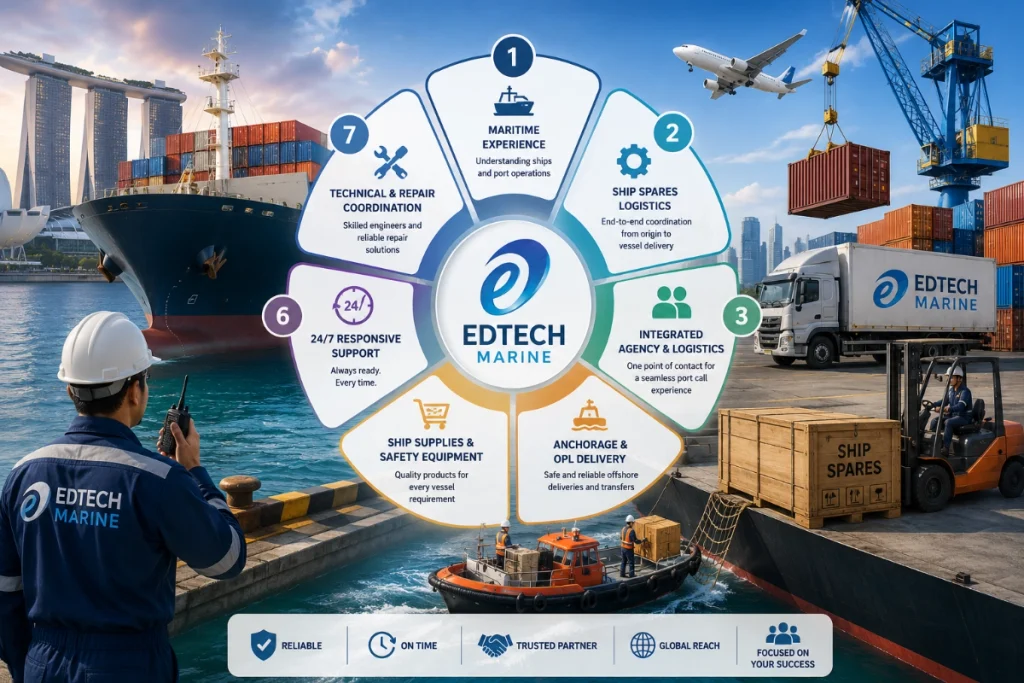
1. Look for genuine maritime experience
The first question to ask is straightforward:
Does the logistics provider understand ships and port operations?
General freight companies may be highly capable at moving cargo by road, air or sea. Supporting an operating vessel, however, introduces a different set of challenges.
A maritime logistics provider may need to coordinate around:
- vessel ETA and ETD
- berth or anchorage location
- port clearance requirements
- ship spares in transit
- customs documentation
- service engineers
- launch or supply boats
- crew movements
- provisions and ship stores
- technical repairs
- urgent onboard requirements
These activities often need to come together within a narrow service window.
A provider should therefore understand the operational environment surrounding the vessel rather than treating the vessel as simply another delivery address.
Local experience is particularly important in Singapore because arriving vessels must comply with applicable notification, declaration and port-clearance procedures.
MPA states that an owner, agent or master must make the required arrival declaration through digitalPORT@SG within the applicable timeframe. Information includes vessel particulars, purpose of call, arrival details and other operational information.
View MPA’s official vessel arrival procedures
This is also where working with a marine logistics provider that has strong agency capabilities can become valuable.
Edtech Marine’s Ship Agency Singapore operations cover port clearance, customs and immigration coordination, crew changes, husbandry, ship spares, stores, service engineers and logistics support.
Explore Edtech Marine’s Ship Agency Singapore services
When assessing a logistics company, ask how regularly it works directly with vessels and whether it understands the practical requirements associated with a Singapore port call.
Maritime experience is often more valuable than a broad claim of logistics expertise.
2. Check its ship spares logistics capabilities
Ship spares provide one of the clearest examples of why maritime logistics differs from ordinary freight movement.
A replacement component can travel thousands of kilometres successfully and still fail its purpose if it reaches Singapore after the vessel has departed.
Effective ship spares logistics requires coordination across the entire journey.
This can involve:
- vendor collection
- international freight
- import documentation
- customs clearance
- warehouse receipt
- checking and consolidation
- local transportation
- berth delivery
- launch or cargo boat coordination
- anchorage or OPL delivery
- confirmation with the vessel
The final few kilometres can be just as important as the international journey.
The logistics provider should know where the spare is coming from, when it will arrive, where the vessel will be and how the final delivery will reach the vessel before sailing.
Edtech Marine’s logistics operations include air and sea freight, customs clearance, warehousing and distribution, as well as door-to-vessel handling for ship spares and stores at berth, anchorage, OPL and shipyard locations.
For a deeper explanation of the challenges involved, Edtech Marine has a dedicated guide covering Ship Spares Logistics.
Read Edtech Marine’s Ship Spares Logistics guide
When evaluating a provider, ask what happens after the spare arrives in Singapore.
Who receives it?
Where is it stored?
Who checks it?
How will it reach the vessel?
Who confirms delivery?
These questions help distinguish a freight provider from a maritime logistics partner.
3. Consider whether ship agency and logistics are integrated
A shipment rarely arrives in isolation.
During the same Singapore port call, a vessel may also require:
- port clearance
- crew changes
- freshwater
- provisions
- bunkers
- spare parts
- technicians
- surveyors
- repairs
- safety equipment
- waste disposal
- launch boat services
Using separate companies for every requirement increases the number of parties that vessel managers and superintendents need to coordinate.
It also increases the number of handovers.
An integrated ship agency and logistics operation can simplify this process by giving the vessel operator a central point of coordination.
For example, a local agency team that already understands the vessel’s ETA, location and planned activities may be better positioned to coordinate the timing of a spare-parts delivery or technician attendance.
Edtech Marine’s agency offering combines vessel port-call services, husbandry, crew change, logistics and technical support. Its logistics team operates around the clock to support Ship Spares in Transit and other vessel requirements.
View Edtech Marine’s integrated agency and logistics services
This integration can be particularly useful when vessel schedules change.
A vessel arriving several hours earlier or later than planned can affect transport, technicians, crew movements, deliveries and launch boat arrangements.
The ability to coordinate those changes through one maritime-focused team can reduce unnecessary communication and operational confusion.
4. Check whether anchorage and OPL deliveries can be handled
Not every vessel requirement is completed alongside a berth.
Some vessels require stores, spares, personnel or other items to be transferred while at anchorage or offshore.
This means a maritime logistics company should understand the difference between delivering goods to a terminal and arranging the final transfer to a vessel.
Depending on the circumstances, offshore support can include:
- ship spares delivery
- stores and provisions
- document delivery
- crew transfers
- superintendent transfers
- service engineer transfers
- technicians
- freshwater
- urgent vessel requirements
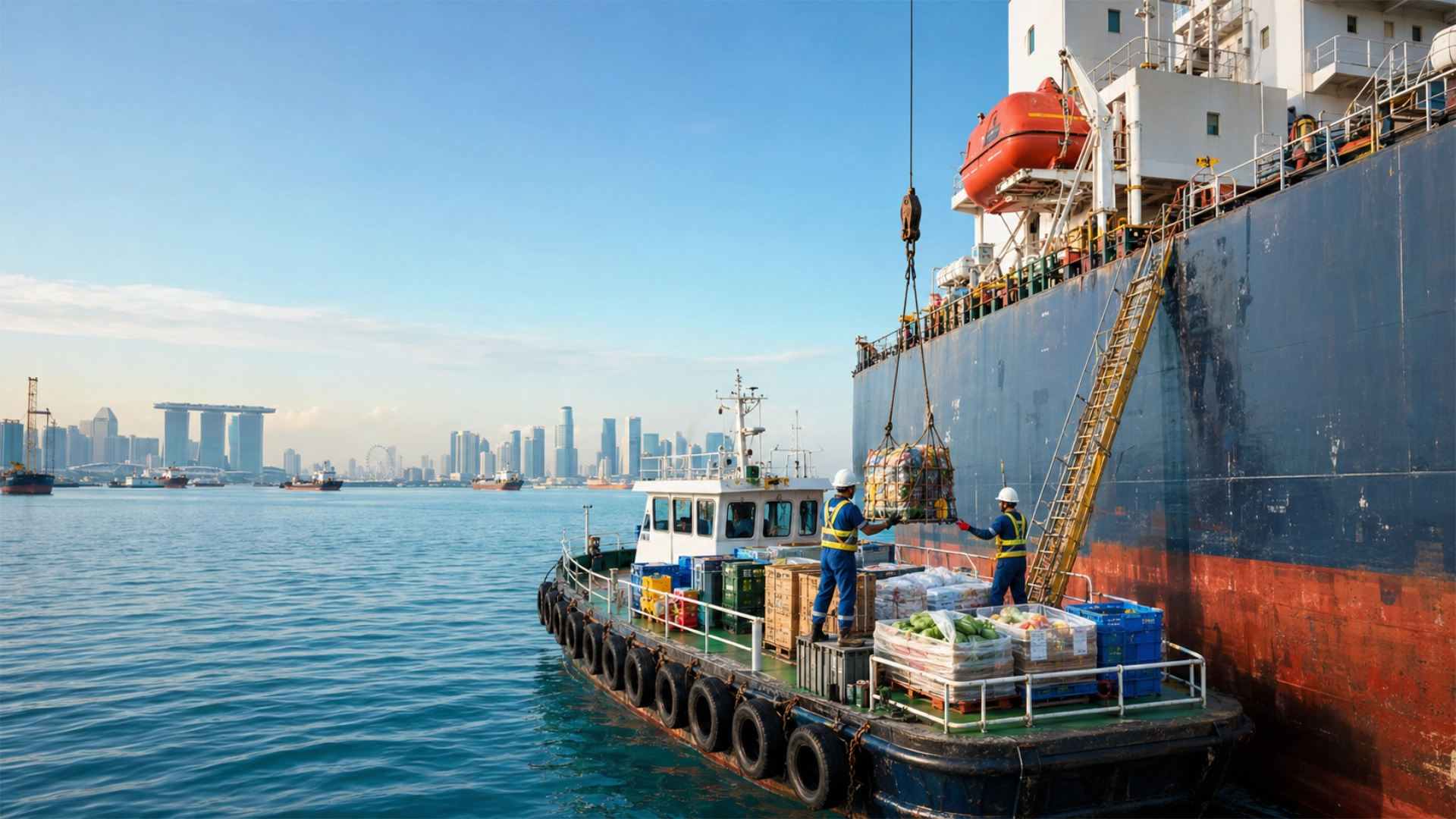
Edtech Marine provides OPL and cargo boat operations in Singapore, including ship spares and stores delivery, provisioning, personnel transfers, crew changes and warehousing or staging of spares before offshore delivery. Its offshore operations are coordinated through a 24/7 agency team.
Explore OPL and Cargo Boat Operations in Singapore
For vessel managers, this is an important capability to check before appointing a logistics partner.
Ask whether the provider can deliver to:
- berth
- anchorage
- OPL
- shipyard
Also establish whether the same provider can arrange the required marine transport.
This becomes especially important for urgent spares or technical personnel when vessel schedules leave little room for delay.
5. Assess its ship supply and safety equipment capabilities
Logistics and vessel supply are closely connected.
A vessel that initially requires one spare part may subsequently need additional deck stores, safety equipment, consumables or provisions before departure.
Working with a provider that also understands ship supply can reduce the number of separate vendors involved in the port call.
Typical vessel requirements can include:
- deck and engine stores
- maintenance tools
- safety equipment
- navigation equipment
- PPE
- lifejackets
- lifebuoys
- immersion suits
- Self-Contained Breathing Apparatus
- fire-fighting products
- marine pyrotechnics
- provisions
- general consumables
Edtech Marine’s Ship Supplies division provides marine products covering areas including safety equipment, maintenance equipment, navigation systems and vessel provisions.
Explore Edtech Marine’s Ship Supplies
Safety-related equipment requires particular care.
The International Maritime Organization describes the International Convention for the Safety of Life at Sea (SOLAS) as one of the most important international treaties concerning the safety of merchant ships.
SOLAS establishes minimum standards for the construction, equipment and operation of ships consistent with their safety.
Read the IMO’s official SOLAS overview
A logistics provider does not determine the vessel’s regulatory or class requirements. Those responsibilities remain with the relevant vessel interests and authorities.
However, a marine supplier familiar with vessel equipment and maritime requirements can make sourcing, documentation and delivery considerably easier.
When comparing providers, consider whether the company can support both the movement of goods and the practical sourcing of marine equipment.
6. Prioritise responsiveness and 24/7 coordination
Maritime logistics cannot always operate within ordinary office hours.
Ships move continuously.
ETAs change.
Flights are delayed.
Technicians become unavailable.
Berthing arrangements change.
Urgent repairs arise.
A spare expected in the morning may arrive late in the evening.
Responsiveness should therefore be treated as a core operational capability rather than simply a customer-service benefit.
Before selecting a maritime logistics company in Singapore, ask:
- Is operational support available 24/7?
- Who will be responsible for my vessel?
- How are ETA changes handled?
- How will urgent requirements be communicated?
- Can the team coordinate directly with suppliers and technicians?
- Can launch or supply boats be arranged?
- Will we receive status updates without repeatedly requesting them?
Edtech Marine states that its marine agency and logistics team operates 24/7, maintaining direct communication throughout the vessel’s port stay and coordinating Ship Spares in Transit and other logistics requirements.
Another useful consideration is vessel turnaround time.
Poorly coordinated documentation, crew movements, spares, stores and technical services can all contribute to avoidable delays.
Edtech Marine has also published a guide covering practical ways to reduce vessel turnaround time in Singapore Port, including ship spares coordination, crew changes, OPL services and pre-arrival planning.
Read 7 Powerful Ways to Reduce Vessel Turnaround Time in Singapore Port
The purpose of a good logistics partner should be to make vessel support easier to manage, not add another layer of coordination.
7. Look for technical and repair coordination capabilities
Not every port call goes exactly according to plan.
A vessel may arrive with:
- machinery problems
- equipment defects
- damaged components
- fabrication requirements
- underwater inspection needs
- tank-cleaning requirements
- safety equipment issues
- urgent technical work
A spare may need to be sourced and delivered, but an engineer may also need to board the vessel to inspect or install it.
This is where logistics and technical support begin to overlap.
A logistics provider that also has access to marine engineering and repair capabilities can potentially coordinate more of the requirement through a single operational channel.
Edtech Marine’s Repairs & Engineering division provides marine engineering support ranging from routine maintenance to urgent repair work.
Explore Edtech Marine’s Repairs & Engineering services
Its ship agency operations also include coordination of service engineers, technicians and surveyors for vessel boarding.
For superintendents, this combination can be particularly useful when dealing with an unexpected technical issue during a short Singapore call.
Instead of independently coordinating the logistics provider, agent, technician and repair contractor, more of the work may be managed through one maritime-focused point of contact.
Do not overlook ship husbandry requirements
Logistics is often only one component of the vessel’s overall husbandry requirements.
A vessel calling Singapore may simultaneously need:
- crew support
- hotel arrangements
- local transportation
- provisions
- freshwater
- spares
- documents
- technicians
- stores
- launch boats
Planning these requirements separately can create unnecessary complexity.
Where possible, ship managers should identify the complete list of requirements before arrival and determine which activities can be consolidated.
Edtech Marine’s guide to ship husbandry services in Singapore covers areas including vessel supplies, ship spares, launch boat arrangements, personnel transfers and shore-side transportation.
Read Edtech Marine’s guide to Ship Husbandry Services in Singapore
Early planning gives both the vessel and the local service provider more time to coordinate suppliers, transport, documentation and offshore arrangements.
Why specialist maritime logistics matters in Singapore
Singapore’s role in global shipping makes it one of the world’s most important locations for maritime support services.
In 2025, the Port of Singapore recorded:
- 44.66 million TEUs in container throughput
- 3.22 billion GT in vessel arrivals
- 56.77 million tonnes of marine fuel sales
View MPA’s official 2025 port performance report
Singapore is also connected to more than 600 ports worldwide and hosts more than 200 international shipping groups.
This ecosystem provides shipowners and managers with access to a broad range of specialist marine services.
However, it also illustrates why there is an important distinction between general logistics and maritime logistics.
A specialist maritime provider needs to understand how the shipment connects with:
the vessel + the port call + the operational window.
This can mean arranging for a spare to meet the vessel, coordinating a cargo boat, receiving items at a warehouse, sourcing marine equipment, arranging technical attendance or managing several requirements through the same agency team.
Edtech Marine brings together agency, logistics, product supply and repair or engineering capabilities through its wider maritime service offering.
Explore Edtech Marine’s full range of maritime services
Questions to ask a maritime logistics company in Singapore
Before appointing a provider, ask these questions.
1. How much of your work involves vessels?
A company with regular maritime experience should understand the operational differences between delivering to a warehouse and delivering to a ship.
2. Can you manage Ship Spares in Transit?
Ask whether the provider can handle freight, customs clearance, warehousing, consolidation and final door-to-vessel delivery.
3. Where can you deliver?
Confirm whether delivery can be made to berth, anchorage, OPL and shipyard locations.
4. Can you arrange launch or cargo boats?
This is particularly important for offshore deliveries and personnel transfers.
5. Do you provide ship agency services?
Integrated agency and logistics support can reduce the number of parties involved in the port call.
6. Can you coordinate engineers and technicians?
Technical attendance may need to be synchronised with both the spare-parts delivery and the vessel’s schedule.
7. Do you supply marine stores and safety equipment?
A broader marine supply capability can reduce the need to source items from multiple vendors.
8. Is your operational team available around the clock?
Ships do not operate according to normal office hours.
9. How will we receive status updates?
There should be a clear process for communicating shipment status, delivery arrangements and unexpected changes.
10. What documentation will we receive?
Depending on the requirement, this may include delivery notes, invoices, certificates, service reports and other operational documentation.
The answers will help determine whether the company simply transports freight or genuinely understands vessel support.
Choosing a maritime logistics company Singapore vessel operators can rely on
Choosing the right maritime logistics company Singapore shipowners and managers work with should ultimately come down to operational capability.
Do not assess the provider on transportation alone.
Consider whether it understands:
- Singapore port operations
- vessel schedules
- Ship Spares in Transit
- customs and documentation
- warehousing
- berth and anchorage delivery
- OPL operations
- launch and cargo boats
- ship supplies
- marine safety products
- technicians and service engineers
- repair requirements
- ship agency coordination
The strongest maritime logistics partner should reduce the amount of coordination required from the shipowner, vessel manager or superintendent.
Edtech Marine was established in Singapore in 2015 by maritime industry professionals with decades of industry experience. Its operations today combine ship agency, 24/7 marine logistics, ship supplies, offshore support and repairs and engineering.
For vessels calling Singapore, this provides an opportunity to coordinate multiple operational requirements through one local maritime team.
Whether the requirement involves Ship Spares in Transit, customs clearance, warehousing, a cargo boat, marine supplies, technician attendance or broader agency support, planning before the vessel arrives gives the operation the best chance of being completed within the available port-call window.
Frequently asked questions
What does a maritime logistics company do?
A maritime logistics company coordinates the movement, storage and delivery of goods associated with ships and marine operations. Depending on its capabilities, this may include freight, customs clearance, warehousing, Ship Spares in Transit, stores, door-to-vessel delivery, offshore transfers and coordination with local ship agents.
Why is maritime logistics different from general logistics?
General logistics often moves cargo between fixed locations. Maritime logistics must frequently deliver to a moving asset within a limited operational window. Vessel ETAs, port procedures, berth locations, anchorage arrangements and departure schedules can all affect the delivery.
What are Ship Spares in Transit?
Ship Spares in Transit are spare parts or equipment being transported for eventual delivery to a vessel. They may require international freight, customs clearance, temporary warehousing and final delivery to a vessel at berth, anchorage, OPL or a shipyard.
Can ship spares be delivered to vessels at anchorage?
Yes, depending on the circumstances and applicable arrangements. The logistics provider may coordinate the final offshore delivery using an appropriate launch, supply or cargo boat.
Edtech Marine’s offshore operations include ship spares and stores deliveries at anchorage and OPL.
Learn more about Edtech Marine’s offshore vessel support
Why use a local maritime logistics company in Singapore?
A local maritime logistics company can provide knowledge of Singapore port operations, customs procedures, transport arrangements, marine suppliers and offshore delivery options.
This becomes particularly important when a vessel has limited time in port or multiple services need to be coordinated.
Can one company manage both ship agency and logistics?
Yes. Some maritime companies integrate the two functions.
Edtech Marine’s Singapore agency operation provides port agency, husbandry, crew change and logistics services, including customs clearance, warehousing and door-to-vessel delivery.
Explore Edtech Marine’s Ship Agency Singapore services
What information should I provide when requesting a quotation?
Provide as much operational information as possible, including:
- vessel name
- IMO number
- ETA and ETD
- expected berth or location
- description of goods
- quantity
- dimensions
- weight
- shipment origin
- supplier details
- expected arrival time
- required delivery time
- whether offshore delivery is required
- any technical or personnel requirements
Accurate information allows the logistics provider to plan the operation more effectively.
Need maritime logistics support in Singapore?
If your vessel is calling Singapore and requires ship spares logistics, agency support, warehousing, customs clearance, ship supplies, offshore delivery or technical coordination, Edtech Marine can support the requirements throughout the port call.
Early coordination is particularly important for urgent spares and offshore deliveries.









1 thought on “7 Things to Look for in a Maritime Logistics Company in Singapore”
Pingback: What to Look for in a Transport Company: A Guide for Australian Businesses – Exltrans : Fast & Efficient Delivery