Introduction
A technical defect discovered shortly before a vessel reaches Singapore can place immediate pressure on the vessel manager, superintendent and shipboard team.
The repair itself may appear straightforward. However, arranging suitable technicians, replacement parts, tools, transport, approvals and testing within a short port-call window requires careful planning.
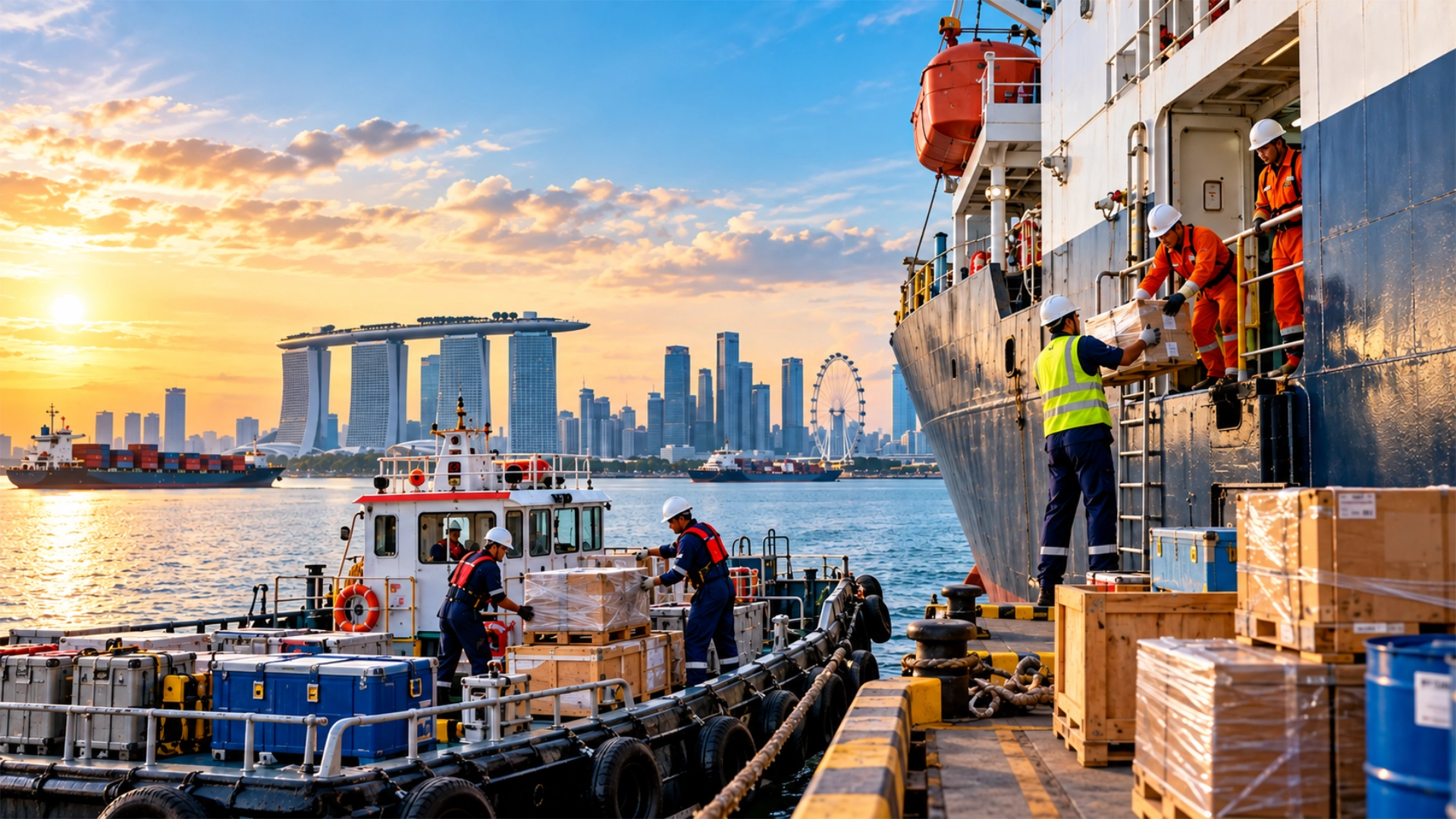
The challenge becomes greater when the vessel remains at anchorage or requires attendance outside port limits. Personnel and equipment must be transferred safely while weather, boarding arrangements, craft availability and the vessel’s departure schedule must be considered.
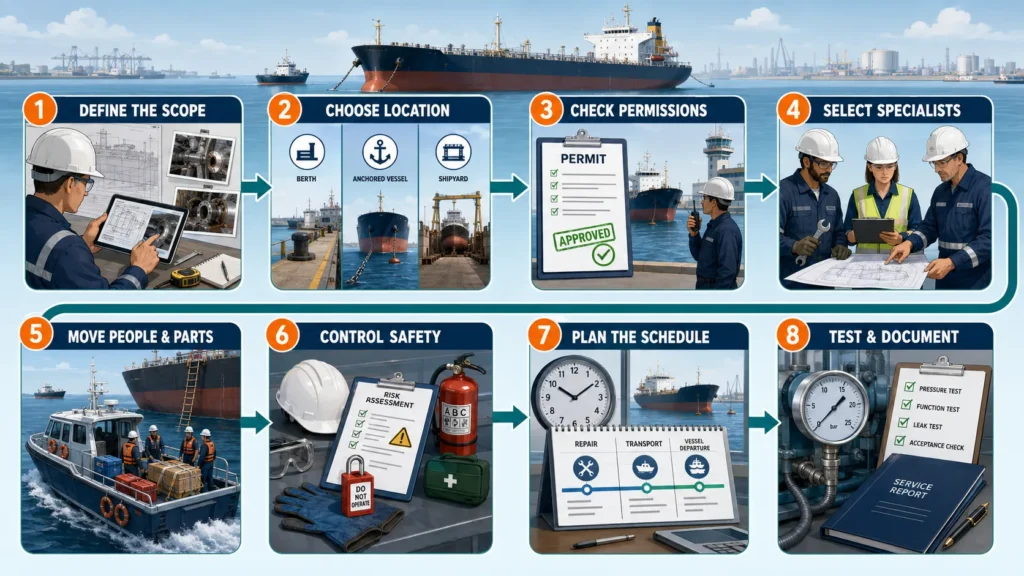
Successful marine repair in Singapore therefore begins before the technicians board the vessel. This guide explains eight practical steps for planning onboard ship repair, fabrication and other afloat work.
What Is Afloat Repair?
Afloat repair refers to maintenance or repair performed while a vessel remains waterborne instead of entering dry dock.
Depending on the technical scope and applicable permissions, the work may take place:
- Alongside a berth
- At a Singapore anchorage
- At an anchorage allocated for repair work
- At a suitable offshore location
- Outside port limits
- Afloat within a shipyard
Onboard ship repair is a broader term covering technical work carried out aboard a vessel. It may include inspection, maintenance, adjustment, component replacement, testing and fabrication where suitable capabilities are available.
Not every job is appropriate for afloat repair. The vessel’s condition, cargo, work location, safety requirements, classification implications and need for dry access must be considered before deciding where the work should be conducted.
1. Prepare a Precise Repair Brief
The quality of the initial repair request directly affects quotation accuracy, technical preparation and mobilisation time.
A request stating only that a pump, pipe or deck fitting is damaged is unlikely to provide enough information. The attending team may arrive without the correct tools, materials or replacement parts.
A useful repair brief should include:
- Vessel name, type and International Maritime Organization number, where applicable
- Expected time of arrival and departure
- Proposed berth, anchorage or offshore location
- Equipment manufacturer, model and serial number
- Clear description of the defect
- Date and circumstances in which the problem began
- Current operating condition of the equipment
- Photographs and videos of the affected area
- Available drawings, manuals and previous service reports
- Confirmed dimensions and material specifications
- Access restrictions around the worksite
- Required repair or completion standard
- Possible involvement of the classification society, flag administration or manufacturer
- Whether hot work, lifting, working at height or enclosed-space entry may be required
Measurements should be checked onboard whenever possible. Even a small dimensional error can make a prefabricated part unusable.
The coordinator should also be told how the defect affects the vessel’s operation. This helps the technical team assess urgency, operational consequences and suitable contingency arrangements.
2. Select a Suitable Work Location
The most convenient location is not necessarily the safest or most practical location.
| Location | Possible advantage | Important consideration |
|---|---|---|
| Berth | Easier movement of technicians, tools and materials | Terminal rules, cargo operations and berth schedules may restrict access or certain types of work |
| Anchorage | Work may proceed while the vessel remains afloat | Authority requirements, launch transfer, weather, sea conditions and boarding arrangements must be considered |
| Outside port limits | May suit certain passing vessels or offshore attendance requirements | Exact position, jurisdiction, craft clearance, distance, weather and transfer arrangements affect feasibility |
| Shipyard | Better suited to extensive repairs, heavy work and jobs requiring shore facilities | Yard availability, vessel movement and additional time may be required |
| Dry dock | Provides dry access to the hull and underwater areas | Docking schedules, cost and preparation requirements must be considered |
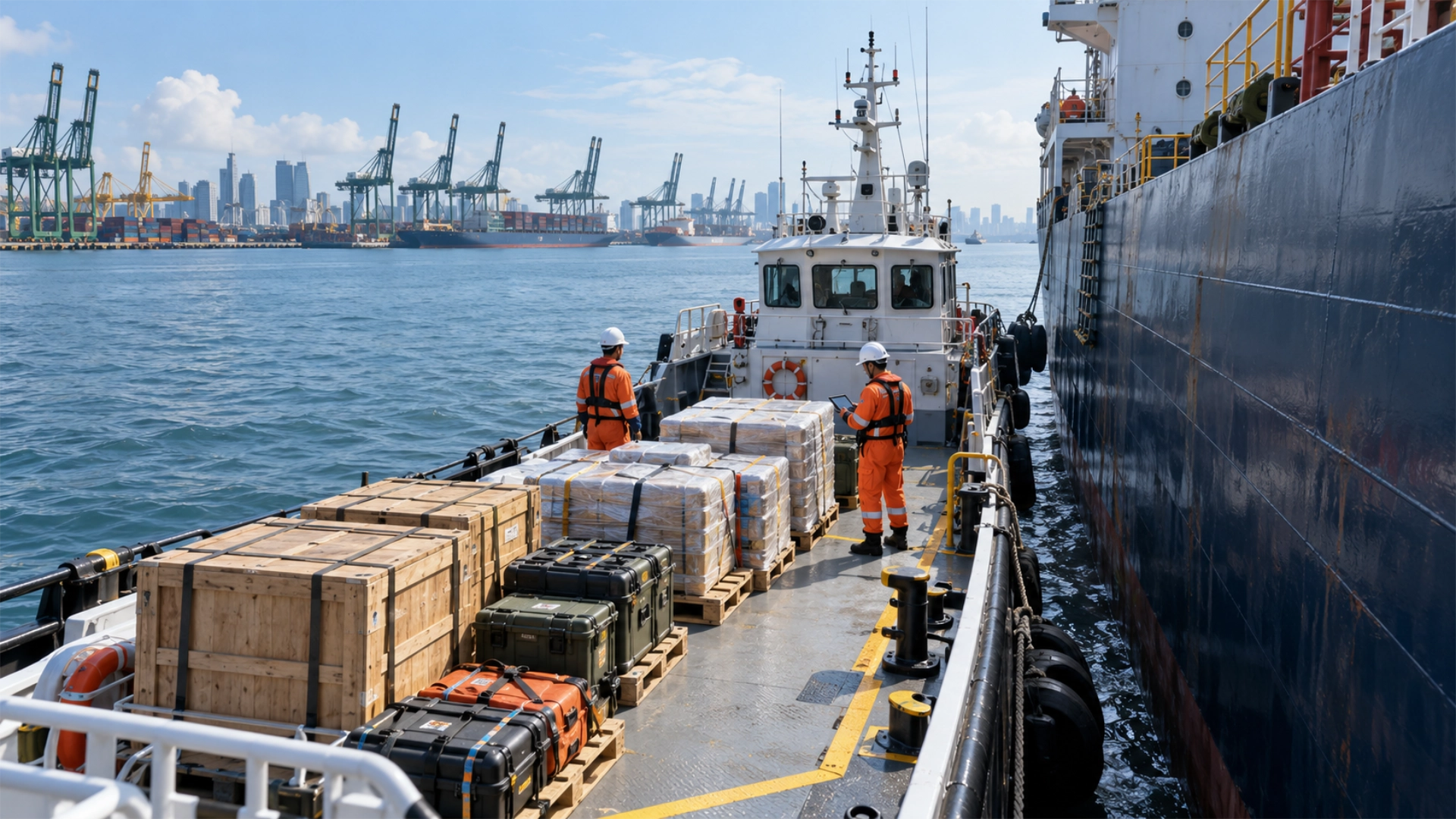
For anchorage or offshore attendance, the plan must cover the movement of technicians, toolboxes, replacement parts, testing equipment and any controlled items.
The launch or supply boat must be suitable for the personnel and cargo being transported. Package dimensions, weights, lifting arrangements, boarding facilities and sea conditions should be checked before mobilisation.
Every harbour craft proceeding outside Singapore’s port limits must possess a valid port clearance certificate, according to the Maritime and Port Authority of Singapore’s harbour-craft requirements.
For an overview of offshore transfer and vessel-support considerations, see Edtech Marine’s guide to supply boats in Singapore.
3. Check Permissions Before Mobilisation
Cold work remains subject to applicable vessel, terminal and regulatory controls. Hot work normally introduces additional approval, gas-testing and fire-safety requirements.
The Maritime and Port Authority of Singapore’s hot-work requirements state that permission must be sought from the Port Master before onboard repairs involving hot work are conducted in Singapore port waters.
When approval is granted, a specific anchorage may be allotted for the repair. Applications are submitted through digitalPORT@SG, and the authority advises submission three days before the intended hot-work period.
The authority’s frequently asked questions identify a specific exception for hot work conducted in a designated approved engine-room workshop under the circumstances described in its guidance.
Requirements must therefore be checked against:
- The vessel type
- The exact work location
- The proposed repair
- The vessel’s current and previous cargo
- The condition of relevant tanks and spaces
- The presence of dangerous goods
- The required safety arrangements
Permission granted for one vessel, location or repair should never be assumed to cover a different operation.
Separate approval or confirmation of no objection may also be required for certain special marine works within the port. This does not mean that every routine repair requires approval from the same department.
The authority’s guidance on special marine works and operations covers specified operations involving rigs, floating production units, crane barges, diving, surveys and other special activities.
Where applicable, the submission may require a work methodology statement containing:
- Scope of work
- Operating dates
- Vessel particulars
- Assigned anchorage
- Detailed operating schedule
- Harbour craft involved
- Safety measures
- Communication plan
- Contact details for the person in charge
The vessel’s agent and repair coordinator should verify the applicable requirements before technicians and equipment are mobilised.
4. Match the Specialist to the Repair
Afloat repair may involve several organisations rather than one contractor.
Depending on the job, the vessel operator may need to coordinate:
- A repair specialist
- The vessel’s local agent
- The equipment manufacturer
- A classification society surveyor
- The flag administration
- A launch or supply-boat operator
- A lifting or crane provider
- A diving contractor
- A local supplier of materials or replacement parts
The repair company should have suitable experience with the affected equipment, material and vessel environment.
Before appointment, confirm:
- Technical competence for the specific repair
- Personnel qualifications
- Insurance and safety documentation
- Required tools and testing instruments
- Availability during the vessel’s operating window
- Material certificates where required
- Welding procedures and welder qualifications where applicable
- Testing and inspection arrangements
- Ability to provide a written completion report
- Classification or manufacturer approval requirements
Where the repair affects classed structure, machinery or equipment, the vessel’s classification society should be consulted early.
Physical completion of the work does not automatically mean that the repair has been accepted by the classification society, flag administration or equipment manufacturer.
Edtech Marine publicly states that it offers repairs and engineering support, including routine maintenance and emergency repairs. Its ship-agency page separately lists emergency repairs and fabrication among technical services supported through industry partnerships and relationships with service providers.
Because the public website does not identify which repair trades are performed by Edtech personnel and which are partner-delivered, the delivery arrangement should be confirmed for every requirement.
5. Coordinate Technicians, Spares and Tools Together
A repair team cannot complete the work if a critical replacement component is still awaiting customs clearance or delivery.
The personnel, equipment and material plans should therefore be developed as one coordinated work package.
Confirm:
- Names and identification details of boarding personnel
- Boarding location and estimated transfer time
- Vessel contact person
- Number and weight of toolboxes
- Replacement parts and consumables
- Testing instruments
- Gas cylinders or controlled items being transported
- Package dimensions and weights
- Lifting requirements
- Customs status of imported spares
- Storage requirements before delivery
- Return arrangements for removed components
- Transport arrangements after completion
Ship spares may need to be received, documented, stored, consolidated and delivered according to the vessel’s changing schedule.
Edtech Marine’s ship agency and logistics services publicly include customs clearance, warehousing and door-to-vessel handling of ship spares and stores at berth, anchorage, outside port limits and shipyard.
Its separate ship spares logistics guide explains the broader planning challenges involved in moving urgent parts to vessels.
Combining compatible personnel, spares and equipment movements may reduce unnecessary launch trips. However, the selected craft must remain suitable and authorised for every item being carried.
6. Establish the Safety and Work-Control Plan
Repair work should be managed under the vessel’s Safety Management System, where applicable, together with the operator’s procedures and the requirements of the work location.
The International Safety Management Code establishes an international standard for safe ship management and operation. Its principles include assessing identified risks to ships, personnel and the environment and establishing appropriate safeguards.
Depending on the repair, the work-control plan may include:
- Risk assessment
- Permit to work
- Machinery or electrical isolation
- Lockout and tagout arrangements
- Hot-work permit
- Gas testing
- Fire watch
- Enclosed-space entry procedures
- Working-at-height controls
- Lifting plan
- Personal protective equipment
- Toolbox meeting
- Emergency response arrangements
- Communication between technicians and shipboard personnel
The responsible shipboard officers should understand the work scope, its effect on vessel systems and the conditions required before technicians begin.
If the actual condition differs from the information originally supplied, the team should stop and reassess the work. The original risk assessment, quotation or repair method may no longer be suitable.
7. Build a Realistic Repair Schedule
A quotation may state that the technical repair requires six hours. This does not mean the complete operation will take only six hours.
The overall schedule may also need to include:
- Authority and terminal approvals
- Customs clearance
- Technician mobilisation
- Collection of tools and materials
- Travel to the launch point
- Loading of personnel and equipment
- Marine transfer
- Safe boarding
- Vessel induction
- Worksite preparation
- Machinery isolation
- Repair or fabrication
- Reassembly
- Testing and commissioning
- Surveyor attendance
- Documentation
- Demobilisation
Weather and sea conditions may affect anchorage and outside-port-limits attendance. A contingency period should be included when the vessel has a fixed departure time.
Where practical, activities can be arranged in parallel. For example, the technical specialist may review drawings while the spare parts are being cleared and the agent is coordinating boarding arrangements.
Good planning cannot remove every delay, but it can reduce unnecessary waiting between stages. Edtech Marine’s guide to reducing vessel turnaround time in Singapore Port provides additional guidance on coordinating time-sensitive port services.
8. Test, Document and Close the Repair
The job is not complete when the final component has been installed.
The vessel and attending technical team should agree on how the repair will be tested and accepted. Depending on the equipment and repair scope, this may include:
- Visual inspection
- Dimensional inspection
- Pressure or leakage testing
- Electrical testing
- Operational testing
- Testing under load
- Alarm and safety-device checks
- Non-destructive testing
- Manufacturer review
- Classification society inspection
- Confirmation by the responsible shipboard officer
The completion package should record:
- Work performed
- Materials and replacement parts used
- Test results
- Before-and-after photographs
- Outstanding limitations
- Recommended follow-up work
- Technician’s service report
- Applicable material and test certificates
- Surveyor endorsement where required
Any temporary repair should be identified clearly. The report should explain its limitations, any operating restrictions and when a permanent repair must be completed.
Common Causes of Marine Repair Delays
Marine repair projects in Singapore can lose time before technicians reach the worksite.
Common causes include:
- Incomplete defect descriptions
- Incorrect measurements
- Missing drawings
- Unclear material specifications
- Late classification society involvement
- Unavailable replacement parts
- Customs-clearance delays
- Unsuitable transport for tools or equipment
- Unconfirmed boarding arrangements
- Approval applications submitted too late
- Unsafe worksite conditions
- Repair scopes changing after attendance
- Insufficient time for testing
- Weather or sea conditions affecting transfer
A detailed pre-arrival discussion can identify many of these risks while the vessel is still at sea.
When Is a Shipyard More Suitable?
Anchorage or offshore repair can be useful, but it should not be treated as a substitute for a shipyard in every situation.
A shipyard may be more suitable when the work involves:
- Extensive structural repair
- Repairs requiring dry access below the waterline
- Major machinery removal
- Large-scale steel renewal
- Heavy lifting
- Extensive hot work
- Substantial shore utilities
- Long-duration repairs
- Conditions that cannot be made safe afloat
- Inspection or certification requiring dry docking
Some underwater inspection, cleaning and specialist work can be conducted while a vessel remains afloat. The appropriate location depends on the exact technical scope, safety requirements and applicable approvals.
The decision should prioritise safety, technical integrity and regulatory acceptance rather than turnaround time alone.
How Edtech Marine Supports Repair Coordination
Edtech Marine’s public website confirms that the company provides several services relevant to repair attendance, including:
- Routine maintenance and emergency repair support
- Coordination of service engineers and technicians for vessel boarding
- Coordination of surveyors
- Ship agency and port-call support
- Launch and supply-boat hire
- OPL and fast-craft support
- Customs clearance and ship-spares logistics
- Warehousing and door-to-vessel delivery
- Underwater inspection and cleaning
- Diving services
- Floating crane services
- Tank cleaning
- Waste-oil removal
- Shipyard and dry-docking arrangements
- Emergency repairs and fabrication through maritime service-provider relationships
The exact technical trade, attending company, qualifications, work location and certification requirements should be confirmed for every project.
Where OPL attendance is requested, Edtech should also confirm whether the required technicians, equipment and repair coordination can be arranged for the vessel’s exact position.
Frequently Asked Questions
Can marine repairs be carried out at a Singapore anchorage?
Some repairs can be undertaken at anchorage, subject to the technical scope, vessel type, cargo, safety conditions and applicable approvals.
Hot work in Singapore port waters requires permission from the Port Master unless the specific operation falls within an applicable exception identified by the authority.
Can Edtech coordinate repair attendance outside port limits?
Edtech publicly offers OPL support, OPL fast-craft services, supply-boat hire and coordination of technicians for vessel boarding.
Whether a particular repair attendance can be arranged outside port limits must be confirmed against the vessel’s exact position, repair scope, transport requirements, weather and applicable permissions.
What information is required for a marine repair quotation?
Provide the vessel particulars, schedule, work location, defect description, photographs, drawings, confirmed measurements, equipment information and expected completion standard.
State whether hot work, lifting, working at height, enclosed-space entry or classification society involvement may be required.
What is the difference between onboard ship repair and afloat repair?
Onboard ship repair refers to technical work carried out aboard a vessel.
Afloat repair means that the vessel remains waterborne while the work is completed instead of entering dry dock.
Does an anchorage repair always reduce turnaround time?
No. Anchorage repair can reduce disruption when properly planned, but late approvals, unavailable spares, unsuitable weather or incomplete technical information can create delays.
The complete operation must be assessed rather than only the estimated repair duration.
Does Edtech provide marine fabrication?
Edtech’s public website lists emergency repairs and fabrication among the technical services supported through its maritime partnerships and service-provider relationships.
The required fabrication process, material, work location, personnel qualifications and certification requirements should be confirmed before mobilisation.
How early should a repair request be submitted?
As early as possible. Planned repairs should ideally be discussed before the vessel arrives in Singapore.
For hot-work applications in Singapore port waters, the Maritime and Port Authority of Singapore advises online submission three days before the intended work period. Emergency cases should follow the authority’s published contact procedure.
Plan the Repair Before the Vessel Arrives
Successful afloat repair depends on more than finding an available technician.
The technical scope, work location, approvals, safety controls, replacement parts, transport, testing and vessel schedule must work together.
Early planning gives the technical specialist time to review the defect and allows the local coordinator to arrange the necessary personnel, equipment and access.
To discuss an onboard, anchorage or outside-port-limits requirement, contact Edtech Marine with:
- Vessel name and schedule
- Proposed work location
- Description of the defect
- Photographs and videos
- Equipment information
- Drawings and measurements
- Required completion date
- Possible safety or approval requirements
Edtech Marine can then confirm which technical attendance, service-provider support, spares logistics and marine transport arrangements are available for the specific requirement.