Introduction
Marine pyrotechnics are essential visual distress signals carried aboard many commercial vessels, offshore vessels, harbour craft, lifeboats and liferafts. They include parachute flares, hand flares and buoyant smoke signals used to attract attention during an emergency.
However, marine pyrotechnics have marked expiry dates. Once a device has expired, become damaged or is no longer suitable for service, it should be removed from the vessel’s active safety inventory and managed through an appropriate shore-based arrangement.
Marine pyrotechnics disposal in Singapore should not be treated as ordinary ship-waste disposal. Vessel operators should plan the handover in advance, confirm that the receiving party can legally accept the particular devices and retain appropriate records.
This guide explains the verified regulatory context and the practical steps shipowners, ship managers and masters should consider when arranging disposal during a Singapore port call.
Important: Requirements may vary according to the device, quantity, condition, vessel, flag, terminal and proposed transfer arrangement. The vessel operator should obtain confirmation from the relevant authorities and appointed contractor before moving or handing over any pyrotechnic devices.
What Are Marine Pyrotechnics?
Marine pyrotechnics are visual emergency signals forming part of a vessel’s life-saving equipment.
Common examples include:
- Rocket parachute flares
- Hand flares
- Buoyant smoke signals
- Lifebuoy light-and-smoke signals
- Other approved visual distress signals
The International Maritime Organization’s guidance on life-saving appliances identifies parachute flares, hand flares and buoyant smoke signals as visual aids covered by international life-saving appliance requirements.
SOLAS Chapter III establishes requirements for life-saving appliances and arrangements, while the International Life-Saving Appliance Code provides more specific technical requirements relating to their manufacture, testing, maintenance and record keeping.
The exact type and quantity of equipment required aboard a vessel depends on factors such as the ship type, size, activity and voyage.
Why Expired Marine Pyrotechnics Require Proper Disposal
An expiry date indicates the end of the manufacturer’s stated service period for the device. Once that date has passed, the pyrotechnic should not be relied upon as part of the vessel’s required in-date emergency equipment.
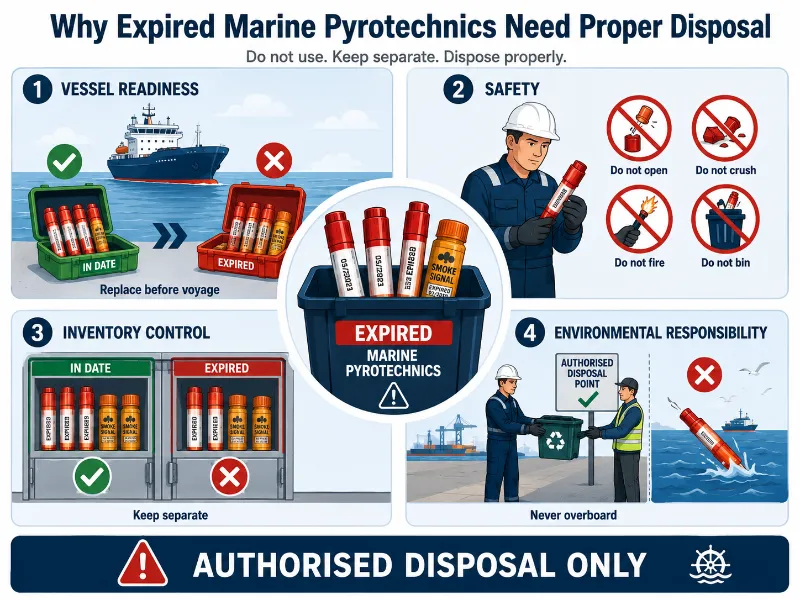
Proper disposal is important for several reasons.
Vessel readiness
Expired equipment should not be counted as serviceable distress-signalling equipment. Replacement should therefore be arranged early enough to ensure that the vessel continues to carry the equipment applicable to its flag, class, vessel type and voyage.
Safety
Marine pyrotechnics contain reactive materials and should continue to be treated cautiously after expiry.
They should not be opened, dismantled, crushed, deliberately discharged or placed in ordinary waste by the vessel’s crew.
Clear inventory control
Expired devices should not remain mixed with serviceable emergency equipment where they could be selected accidentally during an emergency.
The vessel’s safety-equipment inventory should clearly distinguish between in-date equipment and items awaiting an authorised shore-side arrangement.
Environmental responsibility
Expired flares and smoke signals should not be discarded overboard. They are not ordinary marine litter and may present risks to other port users, waste workers and the environment.
Are Expired Marine Pyrotechnics Accepted as Normal Ship Garbage in Singapore?
Vessel operators should not assume that expired pyrotechnics can be placed into Singapore’s regular ship-garbage collection system.
The Maritime and Port Authority of Singapore’s garbage collection guidance states that its complimentary daily collection service is available to vessels at designated anchorages.
However, MPA defines the garbage covered by the service as domestic and operational waste generated during normal ship operations. It specifically excludes industrial waste and certain bulky items.
MPA also states that vessels wishing to dispose of items that are not accepted under its collection service must make their own commercial arrangements with vendors licensed by Singapore’s National Environment Agency.
This does not mean that every NEA-licensed general waste collector can accept marine pyrotechnics.
The NEA waste collection framework divides general waste collection licences into published classes covering categories such as inorganic waste, organic waste, used cooking oil and sanitary waste. The public description does not specifically list expired marine pyrotechnics.
The prudent approach is therefore to obtain written confirmation that the proposed receiving party:
- Can accept the specific type of marine pyrotechnic
- Holds the licences and approvals relevant to its part of the work
- Can arrange any required transport and onward treatment lawfully
- Will provide appropriate handover or disposal documentation
A general statement that a company is “licensed for waste collection” should not, by itself, be treated as confirmation that it can receive expired flares or other pyrotechnic articles.
How to Arrange Marine Pyrotechnics Disposal in Singapore
The exact arrangement should be confirmed for each job. However, vessel operators can use the following compliance-led process.
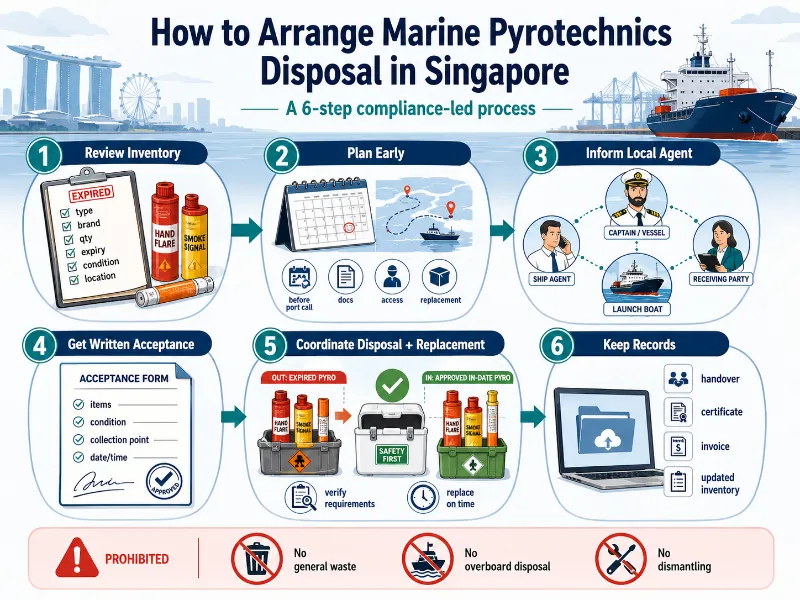
1. Review the Vessel’s Inventory
The vessel should identify the pyrotechnics that are approaching expiry or have already expired.
The inventory provided to the ship manager, agent or service coordinator should include:
- Type of device
- Manufacturer or brand, where available
- Quantity
- Marked expiry date
- General external condition
- Current location aboard the vessel
- Date and location of the proposed Singapore call
Crew members should not open or dismantle a device to obtain additional information.
Any device that appears damaged, corroded, distorted, leaking or otherwise abnormal should be reported through the vessel’s safety-management procedures. The receiving party should be informed of its condition before any collection is attempted.
2. Begin Planning Before the Singapore Port Call
Marine pyrotechnics disposal in Singapore should preferably be planned before the vessel arrives.
Early notice allows the ship manager or agent to determine:
- Whether a suitable receiving party is available
- Whether the contractor will accept the particular devices
- What documentation is required
- Whether the vessel will be at berth, anchorage or offshore
- Whether terminal or shipyard permission is needed
- Whether launch or cargo-boat coordination is required
- Whether replacement safety equipment must be delivered
Last-minute requests may be difficult to complete, particularly when acceptance, access and transport arrangements require confirmation.
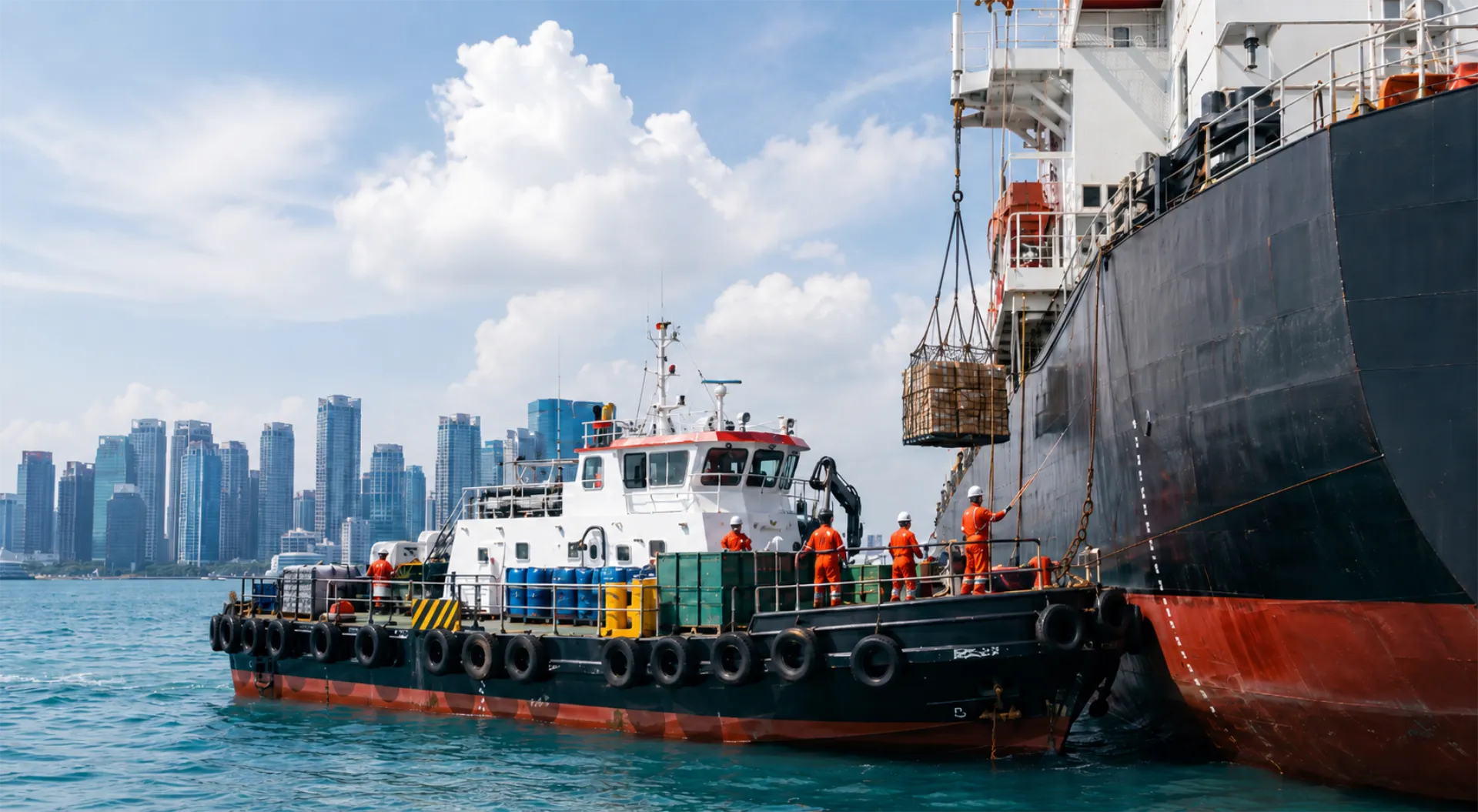
For anchorage and offshore vessel requirements, Edtech Marine’s articles on supply boats in Singapore and OPL and cargo boat operations provide further information on the coordination considerations involved in delivering equipment and supporting vessels away from a berth.
3. Inform the Local Ship Agent
A local agent can act as the coordination link between the master, ship manager, terminal, launch operator, supplier and appointed receiving party.
Edtech Marine’s ship agency services in Singapore include liaison with local authorities, coordination with contractors, ship-spares handling, supply-boat arrangements and other husbandry support. Its website also lists garbage disposal as an agency-coordination service.
For pyrotechnics, however, the operator should distinguish carefully between:
- The company coordinating the operation
- The party transporting the devices
- The party receiving them
- The facility or contractor responsible for final treatment
These may be different organisations, and each party should be appropriately authorised for its role.
4. Obtain Written Acceptance Before the Handover
Before any expired devices are moved from the vessel, the operator or agent should obtain confirmation from the proposed contractor.
The confirmation should cover:
- The precise items being accepted
- The quantity and condition
- The agreed collection point
- The collection date and time
- Packaging or presentation requirements specified by the authorised party
- Required vessel declarations or documents
- The name of the receiving organisation
- The documentation that will be provided after collection
The vessel crew should follow the instructions issued by the ship manager and authorised receiving party. They should not improvise a transfer method.
5. Coordinate Disposal with Replacement
Removal and replacement should be planned together wherever possible.
This helps prevent a situation in which expired items are landed but the vessel does not yet have the required number and type of in-date distress signals.
Before ordering replacements, the ship manager should verify the applicable requirements rather than assuming that the outgoing equipment can simply be replaced item for item.
Relevant considerations may include:
- Flag-state requirements
- SOLAS and LSA Code requirements
- Vessel type and size
- Lifeboat and liferaft requirements
- Trading area and voyage
- Class or survey requirements
- Manufacturer approvals and certification
MPA publishes the LSA Code among its list of IMO mandatory codes. The IMO also confirms that visual aids such as parachute flares, hand flares and buoyant smoke signals fall within international life-saving appliance requirements.
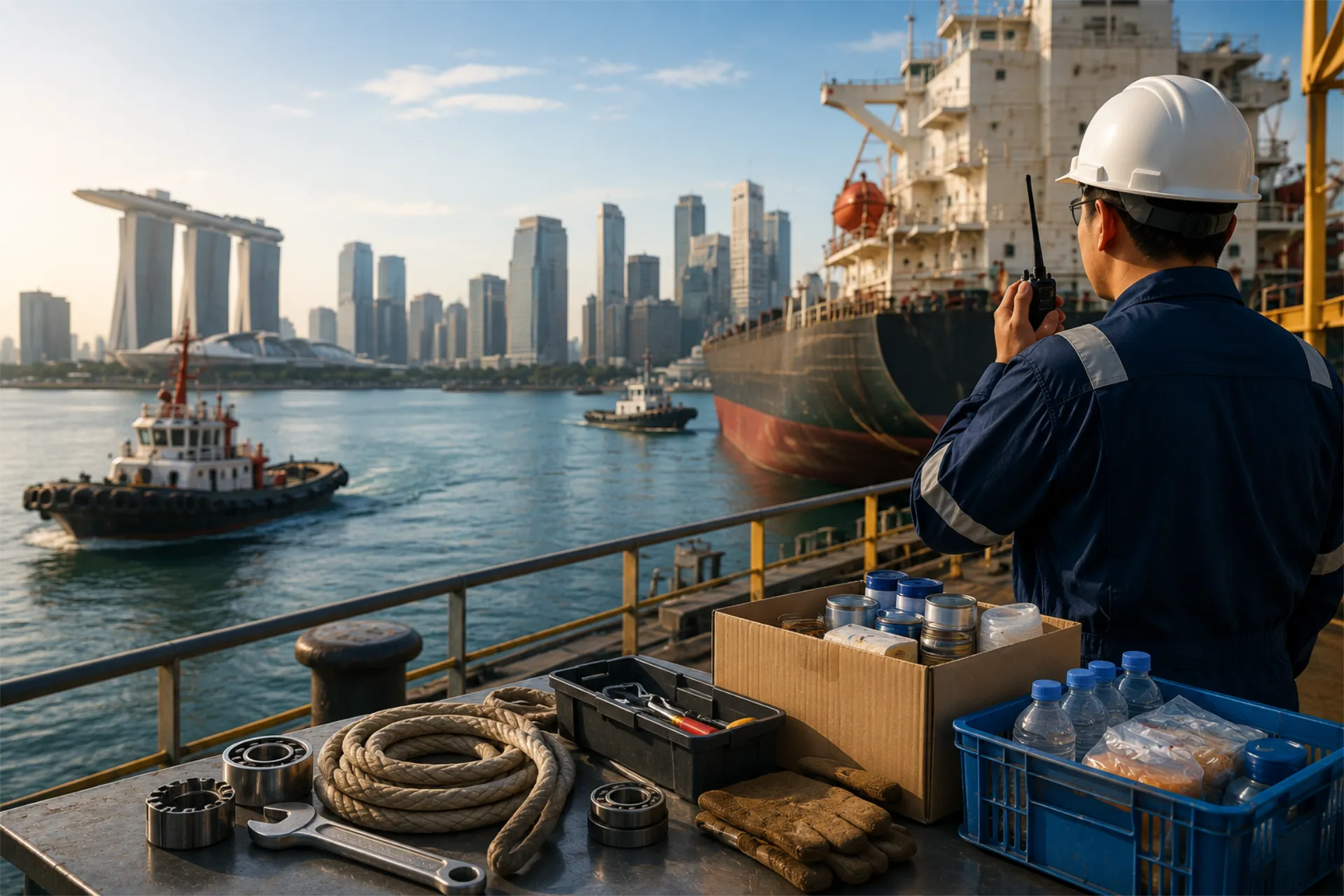
Edtech Marine’s ship supplies service covers safety equipment, ship stores and other vessel requirements. Any product selection should be checked against the vessel’s applicable technical and statutory requirements.
6. Retain the Handover Records
The vessel operator should retain sufficient documentation to show what was removed, who received it and when the handover occurred.
Depending on the arrangement, the records may include:
- Vessel name
- IMO number, where applicable
- Date and location of collection
- Description of the pyrotechnics
- Quantity
- Expiry dates
- Name of the receiving party
- Collection acknowledgement
- Disposal certificate, where issued
- Contractor invoice or job report
- Details of replacement equipment
- Updated safety-equipment inventory
Records should be retained according to the company’s safety-management and document-control procedures.
What Vessel Operators Should Not Do
Expired pyrotechnics should not be treated as routine unwanted stores.
Do not place them in general ship garbage
MPA’s regular service is limited to defined domestic and operational waste. Expired pyrotechnics should not be placed in a ship’s normal garbage unless the relevant authorities and authorised receiving party have expressly confirmed the arrangement.
Do not discard them overboard
Marine pyrotechnics should never be thrown into the sea. Doing so creates an uncontrolled safety and environmental risk.
Do not activate them to get rid of them
An expired flare should not be fired simply as a disposal method. A distress signal may be interpreted as a genuine emergency and could trigger an unnecessary response.
Do not dismantle them
The vessel’s crew should not attempt to open a device, remove its contents or make it inert.
Do not transfer them to an unconfirmed party
A supplier, launch operator or general waste collector should not be assumed to have authority to accept expired pyrotechnics.
Acceptance and the receiving party’s role should be confirmed before the handover.
Why the Ship Agent’s Role Matters
Marine pyrotechnics disposal in Singapore may require coordination across several shore-side parties.
A local ship agent may assist by:
- Gathering the necessary information from the vessel
- Contacting potential authorised receiving parties
- Confirming berth, terminal or anchorage arrangements
- Coordinating launch or cargo-boat access
- Aligning the handover with the vessel’s schedule
- Arranging replacement ship supplies
- Collecting the relevant handover documentation
- Communicating with the ship manager and master
Good coordination is especially important for vessels with short port stays or those remaining at anchorage.
The agent’s involvement does not replace the need to verify that the actual receiving and disposal parties are authorised for the work.
How Edtech Marine Can Support the Port Call
Edtech Marine provides ship agency, marine logistics, ship supplies and offshore coordination services in Singapore.
Depending on the vessel’s requirements, Edtech Marine may assist with:
- Reviewing information provided by the vessel
- Coordinating enquiries with relevant shore-side parties
- Arranging delivery of replacement safety equipment
- Coordinating berth, anchorage or offshore access
- Supporting launch and supply-boat arrangements
- Collecting operational and handover documents
- Aligning the work with other port-call requirements
Edtech Marine should not be described as the licensed final disposal contractor unless the precise arrangement and the licences of the parties involved have been confirmed for that particular job.
Vessel operators can contact Edtech Marine before the vessel’s Singapore call to discuss the coordination and replacement requirements.
Frequently Asked Questions
Can expired marine flares be placed in normal ship garbage in Singapore?
Vessel operators should not assume that they can.
MPA’s regular ship-garbage service covers defined domestic and operational wastes and excludes industrial waste. MPA directs vessels to make separate commercial arrangements for items that are not accepted.
The proposed receiving party should specifically confirm that it can accept the expired pyrotechnics.
Does MPA collect expired marine pyrotechnics?
The published MPA garbage-collection page does not state that its regular service accepts expired marine pyrotechnics.
Operators should contact their agent and obtain confirmation from MPA or an appropriately authorised receiving party for the specific arrangement.
Is every NEA-licensed waste collector allowed to collect expired flares?
This should not be assumed.
NEA publishes different classes of general waste collection licences, but its public descriptions do not specifically identify marine pyrotechnics. The operator should obtain written confirmation that the proposed contractor can accept the particular items.
Can the crew fire expired flares as a disposal method?
No. Expired distress signals should not be discharged simply to dispose of them.
The devices should be managed through a confirmed shore-side arrangement.
Should expired pyrotechnics remain with serviceable equipment?
They should not be allowed to create confusion within the vessel’s active safety inventory.
Their status should be recorded and controlled under the vessel’s safety-management procedures while an appropriate collection arrangement is being made.
What information will a contractor usually need?
The contractor or coordinator may request the device type, quantity, manufacturer, expiry date, condition, vessel location and proposed collection date.
Additional requirements should be confirmed directly with the receiving party.
How early should disposal be arranged?
Planning should begin before the equipment expires and before the vessel arrives in Singapore.
Additional lead time may be required for anchorage operations, terminal access, contractor availability or replacement delivery.
Will the operator receive a disposal certificate?
This depends on the contractor and arrangement.
The operator should ask in advance what collection, receipt or disposal documentation will be issued and retain it with the vessel’s safety-equipment records.
Conclusion
Marine pyrotechnics disposal in Singapore requires advance planning and confirmation from the relevant shore-side parties.
Vessel operators should not place expired distress signals in ordinary ship garbage, discard them at sea, dismantle them or activate them merely for disposal.
Instead, the ship manager or master should notify the local agent, provide an accurate inventory, confirm that the receiving party can accept the specific devices, coordinate the supply of replacement equipment and retain the relevant handover records.
Because publicly available Singapore guidance does not set out one universal disposal procedure for every type of marine pyrotechnic, each arrangement should be verified according to the device, vessel, location and contractors involved.
To discuss ship agency coordination, vessel supplies or the delivery of replacement marine safety equipment during a Singapore port call, contact Edtech Marine.