Introduction
PFOS free firefighting foam Singapore regulations have introduced important compliance requirements for shipowners, vessel operators and marine businesses. Since 1 January 2026, new International Maritime Organization (IMO) rules have restricted the use and storage of firefighting media containing PFOS. Singapore has also implemented environmental controls through the Maritime and Port Authority of Singapore (MPA) and National Environment Agency (NEA).
These changes mean that marine operators must review their existing firefighting equipment, verify chemical compliance and consider suitable PFOS-free alternatives. This guide explains the latest requirements, what shipowners should check before their next safety survey and the firefighting solutions available from Edtech Marine.
What Is PFOS-Free Firefighting Foam?
PFOS belongs to a larger group of synthetic chemicals known as PFAS. These substances have historically been used in certain firefighting foams because of their ability to improve the suppression of fires involving flammable liquids.
Traditional Aqueous Film-Forming Foam (AFFF) has been widely used in marine and industrial environments, including onboard vessels, offshore installations and fuel-handling facilities.
However, PFOS is recognised as a persistent organic pollutant. It degrades very slowly and can accumulate in the environment and living organisms.
PFOS-free firefighting foam is formulated or verified to meet the applicable restriction on PFOS content.
An important distinction is that PFOS-free does not necessarily mean PFAS-free. Some firefighting foams may contain other PFAS substances even when PFOS is absent.
This distinction is particularly important under Singapore’s broader environmental restrictions, which address additional PFAS chemicals.
IMO PFOS Ban: What Changed on 1 January 2026?
The International Maritime Organization adopted amendments to the International Convention for the Safety of Life at Sea (SOLAS), specifically Chapter II-2, Regulation 10.
The amendments prohibit the use or storage of fire-extinguishing media containing PFOS above the applicable concentration limit.
Under the IMO’s interpretation, the prohibited concentration is more than 10 mg/kg, equivalent to 0.001% by weight.
These requirements apply to relevant fixed firefighting systems and portable or mobile firefighting equipment.
Requirements for New and Existing Ships
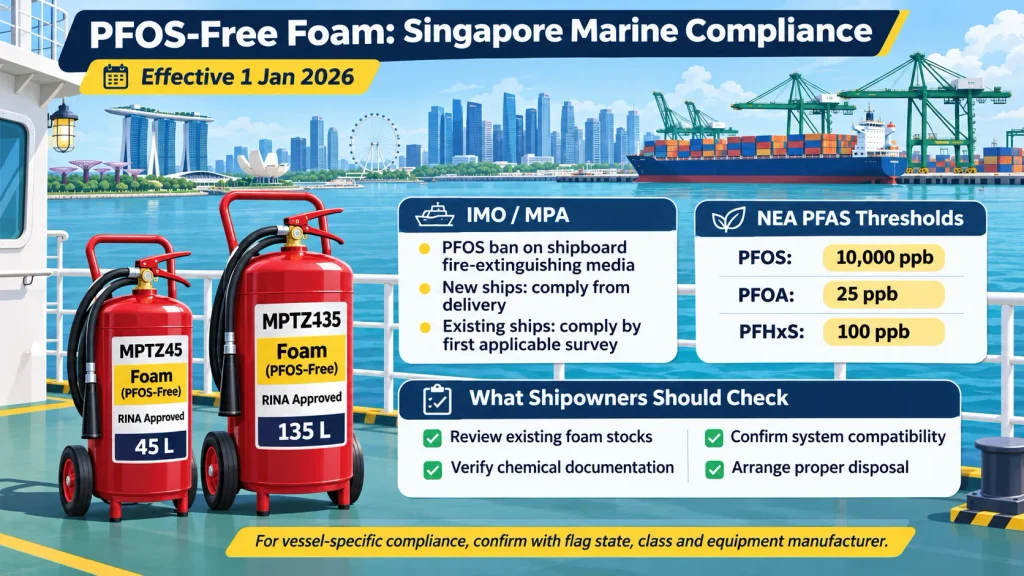
New ships constructed on or after 1 January 2026 must comply with the PFOS restrictions upon delivery.
Existing ships constructed before 1 January 2026 must comply no later than their first applicable survey on or after that date.
The requirements also extend to relevant high-speed craft covered by the applicable IMO codes.
Shipowners should therefore review existing foam stocks rather than assume that previously approved equipment remains acceptable.
For the official regulatory announcement, refer to the IMO’s overview of shipping regulations effective from 1 January 2026.
Singapore’s MPA Regulations on PFOS Firefighting Foam
Singapore implemented the relevant SOLAS amendments through the Merchant Shipping (Safety Convention) (Amendment) Regulations 2025.
The Maritime and Port Authority of Singapore (MPA) issued Shipping Circular No. 11 of 2025, confirming that the amendments entered into force on 1 January 2026.
For Singapore-registered ships covered by the requirements, operators must ensure that applicable firefighting media do not exceed the prohibited PFOS concentration.
This includes reviewing firefighting foam contained in portable and mobile extinguishers and fixed foam systems.
Where prohibited foam is removed from a vessel, it must be delivered to appropriate shore-based reception facilities.
The exact application of the maritime requirements depends on the vessel’s flag, type, certification and applicable regulations.
Official reference: MPA Shipping Circular No. 11 of 2025 – Merchant Shipping (Safety Convention) (Amendment) Regulations.
NEA Regulations: Singapore’s Broader PFAS Restrictions
In addition to maritime regulations, Singapore’s National Environment Agency (NEA) has introduced restrictions affecting firefighting foam containing certain PFAS substances.
Effective 1 January 2026, Singapore began phasing out the import and use of firefighting foams containing specified PFAS chemicals above their respective unintentional trace contamination thresholds.
The restrictions cover three categories:
| Chemical | Threshold |
|---|---|
| PFOS, its salts and related compounds | 10,000 ppb |
| PFOA, its salts and related compounds | 25 ppb |
| PFHxS, its salts and related compounds | 100 ppb |
These thresholds highlight why purchasing a product labelled merely as PFOS-free may not be sufficient to establish full compliance with Singapore’s requirements.
Marine suppliers, shipowners and businesses handling firefighting foam should obtain appropriate supporting documentation, including chemical test reports, Safety Data Sheets or technical specifications.
The NEA’s official Stockholm Convention information page explains Singapore’s approach to phasing out PFAS-containing firefighting foams.
For detailed technical guidance, refer to the NEA Industry Guidelines on the Phase-Out of PFAS-Containing Firefighting Foams, revised on 27 March 2026.
What Should Shipowners Check Before Their Next Safety Survey?
The transition to PFOS-free firefighting equipment should begin with an assessment of the existing equipment onboard.
Shipowners and vessel managers should prioritise five areas.
1. Identify Existing Firefighting Foam
Review the vessel’s firefighting equipment, including portable foam extinguishers, mobile units, fixed foam systems and stored foam concentrate.
Record the equipment manufacturer, model, foam type and available certification.
For replacement equipment, operators can explore Edtech Marine’s range of marine fire extinguishers.
2. Verify the Chemical Composition
Obtain a manufacturer’s declaration or appropriate laboratory test report confirming the PFOS concentration.
Where Singapore’s broader environmental requirements apply, supporting documentation should also address PFOA and PFHxS.
A general product approval certificate should not be assumed to confirm chemical compliance unless it expressly covers the relevant substances.
3. Check Documentation and Traceability
Ensure that compliance documentation can be traced to the actual extinguishing media onboard.
Relevant information may include the foam manufacturer, product type, production date, batch number and applicable approval references.
Classification society DNV provides further guidance on documenting PFOS-free fire-extinguishing foam onboard ships.
4. Confirm Equipment Compatibility
When replacing firefighting foam, it is important to ensure that the new formulation remains suitable for the existing equipment.
Differences in viscosity, mixing ratio and chemical characteristics can affect a system’s performance.
Where fixed foam systems are involved, the manufacturer or qualified service provider should verify compatibility before replacement.
5. Arrange Proper Disposal
Non-compliant foam must not be discharged into the sea, drainage systems or the surrounding environment.
Prohibited foam removed from ships must be delivered to appropriate shore-based reception facilities. Singapore’s requirements also address the treatment and disposal of regulated PFAS-containing firefighting waste.
The NEA’s toxic industrial waste guidance and FAQs provide information on engaging appropriately licensed waste collectors.
Why Replacing Firefighting Foam Requires Careful Planning
Replacing non-compliant foam is not always as straightforward as emptying a tank and introducing a new product.
Residual PFAS chemicals can remain inside storage tanks, hoses, pipelines and associated firefighting equipment. If these components are not cleaned appropriately, newly introduced foam may become contaminated.
Replacement foam formulations may also behave differently within existing firefighting systems.
For example, a change in foam viscosity or proportioning requirements could affect system performance.
The NEA’s industry guidelines address cleaning procedures, compatibility considerations and waste management during the transition to alternative firefighting foams.
For vessel operators, the objective should be to achieve regulatory compliance without compromising firefighting effectiveness.
PFOS-Free Foam Fire Extinguishers from Edtech Marine
As a Singapore-based provider of marine supplies and safety equipment, Edtech Marine’s ship supplies services support the equipment procurement requirements of vessel operators and maritime businesses.
Edtech’s current product range includes two high-capacity foam fire extinguishers identified in its catalogue as PFOS-free and RINA-approved.
MPTZ45 – 45L PFOS-Free Foam Fire Extinguisher
The MPTZ45 is a 45-litre cartridge-type foam fire extinguisher designed for marine firefighting applications requiring higher extinguishing capacity.
Its published specifications include:
- Capacity: 45 litres
- Fire rating: A-IIB
- Operating temperature: +5°C to +60°C
- Weight: 85 kg
- PFOS-free formulation
- RINA approval
The MPTZ45 offers a mobile firefighting solution for applications requiring a larger foam extinguisher, subject to the vessel’s equipment requirements.
View the MPTZ45 45L Foam Fire Extinguisher.
MPTZ135 – 135L PFOS-Free Foam Fire Extinguisher
For applications requiring a higher-capacity mobile extinguisher, Edtech Marine also supplies the MPTZ135.
Its published specifications include:
- Capacity: 135 litres
- Fire rating: A-IVB
- Operating temperature: +5°C to +60°C
- Weight: 220 kg
- PFOS-free formulation
- RINA approval
The MPTZ135 is intended for applications requiring a larger quantity of firefighting foam, subject to the applicable equipment approvals and fire safety arrangements.
View the MPTZ135 135L Foam Fire Extinguisher.
Both models are identified as PFOS-free in Edtech’s published product specifications. Buyers should request the relevant manufacturer declarations, chemical test reports and approval documentation to confirm suitability for their specific applications and applicable regulatory requirements.
Frequently Asked Questions About PFOS-Free Foam
Is PFOS-Free Firefighting Foam Mandatory for Ships in Singapore?
For ships covered by the relevant SOLAS and High-Speed Craft Code requirements, firefighting media exceeding the permitted PFOS concentration are prohibited.
Existing vessels must comply no later than their first applicable survey on or after 1 January 2026.
Does Every Existing Foam Fire Extinguisher Need to Be Replaced?
Not necessarily. Existing firefighting equipment may remain in service if the extinguishing media meet the applicable chemical restrictions, acceptable documentation is available and the equipment continues to satisfy relevant safety requirements.
If the chemical composition cannot be verified, additional testing or replacement may be necessary.
Is PFOS-Free Foam the Same as Fluorine-Free Foam?
No. PFOS-free foam meets the applicable restriction on PFOS, but may still contain other PFAS chemicals.
Fluorine-free foam is formulated without intentionally added fluorinated surfactants or PFAS.
The selection of any alternative must still account for firefighting performance, certification and equipment compatibility.
What Documentation Should Be Available During a Vessel Survey?
Shipowners should have suitable evidence confirming that the firefighting media onboard meet the applicable PFOS restriction.
Acceptable documentation may include a manufacturer’s declaration, an accredited laboratory test report or an approval certificate expressly confirming PFOS-free status, depending on the survey requirements.
Preparing Your Vessel for PFOS-Free Firefighting Compliance
Singapore’s 2026 firefighting foam restrictions reinforce the importance of reviewing not only the condition of onboard safety equipment but also the chemical composition of its extinguishing media.
Shipowners and marine operators should assess existing foam stocks, verify supporting documentation and plan any necessary replacements in accordance with applicable maritime and environmental requirements.
Choosing appropriately approved and documented equipment is an important part of maintaining effective fire protection while supporting regulatory compliance.
Looking for PFOS-free foam fire extinguishers in Singapore?
Edtech Marine supplies marine firefighting equipment, including the MPTZ45 45L and MPTZ135 135L foam fire extinguishers.
Contact Edtech Marine to enquire about product specifications, availability, supporting documentation and quotations.
Edtech Marine – Your Trusted Marine Supplies & Safety Specialist
Email: info@edtech.com.sg
Telephone: +65 6397 5980
Regulatory information is based on official publications available as at November 2026. Vessel-specific compliance and product suitability should be confirmed with the relevant flag administration, classification society and equipment manufacturer.