Introduction: Why Ship Spares Logistics Matters
Modern shipping relies heavily on the seamless operation of vessels. Vessels operate on tight schedules, across global routes and under strict regulatory oversight. In this environment, ship spares logistics plays a decisive role in keeping ships operational, safe and compliant.
Ship spares logistics covers the planning, sourcing, storage, movement and delivery of spare parts required to maintain and repair vessels. These parts range from small electronic components to large engine and propulsion systems. When spare parts are unavailable or delayed, vessels face downtime, commercial losses and increased safety risks.
Effective ship spares logistics is not simply a procurement task – it is a specialized discipline that blends supply chain management, maritime operations, regulatory compliance and increasingly, digital systems and training support
Understanding the Complexity of Ship Spares Logistics
Ship spares logistics differs fundamentally from standard supply chains. Traditional logistics focuses on predictable demand and fixed destinations. In contrast, ship spares logistics must support:
Moving vessels rather than fixed facilities
Unpredictable breakdowns
Tight repair windows
Diverse international regulations
Remote and high-risk operating environments
A single vessel may require spare parts to be delivered to multiple ports across continents, sometimes with only hours of notice. Each shipment may involve customs clearance, port coordination and last-mile delivery directly to the vessel.
This complexity makes ship spares logistics a high-stakes function where planning, accuracy and coordination directly affect operational performance. Ship spares logistics must operate within international regulatory frameworks set by bodies such as the International Maritime Organization (IMO).
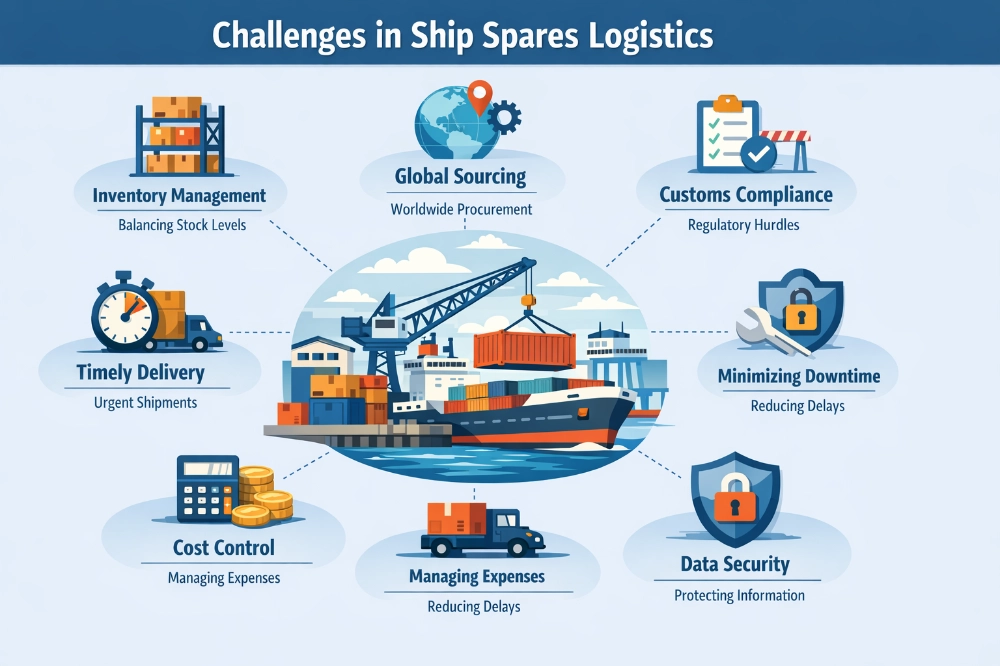
The 7 Key Challenges in Ship Spares Logistics Operations
Navigating the world of ship spares logistics presents a unique set of challenges. Addressing these challenges effectively is crucial for maintaining efficient and cost-effective operations. Here are seven key hurdles that ship owners, operators, and logistics providers face:
Challenge 1: Inventory Management and Optimization
Maintaining optimal inventory levels is a delicate balance. Overstocking ties up capital and increases storage costs, while understocking raises the risk of delays and vessel downtime. Effective inventory management requires accurate demand forecasting based on vessel age, operating conditions, and maintenance schedules.
Implementing robust inventory control systems and using data analytics can help optimize stock levels and reduce unnecessary expenditure. Spare parts optimization – particularly the identification and management of critical spares – is essential for cost control and operational efficiency.
Challenge 2: Global Sourcing and Procurement Strategies
The global nature of the shipping industry necessitates sourcing spares from various suppliers around the world. This presents challenges related to supplier selection, quality control, and price negotiation. Developing strong relationships with reliable suppliers and implementing robust procurement strategies are essential for ensuring access to high-quality spares at competitive prices.
Global sourcing challenges include navigating different time zones, languages, and cultural norms. Procurement strategies must address these complexities to ensure seamless and efficient sourcing processes.
Challenge 3: Customs Compliance and International Regulations
Ship spares logistics must navigate a complex landscape of customs regulations and international trade requirements. Import and export documentation, duties, and tax rules vary significantly between countries. Non-compliance can result in delays, fines, or legal consequences.
Staying current with regulatory requirements and working with experienced customs partners is essential to ensuring smooth and compliant spare parts movements.
Challenge 4: Timely Delivery and Last-Mile Logistics Solutions
Urgency is a defining characteristic of ship spares logistics. Spare parts are often required quickly to prevent extended downtime. Ensuring timely delivery – particularly to remote ports or vessels – requires dependable transport networks, experienced logistics partners, and effective tracking systems.
The last mile of delivery, from port or airport to the vessel, often presents the greatest operational challenge and requires careful coordination.
Challenge 5: Minimizing Downtime and Operational Disruptions
The primary objective of ship spares logistics is to minimize vessel downtime. Delays in spare parts delivery can result in lost revenue, missed schedules, and increased repair costs.
Proactive maintenance planning, efficient spare parts management and responsive logistics support are essential to preventing unexpected disruptions and limiting their operational impact.
Challenge 6: Cost Control and Budget Management
Ship spares logistics represents a significant operational cost. Effective cost control requires optimizing inventory levels, negotiating competitive supplier pricing, streamlining logistics workflows and reducing waste.
Regular cost monitoring and performance reviews help identify inefficiencies and support more informed budget decisions.
Challenge 7: Maintaining Data Security and Transparency
As ship spares logistics becomes increasingly digitized, data security and transparency are growing concerns. Sensitive information such as inventory data, pricing and shipment details must be protected from cyber threats.
At the same time, transparency across the supply chain enables better tracking, improved decision-making, and stronger trust between stakeholders.
Best Practices for Streamlining Ship Spares Logistics
To overcome the challenges and optimize ship spares logistics, several best practices can be implemented. These practices focus on leveraging technology, building strong partnerships, and adopting a proactive approach to spares management. Here are some key strategies:
- Implement a robust inventory management system: Use software to track inventory levels, forecast demand, and automate ordering processes. This minimizes stockouts and overstocking.
- Develop strong relationships with reliable suppliers: Establish partnerships with reputable suppliers who can provide high-quality spares at competitive prices.
- Utilize a global network of logistics partners: Work with experienced logistics providers who have a proven track record of handling ship spares shipments.
- Implement a proactive maintenance program: Conduct regular inspections and maintenance to identify potential problems before they lead to breakdowns.
- Train crew members on basic maintenance and repair procedures: Equip crew members with the skills to perform minor repairs at sea, reducing the need for immediate assistance.
- Utilize data analytics to identify trends and optimize processes: Analyze data to identify areas for improvement in inventory management, procurement, and logistics.
- Embrace technology to enhance visibility and control: Use tracking systems, mobile apps, and other technologies to monitor shipments and manage inventory in real-time.
Edtech Marine as a Strategic Partner in Ship Spares Logistics
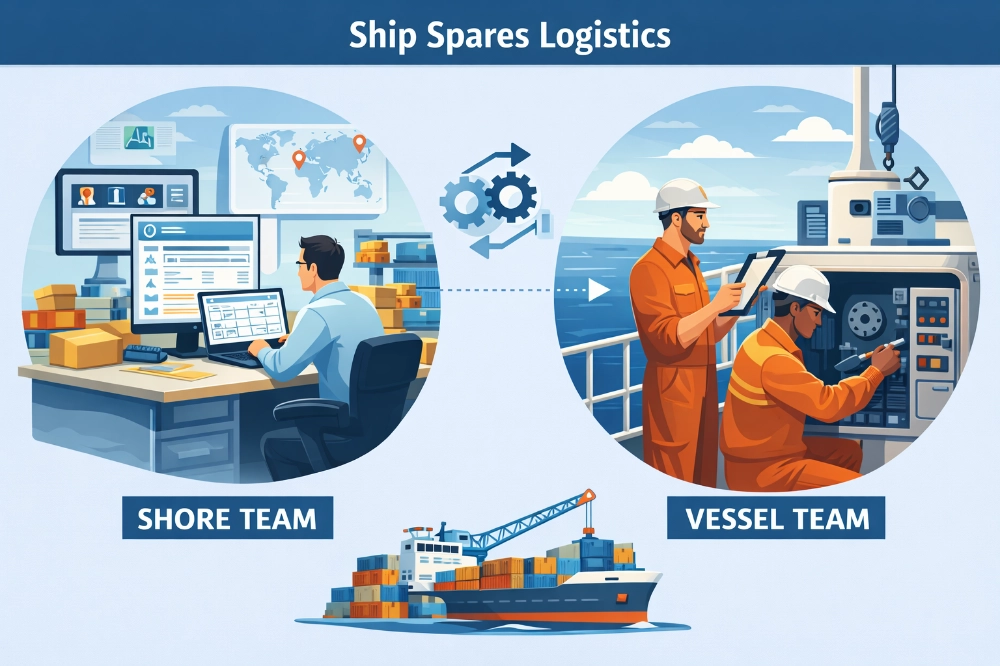
Effective ship spares logistics depends not only on systems, suppliers and transport networks, but also on clear coordination between vessels and shore-based teams. This is where Edtech Marine acts as a strategic partner, supporting operational clarity and consistency across the ship–shore interface.
Improving Accuracy in Spare Parts Identification and Requests
Delays in ship spares logistics often originate onboard due to:
Incorrect part identification
Incomplete technical details in requisitions
Unclear indication of urgency or operational impact
Edtech Marine supports improved accuracy by helping align technical references, documentation standards and operational workflows, ensuring that spare part requests are precise, complete and actionable for procurement and logistics teams.
Supporting Structured Maintenance and Failure Reporting
Timely and well-structured reporting of equipment issues is essential for efficient ship spares logistics. When faults are identified and described clearly, shore teams can assess priority, source parts correctly and plan deliveries without unnecessary escalation.
By reinforcing consistent reporting practices and standardized technical information, Edtech Marine helps reduce ambiguity and improves coordination between maintenance, procurement and logistics functions.
Reducing Errors and Unplanned Logistics Pressure
Clearer requests and better prioritization lead to more predictable logistics operations. This reduces:
Re-ordering caused by incorrect specifications
Urgent shipments driven by avoidable misunderstandings
Operational delays linked to spare part errors
Through this role, EdTech Marine contributes to ship spares logistics as a process-focused and coordination-driven partner, supporting reliability, cost control, and operational efficiency.
Cost Control Through Smarter Ship Spares Logistics
Cost efficiency does not come from cutting corners—it comes from better planning.
Effective cost control includes:
Reducing emergency air freight
Optimizing inventory investment
Eliminating obsolete spares
Monitoring supplier performance
Data-driven decision-making allows organizations to manage budgets without compromising vessel reliability.
Sustainability and the Future of Ship Spares Logistics
Sustainability is becoming a growing consideration in maritime logistics. Ship spares logistics can support sustainability goals by:
Consolidating shipments
Optimizing transport routes
Reducing packaging waste
Extending equipment lifecycles through better maintenance
Looking ahead, predictive maintenance, artificial intelligence, and greater data integration will continue to reshape ship spares logistics into a more efficient and resilient discipline.
Frequently Asked Questions (FAQs) About Ship Spares Logistics
What is ship spares logistics?
Ship spares logistics is the coordinated process of planning, sourcing, storing, transporting and delivering spare parts required to maintain and repair vessels. It ensures that ships receive the correct parts, at the correct location, within the required timeframe to maintain operational readiness.
Why is ship spares logistics critical to vessel operations?
Ship spares logistics directly affects vessel availability, safety and commercial performance. Delays or errors in spare parts delivery can lead to downtime, missed schedules, regulatory non-compliance and increased operational costs.
What is the difference between planned and unplanned ship spares?
Planned spares support scheduled maintenance and overhauls and are typically sourced in advance.
Unplanned spares are required due to unexpected equipment failures and often involve urgent sourcing and expedited delivery.
Effective ship spares logistics must support both scenarios.
What are the most common causes of delays in ship spares logistics?
Common causes include:
Incorrect or incomplete spare part identification
Documentation errors during customs clearance
Limited port infrastructure or last-mile access
Poor coordination between vessel and shore teams
Over-reliance on emergency logistics instead of planning
How does inventory management impact ship spares logistics?
Inventory management determines whether spare parts are available when needed without tying up excessive capital. Poor inventory control leads to either stock shortages or excess obsolete spares. Optimized inventory balances availability, cost and risk.
How does ship spares logistics differ from standard supply chain logistics?
Unlike standard supply chains, ship spares logistics must:
Support moving assets (vessels)
Operate across multiple jurisdictions
Handle unpredictable demand
Deliver directly to ports or vessels
Respond rapidly to operational disruptions
This makes it more complex and time-sensitive.
What role does customs compliance play in ship spares logistics?
Customs compliance is critical. Incorrect documentation or regulatory misunderstandings can delay spare parts for days. Efficient ship spares logistics requires up-to-date regulatory knowledge and standardized documentation processes.
How can ship operators reduce costs associated with ship spares logistics?
Cost reduction strategies include:
Better maintenance planning
Accurate spare parts forecasting
Reducing emergency air freight
Standardizing requisition processes
Improving coordination between vessels and shore teams
What role does EdTech Marine play in ship spares logistics?
EdTech Marine supports ship spares logistics by improving operational clarity and coordination between ship and shore teams. By helping standardize technical references, documentation practices, and reporting structures, EdTech Marine reduces errors, improves prioritization, and supports more predictable logistics outcomes.
Conclusion
Ship spares logistics is a critical enabler of safe, reliable and profitable maritime operations. It demands careful planning, disciplined execution, reliable partners and increasingly, strong digital and training support.
As demonstrated in the original reference material, organizations that treat ship spares logistics as a strategic function – rather than a reactive service – are better positioned to reduce downtime, control costs and maintain compliance in a demanding global industry.
With the added support of partners like EdTech Marine, ship spares logistics can evolve into a well-integrated system that aligns technology, people, and processes to keep vessels moving efficiently – wherever they operate.