
Introduction to Marine Safety and Compliance in Singapore
Marine safety and compliance in Singapore are not just regulatory requirements – they are operational realities that shape how vessels perform in one of the busiest ports in the world.
Singapore is one of the world’s busiest maritime hubs, so vessel owners, operators, and marine managers can’t afford to treat compliance as just another paperwork exercise. In this environment, weak maintenance, missing records, poor crew preparedness or slow shore support can quickly turn into delays, inspection findings, detention and avoidable costs.
That is why marine safety and compliance in Singapore should be managed as a daily operating discipline. It is not only about passing inspections. It is about protecting people, keeping vessels moving, reducing commercial risk and operating responsibly in a high-standard port.
Singapore’s maritime system is supported by the Maritime and Port Authority of Singapore, which oversees port safety, marine services and regulatory enforcement. At the same time, many shipowners and operators rely on local support from an experienced ship agency in Singapore, a responsive marine agency in Singapore and dependable ship supplies and repairs and engineering services to stay ready for port operations.
This guide explains what marine safety and compliance in Singapore really mean in practice, what vessel operators often get wrong, and what steps help reduce risk while improving reliability.
What marine safety and compliance in Singapore really mean
Marine safety compliance in Singapore goes far beyond holding the right certificates. A vessel may look compliant on paper and still perform poorly when tested. That usually happens when maintenance has been delayed, emergency systems are not checked often enough, records are incomplete, or the crew knows the procedure in theory but struggles to apply it under pressure.
Real marine safety and compliance in Singapore mean that a vessel is:
- structurally sound
- properly maintained
- correctly documented
- competently manned
- environmentally responsible
- operationally ready for inspection or emergency response
That distinction matters. In a demanding port environment, there is a big difference between having documents and being truly prepared.
Why Singapore is stricter than many other ports
Singapore’s port environment leaves little room for sloppy operations. Vessel traffic is dense, turnaround expectations are high and enforcement is serious. That does not make Singapore unfriendly to operators. It makes it disciplined.
The Port State Control framework exists to check whether visiting foreign ships comply with international safety and environmental rules. MPA states that these inspections are carried out by Port State Control Officers, and serious deficiencies can lead to detention.
For shipowners, that means compliance failures are not abstract risks. They can become commercial problems very quickly.
Navigation and Communication Equipment
Modern navigation and communication systems are vital for safe passage and effective communication with shore authorities and other vessels. Vessels must be equipped with:
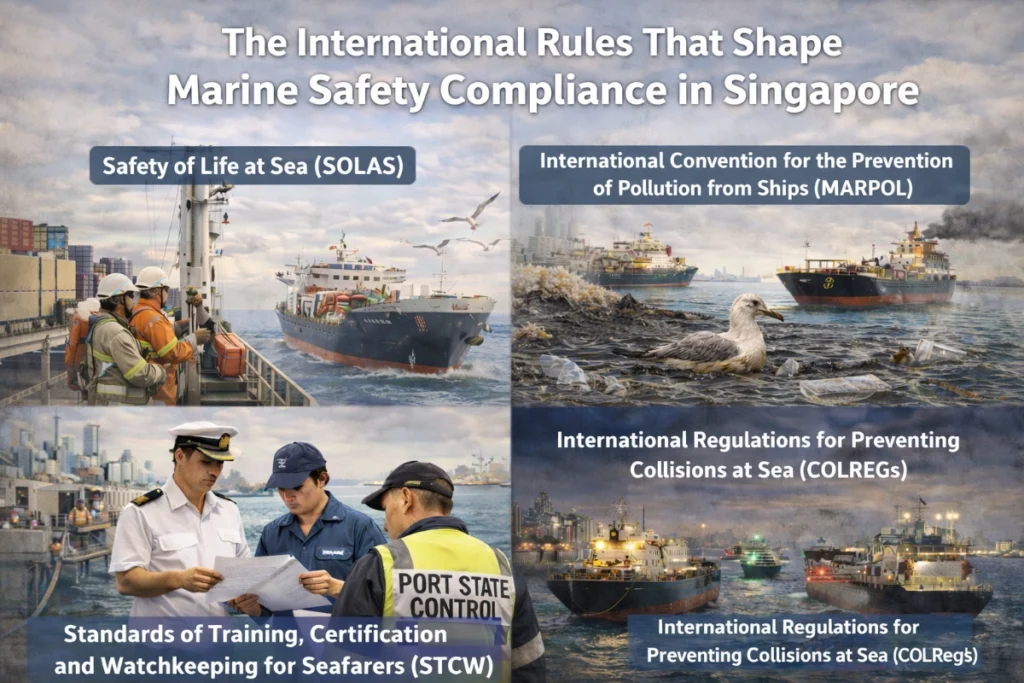
The International Rules That Shape Marine Safety Compliance in Singapore
Marine safety compliance in Singapore does not exist in isolation. It is built on a set of international maritime conventions that influence how ships are designed, equipped, operated, and inspected. These frameworks create a common global standard, while Singapore applies them with a high level of rigour in day-to-day port and vessel operations.
Safety of Life at Sea (SOLAS)
The Safety of Life at Sea (SOLAS) Convention is the foundation of modern ship safety. It sets minimum requirements for vessel construction, onboard safety systems, fire protection, life-saving appliances, and operational procedures. In practical terms, SOLAS defines the baseline for whether a ship is fit to protect lives at sea.
International Convention for the Prevention of Pollution from Ships (MARPOL)
The International Convention for the Prevention of Pollution from Ships (MARPOL) is the main global framework for environmental protection in shipping. It covers pollution risks linked to oil, sewage, garbage, noxious substances, and air emissions. For vessel operators, MARPOL turns environmental responsibility into a direct compliance obligation, not just a matter of good practice.
Standards of Training, Certification and Watchkeeping for Seafarers (STCW)
The Standards of Training, Certification and Watchkeeping for Seafarers (STCW) Convention sets the international benchmark for crew training, professional certification, and watchkeeping standards. Its importance goes beyond qualifications on paper. It places crew competence at the heart of marine safety, because even well-maintained vessels become vulnerable when people are not properly prepared.
International Regulations for Preventing Collisions at Sea (COLREGs)
The International Regulations for Preventing Collisions at Sea (COLREGs) establish the navigational rules that vessels must follow to avoid collisions. They govern issues such as right of way, lights, signals, lookout duties, and safe conduct in different operating conditions. In congested waters such as Singapore’s, these are not abstract rules. They shape everyday navigational decisions and play a critical role in preventing incidents.
The Role of the Maritime and Port Authority of Singapore
The Maritime and Port Authority of Singapore (MPA) plays a central role in maintaining high maritime standards across the country’s shipping and port ecosystem. Through the Singapore Registry of Ships and Port State Control inspections, MPA helps ensure that vessels operating under the Singapore flag, or calling at Singapore ports, meet demanding technical, operational, and safety requirements.
For vessel owners and operators, that has practical consequences. Registration is not just an administrative step, and inspections are not just formalities. Together, they reflect a wider regulatory approach in which safe operation, proper maintenance, accurate documentation, and crew readiness are all treated as part of the same standard. In Singapore, compliance is expected to be built into day-to-day operations rather than addressed at the last minute.
Meeting that standard often requires dependable support on the ground. Operators may need an experienced ship agency in Singapore to coordinate a port call, a responsive marine agency in Singapore for operational assistance, prompt repairs and engineering services to resolve technical issues, and reliable ship supplies to keep the vessel fully prepared. When something urgent arises, having a direct way to contact the team can also make a real difference.
7 Essential Marine Safety and Compliance Strategies
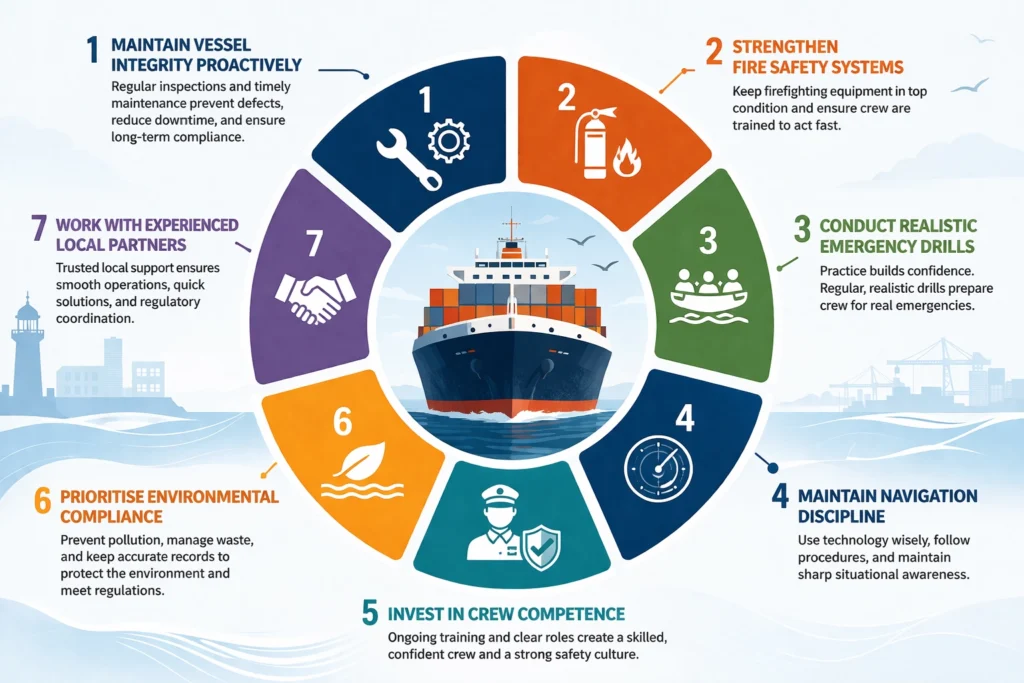
1. Maintain Vessel Integrity Proactively
Vessel integrity is the foundation of marine safety compliance. If the structure, machinery, or core systems of a ship are compromised, every other safety measure becomes less reliable. That is why maintenance should never be treated as a reactive task that only begins when something fails. It needs to be continuous, planned, and properly documented.
In practice, this means identifying structural wear, corrosion, machinery faults, piping issues, and electrical weaknesses before they develop into operational risks. It also means making sure that inspections, servicing schedules, and class-related requirements are kept up to date. A vessel that looks acceptable during routine operations may still fall short during a closer inspection if defects have been deferred for too long.
Access to responsive repairs and engineering services can help operators resolve technical issues early, reduce the risk of costly downtime, and prevent small problems from becoming compliance failures.
2. Strengthen Fire Safety Systems
Fire remains one of the most serious onboard risks in the maritime sector, particularly because it can spread quickly and threaten both life and cargo. For that reason, fire safety should be treated as a live operational priority, not just a requirement satisfied by carrying the right equipment.
Effective fire safety depends on three things: working systems, trained people, and routine verification. Detection systems, alarms, extinguishers, hoses, pumps, fixed firefighting installations, and emergency escape arrangements all need to be in proper condition and ready for immediate use. At the same time, the crew must know exactly how to respond if a fire breaks out under real operating conditions.
Equipment such as SCBA systems and spares should be maintained carefully and checked regularly. The key point is simple: safety equipment must be ready, not merely present.
3. Conduct Realistic Emergency Drills
Emergency drills are one of the clearest indicators of whether a vessel is genuinely prepared. A ship may have compliant paperwork, but if the crew cannot respond calmly and correctly during a drill, that weakness will become obvious very quickly.
Drills should be realistic enough to test actual readiness rather than simply fulfil a schedule. They should cover evacuation procedures, lifeboat operation, firefighting coordination, communication under pressure, and role clarity across the crew. When drills are too routine or rushed, they lose their value. When they are treated seriously, they reveal gaps before a real emergency does.
Operators should also ensure that critical safety equipment, including life jackets and accessories, is easy to access, in good condition, and understood by the crew. Emergency readiness is not only about equipment. It is about confidence, repetition, and coordinated execution.
4. Maintain Navigation Discipline
Safe navigation depends on far more than technology alone. Radar, AIS, ECDIS, and bridge communication systems are important, but they are only effective when used with discipline and sound judgment.
In busy and congested waters, even a small lapse in watchkeeping or communication can create significant risk. That is why navigation discipline must remain a daily priority. Proper lookout procedures, clear bridge communication, accurate interpretation of traffic situations, and strong situational awareness are all essential to preventing collisions and navigational errors.
Technology supports marine safety, but it does not replace professional standards on the bridge. Operators who maintain strong navigational discipline are better positioned to protect life, cargo, and operational reliability.
5. Invest in Crew Competence
Crew competence sits at the centre of marine safety compliance. Well-maintained vessels still become vulnerable when the people operating them are underprepared, poorly supervised, or unclear about their responsibilities.
Training should not be treated as a one-time certification exercise. It should be seen as an ongoing investment in operational resilience. A competent crew responds faster, makes better decisions, communicates more effectively, and handles both inspections and emergencies with greater confidence.
That is especially important in a high-standard environment like Singapore, where compliance is judged not only by documentation, but also by how well procedures are carried out in practice. Strong operators understand that training improves response time, decision-making, confidence, and overall safety culture across the vessel.
6. Prioritise Environmental Compliance
Environmental compliance has become a core part of marine operations, not a secondary concern. Pollution prevention, emissions control, waste handling, and recordkeeping all play a direct role in whether a vessel meets modern compliance expectations.
Operators must manage waste disposal properly, prevent accidental discharge, maintain accurate records, and ensure that emissions-related obligations are understood and followed. This is not just about avoiding regulatory action. It is also about protecting reputation, supporting sustainable operations, and reducing the risk of disruption during inspections.
Reliable access to ship supplies can help operators keep essential equipment, materials, and safety items available when needed, supporting both operational continuity and environmental compliance.
7. Work with Experienced Local Partners
Marine safety compliance often depends as much on coordination as it does on regulation. Even when a vessel is technically sound, delays or gaps in local execution can create unnecessary problems during a port call.
That is why experienced local support can make a meaningful difference. Working with a trusted ship agency in Singapore or a capable marine agency in Singapore helps vessel operators manage logistics, documentation, authority coordination, and urgent operational requirements more efficiently.
When unexpected issues arise, whether technical, procedural, or scheduling-related, the ability to contact support quickly can help prevent minor disruptions from becoming larger compliance or operational problems.
The Role of Marine Support Services
Effective compliance in Singapore rarely depends on regulations alone. It depends on execution, especially during tight, time-sensitive port calls where coordination must happen quickly and correctly.
In practice, vessel operators often rely on experienced local support to manage paperwork, coordinate logistics, arrange technical attendance, and respond to emerging issues without delay. That may involve working with a ship agency, engaging a marine agency, arranging repairs and engineering services, and sourcing ship supplies.
These services are not separate from compliance. In many cases, they are part of how compliance is maintained in practice. A vessel that is well supported on the ground is more likely to remain inspection-ready, operationally efficient, and able to respond quickly when conditions change.
Technology and Innovation in Marine Compliance
Technology is playing a growing role in improving marine safety and compliance, particularly as vessel operators look for better ways to reduce risk and improve visibility across operations.
Real-time monitoring systems can help track machinery performance and onboard conditions more closely. Predictive maintenance tools can identify potential issues before they lead to failure. Digital inspection systems and electronic recordkeeping can also improve consistency, reduce paperwork errors, and support faster decision-making.
That said, technology should be viewed as an enabler rather than a substitute. It can strengthen compliance, but it cannot replace good maintenance practices, strong leadership, competent crews, or disciplined operations. The most effective compliance strategies combine modern tools with dependable human judgment.
Common Compliance Mistakes to Avoid
Some compliance failures come from major problems, but many begin with smaller, avoidable mistakes that build over time.
Operators should avoid relying on documentation alone without checking whether procedures are actually being followed in practice. They should avoid postponing maintenance until defects become more serious. They should not underestimate the importance of crew training, especially in areas such as emergency response, navigation, and equipment handling. Environmental rules should also never be treated as secondary, since poor waste handling or inaccurate records can quickly lead to inspection issues.
In most cases, inspection failures are not caused by a complete lack of awareness. They are caused by gaps between what is recorded, what is expected, and what is happening onboard. Strong compliance depends on closing those gaps consistently.
FAQs
1. What is marine safety and compliance in Singapore?
Marine safety and compliance in Singapore refer to the standards, systems, and day-to-day practices that help vessels operate safely, legally, and responsibly in Singapore waters and port facilities. This includes maintenance, crew readiness, documentation, environmental protection, and inspection preparedness.
2. Why is Singapore strict about marine compliance?
Singapore is one of the busiest and most important maritime hubs in the world. Because vessel traffic is high and operational expectations are demanding, the country applies strong standards to reduce risk, protect the marine environment, and maintain confidence in its port and shipping systems.
3. What is Port State Control?
Port State Control is the inspection of foreign ships to verify that they comply with international maritime regulations. These inspections can cover vessel condition, safety equipment, crew readiness, certificates, and environmental compliance.
4. What is SOLAS?
SOLAS stands for Safety of Life at Sea. It is one of the most important international maritime conventions and sets minimum standards for ship construction, safety systems, life-saving appliances, and safe operation.
5. How can operators stay compliant?
Operators can stay compliant by maintaining vessels proactively, strengthening fire safety, conducting realistic emergency drills, investing in crew competence, managing environmental responsibilities carefully, and working with reliable support partners during port calls.
6. Why are marine agencies important?
Marine agencies help vessel operators manage port coordination, documentation, logistics, and urgent operational needs. In practice, that support can be essential to keeping a vessel compliant, efficient, and ready for inspection.
Conclusion
Navigating the complex landscape of marine safety and compliance in Singapore requires a diligent and informed approach. The Maritime and Port Authority of Singapore, guided by international conventions and its own robust national legislation, maintains a high standard for vessels operating within its waters. From vessel registration and classification to stringent requirements for hull and machinery, fire safety, life-saving appliances, navigation, cargo operations, and environmental protection, every aspect of maritime activity is carefully regulated.
Singapore’s commitment to Port State Control ensures that substandard vessels are identified and addressed, contributing to the overall safety and security of global shipping. For vessel owners and operators, staying abreast of these requirements, maintaining vessels to the highest standards, and fostering a culture of safety are not merely obligations but essential practices for successful and responsible maritime operations in one of the world’s busiest and most vital ports. The ongoing evolution of maritime technology and regulations necessitates continuous learning and adaptation to ensure the continued safe passage of vessels through Singapore’s waters and beyond.
Key Takeaways
- Singapore’s maritime safety and compliance framework is built on international conventions (SOLAS, MARPOL, STCW, COLREGs) and robust national legislation enforced by the MPA.
- Vessel registration under the Singapore flag (SRS) or classification by a recognized society is crucial for operational legality and safety assurance.
- Key safety requirements encompass hull and machinery standards, comprehensive fire safety measures, functional life-saving appliances, and up-to-date navigation and communication equipment.
- Environmental protection is paramount, with strict enforcement of MARPOL annexes, ballast water management, and proper waste disposal.
- Singapore actively conducts Port State Control (PSC) inspections to ensure foreign vessels meet international safety and environmental standards, contributing to the global effort against substandard shipping.
- Specific vessel types, such as passenger ships and tankers, have tailored safety and operational requirements.
- Fostering a strong safety culture through training, risk management, and incident reporting is a core element of Singapore’s maritime strategy.
- Non-compliance with regulations can result in vessel detention, delays, fines, and other significant penalties.




1 thought on “7 Essential Marine Safety and Compliance Strategies in Singapore (Maritime and Port Authority, Safety of Life at Sea, Marine Pollution Prevention)”
Pingback: Ship Supply Chain Management: 7 Proven Ways Singapore Keeps Vessels Moving